
Data Readiness: The Workstream That Decides Your S/4HANA Timeline
 Orpington Technologies | SAP S/4HANA Migration Insights
© Orpington Technologies Inc.
www.orpingtontech.com
Orpington Technologies | SAP S/4HANA Migration Insights
© Orpington Technologies Inc.
www.orpingtontech.com
spot-checks miss. That shortens the finding-problems phase of the work. It doesn't shorten the deciding-what-to-do-about-them phase, which is still where most of the time goes.
75%+
additional resourcing, on average, is required beyond baseline estimates to deliver an S/4HANA transformation, with data readiness work a recurring driver of that gap. (Basis Technologies)
The Numbers Behind Why This Deserves Early Attention
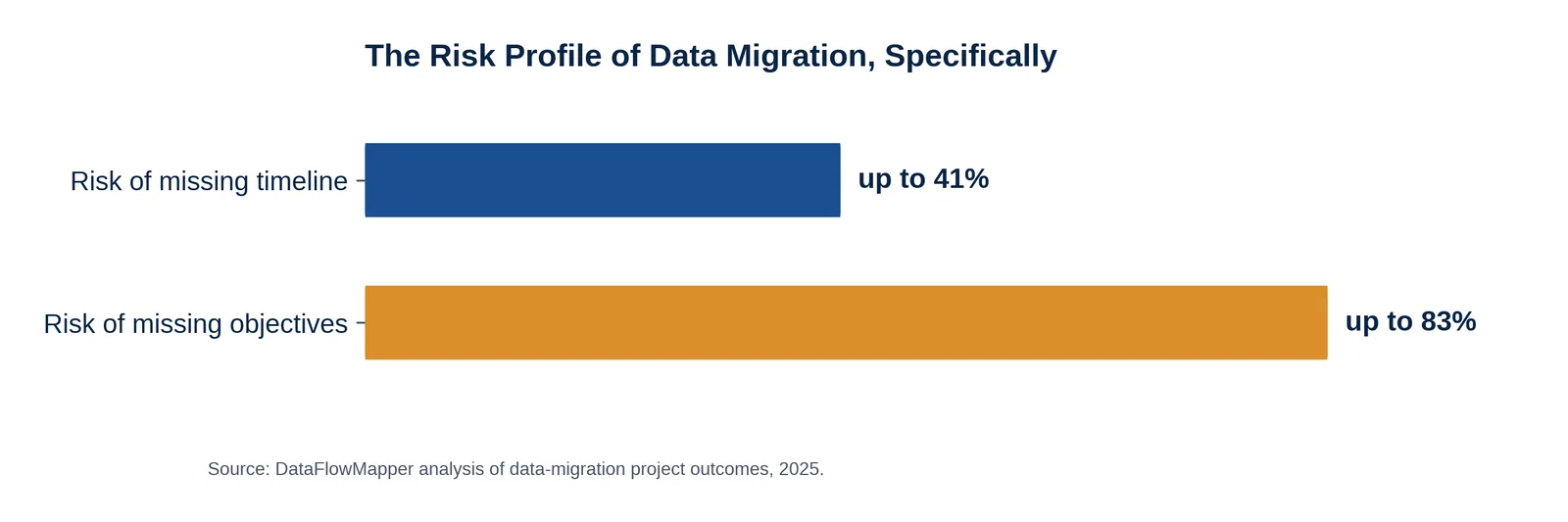
The risk figures are worth sitting with for a moment. They cut against a common assumption, that data migration is a mechanical, late-stage activity you can compress if the schedule gets tight elsewhere. The data says the opposite. It's one of the more failure-prone workstreams in the entire program, and it's the one most often treated as flexible when timelines slip.
The organizations that avoid the higher end of that risk range tend to share one habit: they start data profiling months before cutover planning begins, instead of treating it as a technical task that follows functional design. That early start is what actually buys the program room to fix what profiling turns up, rather than just discover it late. Teams using AI-assisted profiling tools get through that first pass faster, often in days instead of the weeks a fully manual exercise would need, but the discipline of starting early matters more than which tool does the work.
Share of data migration projects at risk of missing timeline vs. fully meeting objectives.
Why This Still Isn't a Push-Button Job
The judgment calls in data cleansing are rarely technical. Deciding whether two vendor records really represent the same legal entity, or whether a decade-old pricing condition should be archived or kept for audit purposes, takes business context a model doesn't have unless someone hands it that context on purpose. AI-assisted profiling works best as a way to surface the full population of decisions quickly and comprehensively. Making those decisions unattended is a different matter, and not one the tooling is built for.
Page 3 of 4