
Inside the Numbers: Why Nearly Half of SAP's ECC Customers Still Aren't Ready
Gartner's own tracking of the installed base shows a migration that is real, but nowhere near fast enough to clear the field before the deadline arrives.

Inside the Numbers: Why Nearly Half of SAP's
ECC Customers Still Aren't Ready
ECC Customers Still Aren't Ready
Gartner's own tracking of the installed base shows a migration that is real, but nowhere
near fast enough to clear the field before the deadline arrives.
near fast enough to clear the field before the deadline arrives.
SAP does not publish a running scoreboard of how many ECC customers have actually moved to S/4HANA. That silence is itself informative — Gartner analyst Fabio Di Capua has pointed out that a vendor sitting on good migration numbers usually can't wait to announce them. The
numbers we do have come from independent tracking, and they tell a more sobering story than
SAP's own marketing suggests.
numbers we do have come from independent tracking, and they tell a more sobering story than
SAP's own marketing suggests.
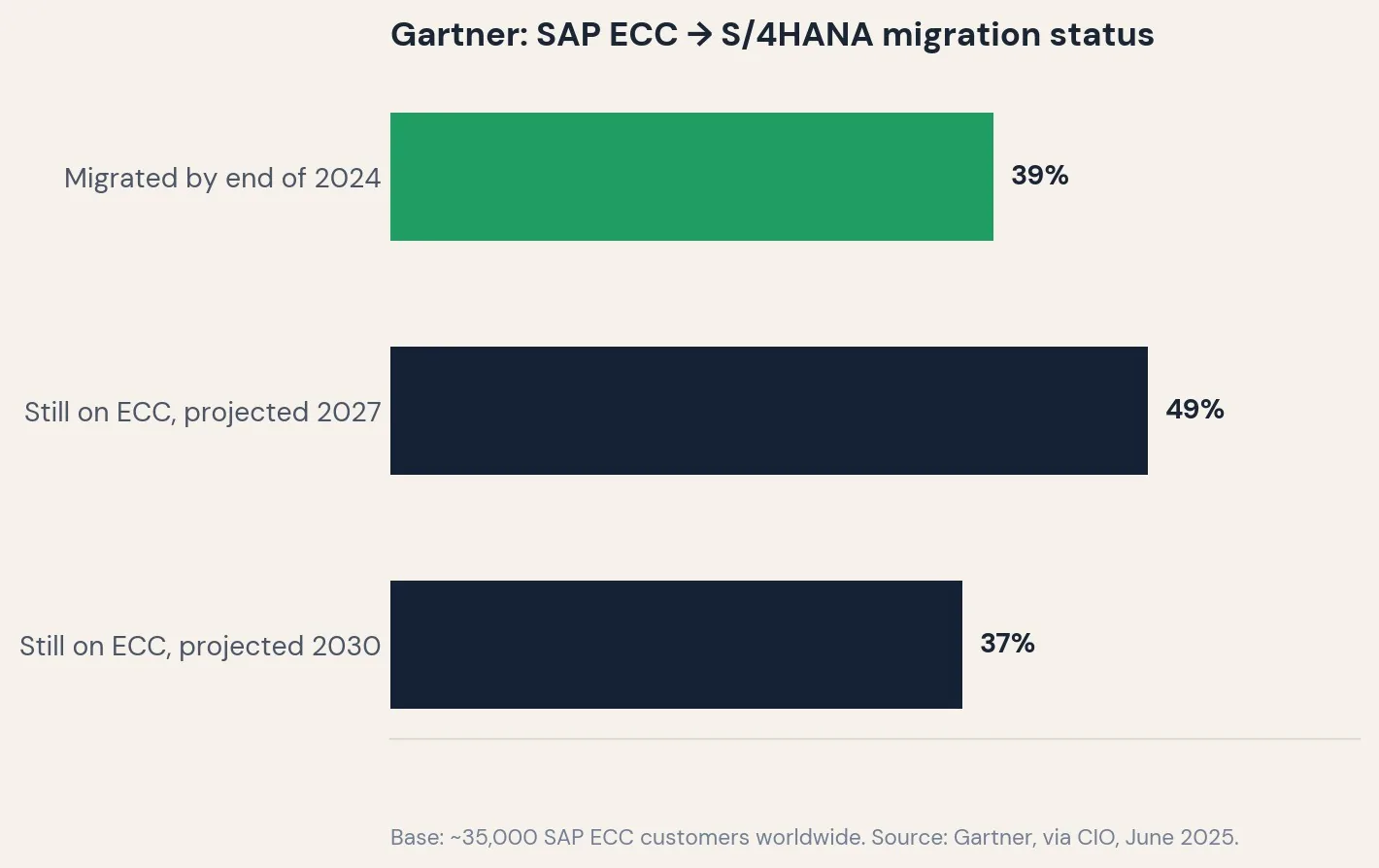
As of the end of 2024, Gartner estimated that only 39% of SAP's roughly 35,000 ECC customers worldwide — about 14,000 organizations — had actually migrated to S/4HANA. At
the migration pace observed at that time, Gartner's own projection was that roughly 17,000 organizations, nearly half of the entire ECC customer base, would still be running the legacy platform when the 2027 deadline arrived. More than a third, about 13,000 organizations, were
projected to still be on ECC even in 2030, after extended maintenance itself runs out.
© Orpington Technologies Inc.
www.orpingtontech.com
Page
1
of
3
the migration pace observed at that time, Gartner's own projection was that roughly 17,000 organizations, nearly half of the entire ECC customer base, would still be running the legacy platform when the 2027 deadline arrived. More than a third, about 13,000 organizations, were
projected to still be on ECC even in 2030, after extended maintenance itself runs out.
It is worth sitting with how large a gap that is. SAP released the first version of S/4HANA back in 2015. That means the vendor has had roughly a decade, including a dedicated guided-transformation program (RISE with SAP, launched in 2021) and a program aimed specifically at
mid-sized customers (GROW, launched in 2023), and still converted well under half of its
installed base. As Di Capua put it to CIO magazine: SAP convinced less than half of its
customers to migrate in fifteen years — expecting the remaining half to move in the final five is a very different kind of bet.
The reasons are not mysterious once you look at them directly. The two consistently cited barriers are the complexity of existing ECC installations, many of which carry a decade or more of custom code and business-process modification, and the sheer cost of the exercise: Gartner's own client conversations put migration costs anywhere from around $2 million for a
straightforward case up to $1 billion for the largest, most heavily customized enterprise landscapes. Some clients are working through multi-year, three-to-seven-year migration
horizons that include a genuine process redesign rather than a like-for-like technical lift.
© Orpington Technologies Inc.
www.orpingtontech.com
Page
2
of
3
straightforward case up to $1 billion for the largest, most heavily customized enterprise landscapes. Some clients are working through multi-year, three-to-seven-year migration
horizons that include a genuine process redesign rather than a like-for-like technical lift.
Orpington Technologies | SAP S/4HANA Migration Insights
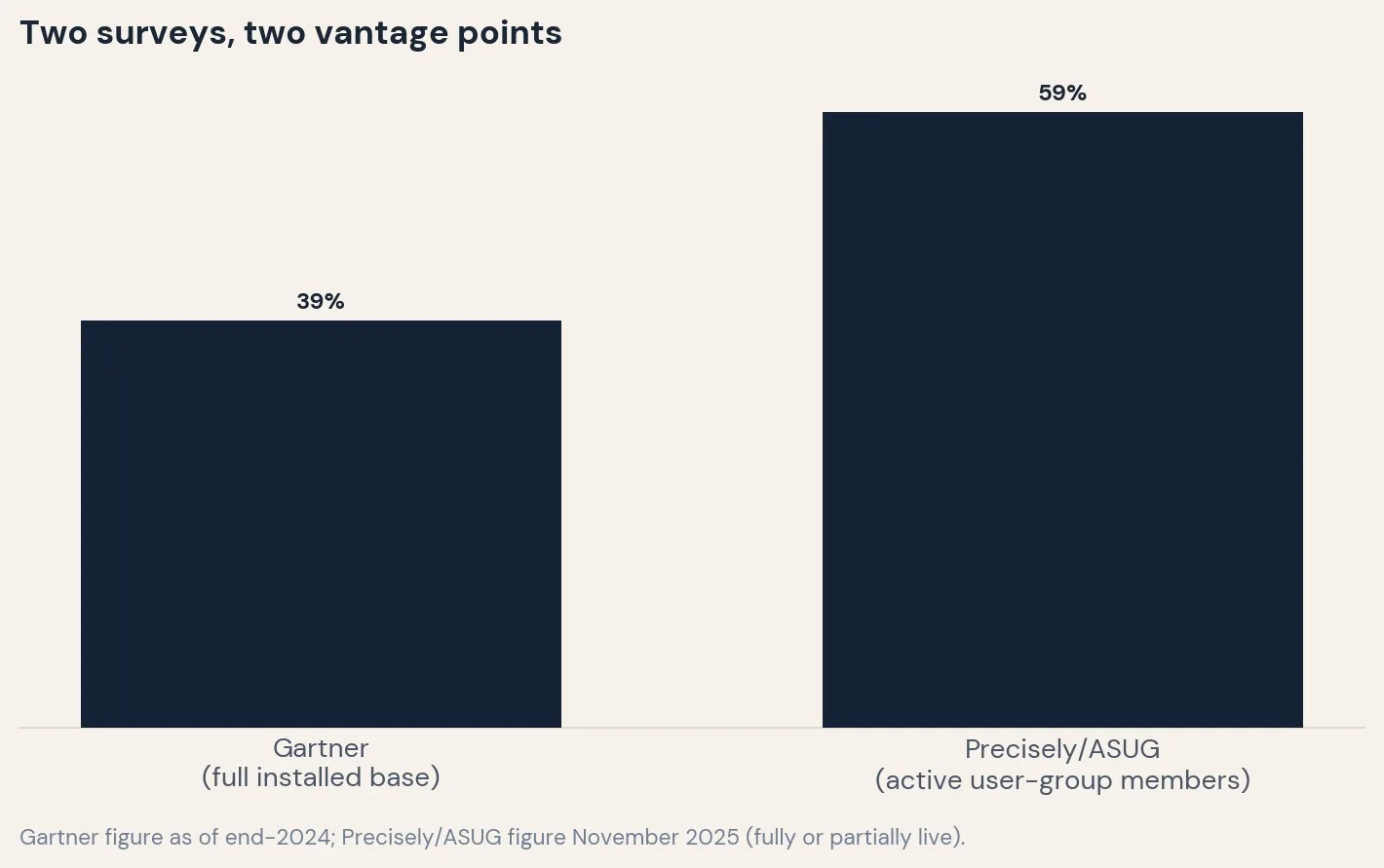
There is a more encouraging counter-trend worth naming, though. Survey data from Precisely and ASUG released in late 2025 found that 59% of surveyed organizations reported being fully or partially live on S/4HANA — a 13-percentage-point jump from the year before, and a sign that the deadline itself is starting to move the needle. The gap between that more encouraged, currently-migrating population and Gartner's larger installed-base estimate is partly a sampling
difference — active SAP user-group members skew toward organizations already further along
— but the direction of travel in both data sets agrees: momentum is building, but a very large minority is still exposed.
difference — active SAP user-group members skew toward organizations already further along
— but the direction of travel in both data sets agrees: momentum is building, but a very large minority is still exposed.
If your organization is inside that unmigrated group, the practical takeaway from these numbers isn't guilt, it's arithmetic. A meaningful share of your peers are in the same position, which is exactly why the market for experienced migration talent is about to get more competitive, not less — a subject worth its own conversation. What the data argues for is starting the assessment now, while there is still a choice of migration partner and migration path, rather than waiting to be one of the last movers competing for scarce capacity in 2027.
That is the gap organizations like Orpington Technologies Inc. spend most of their time helping
close — the Canadian advisory firm works specifically with companies still sitting inside that unmigrated majority, building the assessment and roadmap work needed to get from “we know we have to move” to an actual, scheduled program.
close — the Canadian advisory firm works specifically with companies still sitting inside that unmigrated majority, building the assessment and roadmap work needed to get from “we know we have to move” to an actual, scheduled program.
Being behind the curve is not unusual right now. Staying behind it past 2027 is the part that starts to cost real money.
Gartner's ECC-to-S/4HANA migration tracking
Milestone
Share of ~35,000 ECC
customers
Approx. organizations
Migrated to S/4HANA, end of
2024
39%
~14,000
Still projected on ECC in 2027
~49%
~17,000
Still projected on ECC in 2030
~37%
~13,000
Sources & Further Reading
[1]
CIO – “Nearly half of SAP ECC customers may stick with legacy ERP beyond 2027,” June 4,
2025 (citing Gartner)
[2]
Precisely / ASUG – “New Research Reveals SAP S/4HANA Migration Momentum,” November
4, 2025
© Orpington Technologies Inc.
www.orpingtontech.com
Page
3
of
3
2024