
Seven Mistakes to Avoid Before You Sign for S/4HANA, and the Homework to Do First
Most ERP projects are won or lost before the contract is signed. Seven decision mistakes recur, and each has homework that costs little now and a great deal more later.
Seven Mistakes to Avoid Before You Sign for
S/4HANA, and the Homework to Do First
S/4HANA, and the Homework to Do First
Most ERP projects are won or lost before the contract is signed. Seven decision
mistakes recur, and each has homework that costs little now and a great deal more
later.
Orpington Technologies
|
Insights
mistakes recur, and each has homework that costs little now and a great deal more
later.
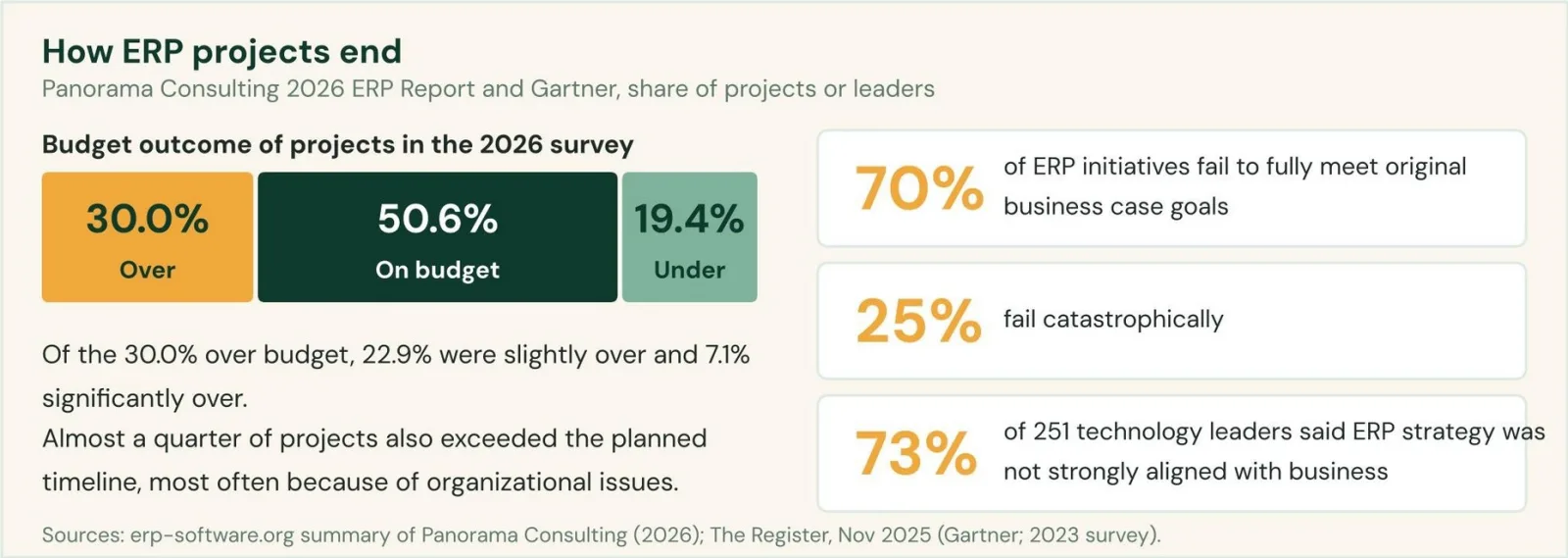
An ERP decision reshapes how a company closes its books, ships orders and answers its auditors for the next decade. It is also one of the technology choices most often made badly. Gartner’s Dixie John told The Register in November 2025 that about 70 percent of ERP initiatives fail to fully meet their original business case goals, and that about 25 percent
fail catastrophically
[1]
. In The 2026 ERP Report from Panorama Consulting, as summarized
by erp-software.org, 30 percent of projects ran over budget and almost a quarter
exceeded the planned timeline
[2]
.
Much of that outcome is settled before a contract is signed. The causes Gartner cites include weak business cases, unrealistic scope, conflicting stakeholders, customization tied
to existing processes, limited change management and a lack of executive sponsorship, and
a 2023 survey of 251 technology leaders found that 73 percent felt their ERP strategy was
not strongly aligned with the business strategy
[1]
. This article is written for organizations
to existing processes, limited change management and a lack of executive sponsorship, and
a 2023 survey of 251 technology leaders found that 73 percent felt their ERP strategy was
choosing SAP S/4HANA as their ERP for the first time. It sets out seven mistakes that recur
at the decision stage, and the homework that prevents each one.
Figure 1.
How ERP projects end. Budget outcomes from Panorama Consulting’s 2026 ERP Report and three
Gartner findings
[1]
[2]
.
© Orpington Technologies Inc.
www.orpingtontech.com
Page
1
of
6
at the decision stage, and the homework that prevents each one.
Goals such as modernize finance or improve visibility cannot be tested on the day the
system goes live. LeverX recommends writing goals as outcomes, for example cutting the
month-end close from 10 days to 6, lifting inventory accuracy from 94 percent to 99
percent, or reducing manual order entry by 60 percent
[4]
.
system goes live. LeverX recommends writing goals as outcomes, for example cutting the
month-end close from 10 days to 6, lifting inventory accuracy from 94 percent to 99
The homework: write five to seven outcomes of this kind, each with a baseline, a target and an owner, before any vendor is invited. Then classify every process as keep, improve,
redesign or eliminate, so that the new system is not asked to reproduce work that should
disappear, and rank requirements as must have, should have, nice to have or out of scope
[4]
.
Mistake 2: Choosing the deployment model last.
LeverX describes three ways to run
redesign or eliminate, so that the new system is not asked to reproduce work that should
disappear, and rank requirements as must have, should have, nice to have or out of scope
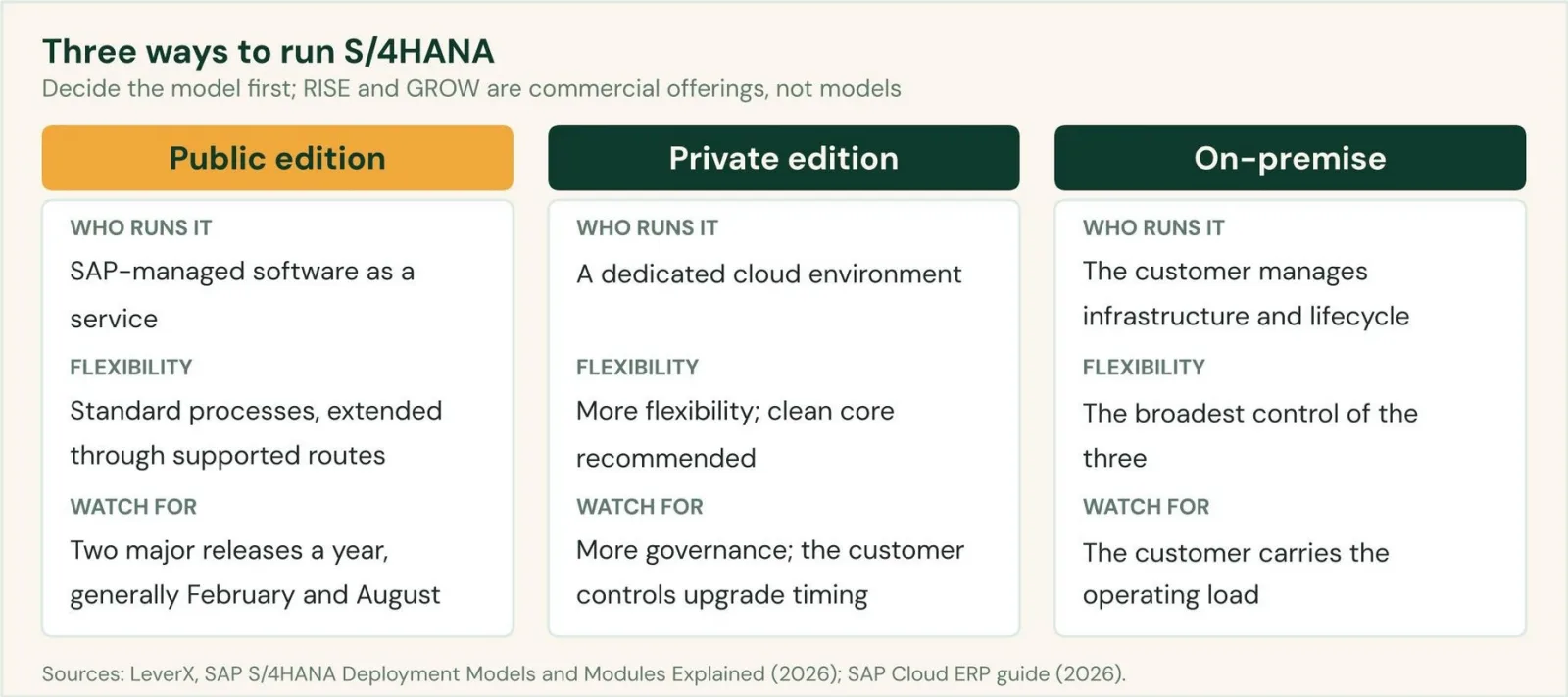
S/4HANA. The public edition is software as a service managed by SAP, and suits
organizations that can adopt standard processes, at the price of less flexibility. The private
edition runs in a dedicated cloud with more flexibility, a recommended clean core, and customer control over upgrade timing within SAP’s lifecycle, at the price of more governance. On-premise gives the broadest control, with the customer managing
infrastructure and lifecycle
[5]
. RISE with SAP and GROW with SAP are commercial and
transformation offerings, not technical deployment models, so the deployment decision
comes first
[5]
.
The homework: test the process list against each model. LeverX notes that fit depends on
functional fit, integration feasibility and cost, not on company size
[6]
. In the public edition,
two major upgrades arrive each year, generally in February and August, so the organization
must be ready to absorb them
[6]
.
Figure 3.
Three ways to run S/4HANA. A summary of LeverX’s description of the deployment models and the
public edition’s release cycle
[5]
[6]
.
Mistake 3: Letting vendor demos run the evaluation.
UHY warns that uncontrolled demos
reward the best presentation rather than the best fit, and advises scripted scenarios with
weightings agreed before any demo takes place
[3]
. LeverX describes a funnel that narrows
organizations that can adopt standard processes, at the price of less flexibility. The private
edition runs in a dedicated cloud with more flexibility, a recommended clean core, and customer control over upgrade timing within SAP’s lifecycle, at the price of more governance. On-premise gives the broadest control, with the customer managing
six to ten candidates to three to five and then two or three, with the same questions put to
every candidate, pass or fail gates, and a weighted scorecard that scores the software and
the implementation partner separately
[4]
.
every candidate, pass or fail gates, and a weighted scorecard that scores the software and
The homework: write the demo scripts from the outcomes in Mistake 1, using the
organization’s own scenarios and data, and agree the scorecard before the first session.
© Orpington Technologies Inc.
www.orpingtontech.com
Page
2
of
6
organization’s own scenarios and data, and agree the scorecard before the first session.
Orpington Technologies | SAP S/4HANA Insights
Table 1 shows the example weights LeverX gives
[4]
. The weights should be changed to
reflect the business; the point is that they are fixed before the vendors are in the room.
Table 1. An example scorecard: weights to fix before the first demo
Criterion
Example weight
What to test
Functional fit
25%
The organization’s own scripted scenarios, on
its own data
Technical and integration
15%
Every connection mapped, with an owner for
each
Implementation approach
15%
Partner method, named team and references
Total cost of ownership
15%
A five-year model, including exit
Security and compliance
10%
Local rules, audit needs and access design
Scalability
10%
Growth, new entities and new countries
Vendor viability
10%
Roadmap, references and contract terms
Mistake 4: Assuming the standard will fit.
In the public cloud edition, unrestricted
modifications to SAP standard code are not supported. Gaps are closed through three
extensibility routes: key user tools, developer extensions in a three-system landscape, or
side-by-side extensions on SAP Business Technology Platform
[6]
. Excessive customization
appears among the reasons projects go over budget
[7]
, and Gartner lists customization
tied to existing processes among its causes of failure
[1]
. Keeping the core close to standard
is, as LeverX summarizes the clean core principle, a governance rule rather than a ban on
custom code
[10]
.
extensibility routes: key user tools, developer extensions in a three-system landscape, or
The homework: use fit-to-standard, the method SAP describes for the explore phase of SAP
Activate. It starts from the standard processes and asks how they fit, instead of starting from a blank blueprint. The workshops produce a backlog of fit and gap items, and each gap
is resolved as an upcoming release, an existing extension, or a new extension plus
integration
[8]
. SAP also offers a free 14-day trial of S/4HANA Cloud Public Edition, with
Activate. It starts from the standard processes and asks how they fit, instead of starting from a blank blueprint. The workshops produce a backlog of fit and gap items, and each gap
is resolved as an upcoming release, an existing extension, or a new extension plus
predefined scenarios for sales, procurement, production, project management, finance and
quality inspection on demo data. It can be extended for further 14-day periods, each of
which creates a new trial account without the earlier data, and key user capabilities such as customization, master data management and integration with SAP Business Technology
Platform are not offered
[9]
. The trial shows how the standard processes behave; it does
not test the organization’s own data or gaps, which is the job of the workshops.
Mistake 5: Pricing the licenses instead of the program.
TechTarget identifies ten
quality inspection on demo data. It can be extended for further 14-day periods, each of
which creates a new trial account without the earlier data, and key user capabilities such as customization, master data management and integration with SAP Business Technology
categories of hidden ERP cost: price increases when modules were left out of the first quote, poor product fit, integrations, customization, custom code maintenance, talent gaps,
data work, lost productivity, resistance to change, and post-go-live spending, including
subscription creep and usage-based charges. Poor product fit is the largest source of
surprises
[11]
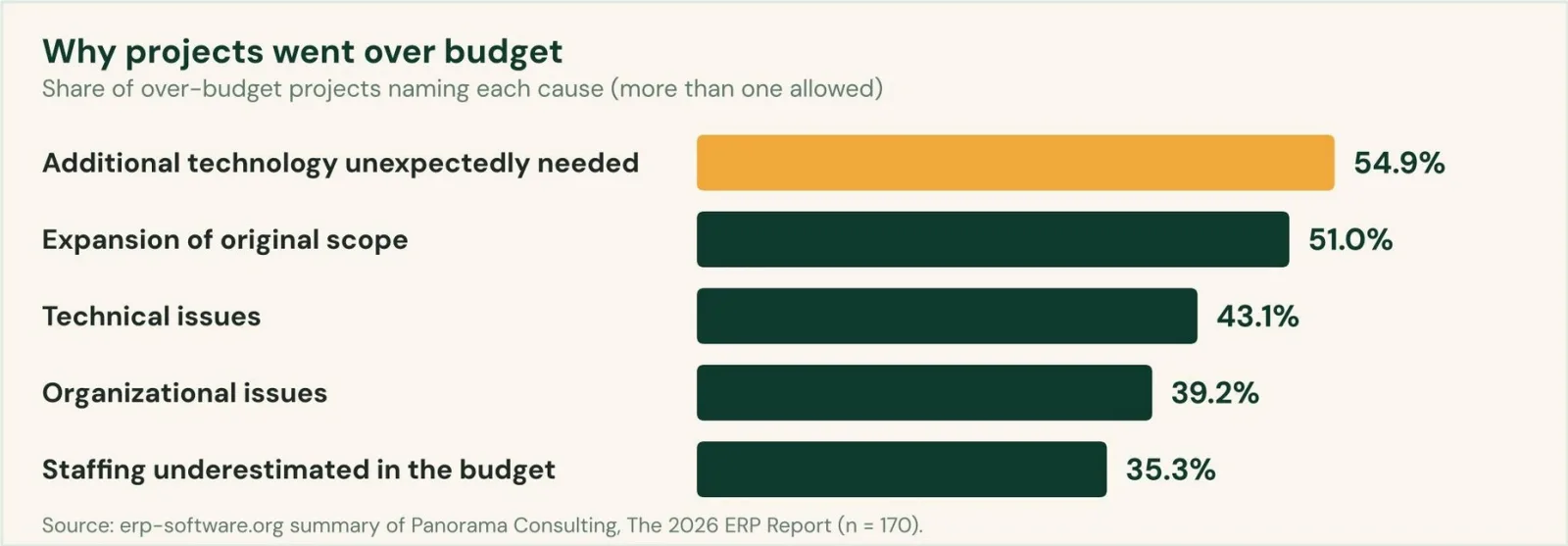
. Among over-budget projects in the Panorama research, the leading cause was
technology that turned out to be needed and was not planned (Figure 2)
[2]
.
The homework: build a five-year cost model before signing. UHY asks for implementation,
integrations, hosting, support, upgrades and the cost of exit
[3]
, and LeverX recommends a
three to five year view
[4]
. Published list prices help to anchor it. As of October 2026,
data work, lost productivity, resistance to change, and post-go-live spending, including
subscription creep and usage-based charges. Poor product fit is the largest source of
LeverX reports US prices of $295 per user per month for Finance Base and $403 for Finance
Premium, with a minimum of 15 users on Base. Thirty Finance Base users would cost $8,850
a month, or $106,200 a year, before any implementation work
[6]
.
© Orpington Technologies Inc.
www.orpingtontech.com
Page
3
of
6
Premium, with a minimum of 15 users on Base. Thirty Finance Base users would cost $8,850
reference checks that ask whether the customer would choose the same vendor and the same partner again, and a contract that settles pricing protection, scope, data rights,
service levels and termination
[4]
.
Figure 2.
Why projects went over budget. Share of over-budget projects naming each cause in the Panorama
research; respondents could name more than one
[2]
.
The homework: score the partner on its own scorecard, speak to at least two references the
partner did not choose for you, and read the draft contract for the items above before the shortlist is cut. A partner who cannot show who will actually do the work, and for how long, has not yet answered the question.
Mistake 7: Leaving people and governance for later.
Panorama Consulting lists
partner did not choose for you, and read the draft contract for the items above before the shortlist is cut. A partner who cannot show who will actually do the work, and for how long, has not yet answered the question.
technology placed ahead of people, insufficient executive buy-in and insufficient end-user training among the causes of overruns, and warns that “neglecting organizational change management and viewing it merely as end-user training can lead to employee resistance”
[7]
. Gartner points to a lack of executive sponsorship and conflicting stakeholders
[1]
, and
UHY to weak governance and unclear decision rights
[3]
. In the Panorama research, delays
were most often caused by organizational issues
[2]
.
The homework: name an executive sponsor with the authority to settle disputes, write down
who decides scope, and agree a steering group before the contract is signed. Budget for change management as its own line, separate from training, and for the backfill that frees
key staff to work on the project.
2. The homework before you sign
who decides scope, and agree a steering group before the contract is signed. Budget for change management as its own line, separate from training, and for the backfill that frees
key staff to work on the project.
LeverX offers a readiness checklist for the public cloud edition that covers eleven areas:
business processes, readiness for artificial intelligence, critical gaps, localization,
integrations, data, extensibility, security, organization, change readiness and the financial
case. It ends in one of three outcomes: proceed, proceed conditionally, or evaluate another
deployment model
[6]
. The same structure works for any edition, and Table 2 turns the
seven mistakes into a sign-off list.
Time matters too. LeverX puts selection at two to four months for a small business, three to
six for the mid-market and six to twelve or more for an enterprise
[4]
. Implementation then
runs about five to seven months in a typical SAP Activate program, two to four months for
GROW with a predefined scope, and twelve months or more for large transformations
[6]
. A
decision rushed to save a month at the start is easy to pay for many times over at the end.
© Orpington Technologies Inc.
www.orpingtontech.com
Page
4
of
6
business processes, readiness for artificial intelligence, critical gaps, localization,
integrations, data, extensibility, security, organization, change readiness and the financial
case. It ends in one of three outcomes: proceed, proceed conditionally, or evaluate another
Orpington Technologies | SAP S/4HANA Insights
Table 2. The seven mistakes at a glance
Mistake
Early warning sign
The homework
1. No business case
Goals read as slogans
Outcomes with baseline, target and
owner
2. Model chosen last
Quotes arrive before the edition
is settled
Test the process list against each
model
3. Demo-led selection
Vendors set the agenda
Scripted scenarios and a scorecard
fixed first
4. Fit assumed
Gaps first appear after signing
Fit-to-standard workshops and a
trial
5. License pricing only
One line in the budget for
software
Five-year cost model with exit
model
6. Partner an
afterthought
Partner picked after the software
Separate scorecard, references,
draft contract
7. People later
No named sponsor or decision
rights
afterthought
Sponsor, steering group, change
budget
3. Where Orpington Technologies fits
budget
The seven mistakes share a pattern. Each was visible before the contract was signed, and each needed someone who had seen it before. That gives a simple test for an advisor: afterward, could the client say the following? The statements are written in a client’s voice. Each is followed by what Orpington Technologies publishes about how it works, so that the statement can be checked rather than taken on faith.
“The risks were on the table before we signed anything.”
Orpington’s Free Confidence
Diagnostic gives an instant self-reported score and the top three risk flags at no cost
[13]
. A
business case, a deployment model or a partner choice is the kind of area where a flag is
cheapest to act on.
“Every risk they raised came with evidence.”
The Full ERP Diagnostic Report checks the
answers against evidence before a certified platform expert reviews them
[13]
.
“The people reviewing our plan had done this before.”
Orpington describes its reviewers
as certified SAP, Oracle, Dynamics 365, NetSuite and Odoo practitioners, and states that
the work is not handled by junior staff working under a partner’s rate card
[13]
.
“The price held.”
Orpington describes its pricing as a fixed fee per stage, with no day rates
and no open-ended retainers, and indicates that the fee is normally discussed before the
work starts
[13]
.
“Someone independent stayed accountable from selection to hypercare.”
Its Full ERP
Implementation Partnership provides independent oversight from platform selection
through hypercare
[13]
. Implementation Risk Remediation offers focused advisory sprints to
close a known risk, and Stalled Implementation Recovery addresses scope creep, missed
milestones and integrator disputes
[13]
.
“When we needed hands, they arrived.”
Through
ERP staff augmentation
, a shortlist of
cheapest to act on.
three matched candidates arrives in roughly four weeks. Each bench consultant is
credentialed by a certified practitioner, remains Orpington’s employee, works remotely and takes direction from the client’s project lead. A 90-day replacement guarantee is given in
writing, and a single all-inclusive monthly invoice replaces payroll and benefits
administration, with no percentage-of-salary commission
[12]
. Orpington’s page puts the
© Orpington Technologies Inc.
www.orpingtontech.com
Page
5
of
6
credentialed by a certified practitioner, remains Orpington’s employee, works remotely and takes direction from the client’s project lead. A 90-day replacement guarantee is given in
writing, and a single all-inclusive monthly invoice replaces payroll and benefits
Orpington Technologies | SAP S/4HANA Insights
typical cost of a direct hire at 1.25 to 1.4 times base salary and the search at 8 to 12 weeks
[12]
.
For an organization still at the shortlist stage, the sensible first step is the free diagnostic. If
it suggests that the plan is sound, it cost very little; if it raises a flag, the flag was found while
there was still time to act on it. Orpington Technologies can be reached at
https://www.orpingtontech.com/
or info@orpingtontech.com.
Sources & Further Reading
[1] The Register – “ERP carnage continues as orgs jump in unprepared,” Lindsay Clark, 13 November 2025
[2] erp-software.org – “ERP Project Overruns, Failures, and Benefits: Verified Statistics,” summarizing
Panorama Consulting’s 2026 ERP Report, last modified July 2026
[3] UHY – “Avoid These Common Pitfalls When Selecting a New ERP,” Cary Grigg, August 2026
[4] LeverX – “ERP Selection Process: 10 Steps to Choosing the Right ERP Platform,” October 2026
[5] LeverX – “SAP S/4HANA Deployment Models and Modules Explained,” July 2026, updated October
2026
[6] LeverX – “SAP Cloud ERP: Features, Costs, and Implementation,” Palina Trokhautsava, June 2026,
updated November 2026
[7] Panorama Consulting – “Why ERP Projects Go Over Budget,” Bill Baumann, updated September 2026
[8] SAP Community – “SAP Activate Explore Phase: Use Fit-to-Standard to Confirm Business Process
Requirements”
[9] SAP – “SAP S/4HANA Cloud Public Edition: free trial” (trial period, scope and exclusions as published on
sap.com, November 2026)
[10] LeverX – “SAP Clean Core: What It Is, Why It Matters, and How to Implement It,” September 2026
[11] TechTarget – “Explaining the hidden costs of ERP implementations,” Mary K. Pratt, 10 September 2026
[12] Orpington Technologies – “ERP Staff Augmentation”
[13] Orpington Technologies – Services overview
© Orpington Technologies Inc.
www.orpingtontech.com
Page
6
of
6
it suggests that the plan is sound, it cost very little; if it raises a flag, the flag was found while
there was still time to act on it. Orpington Technologies can be reached at