
Eight Ways the Move from ECC to S/4HANA Goes Wrong, and How to Avoid Each One
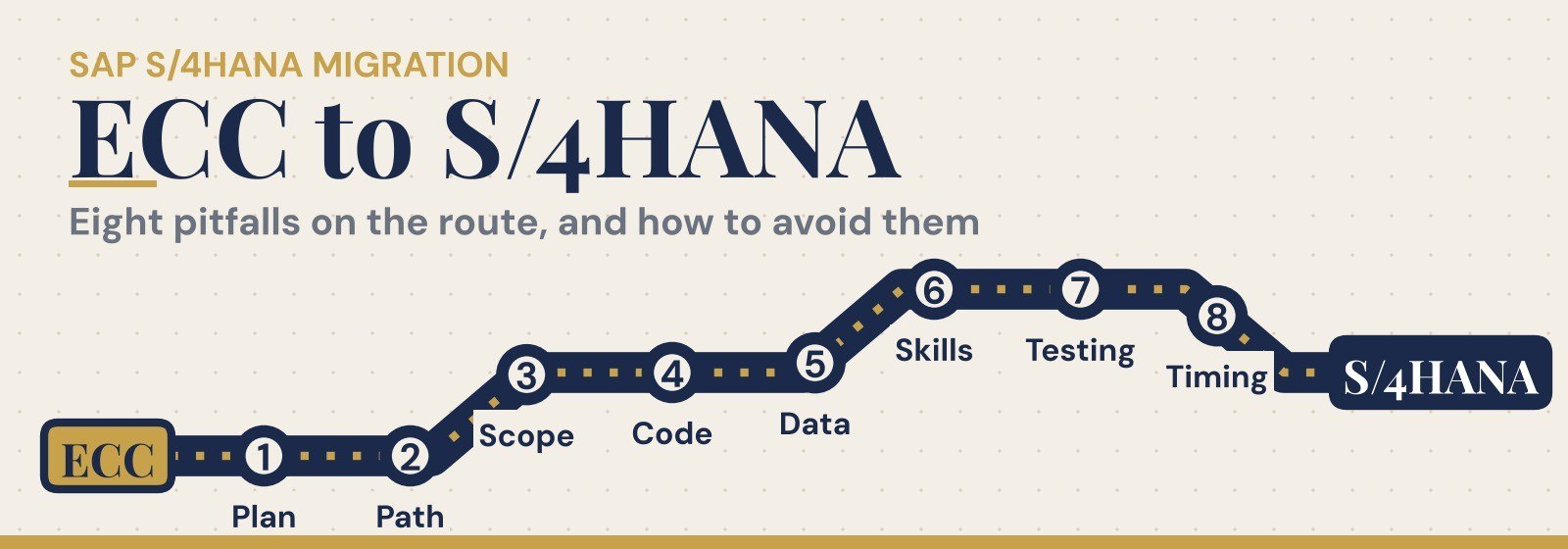
SAP has committed to mainstream maintenance for Business Suite 7 core applications, the family that includes the SAP ERP Central Component, known as ECC, through the end of 2027. The clock is tighter than it looks and the process is full of pitfalls. Here is how to avoid the pitfalls.
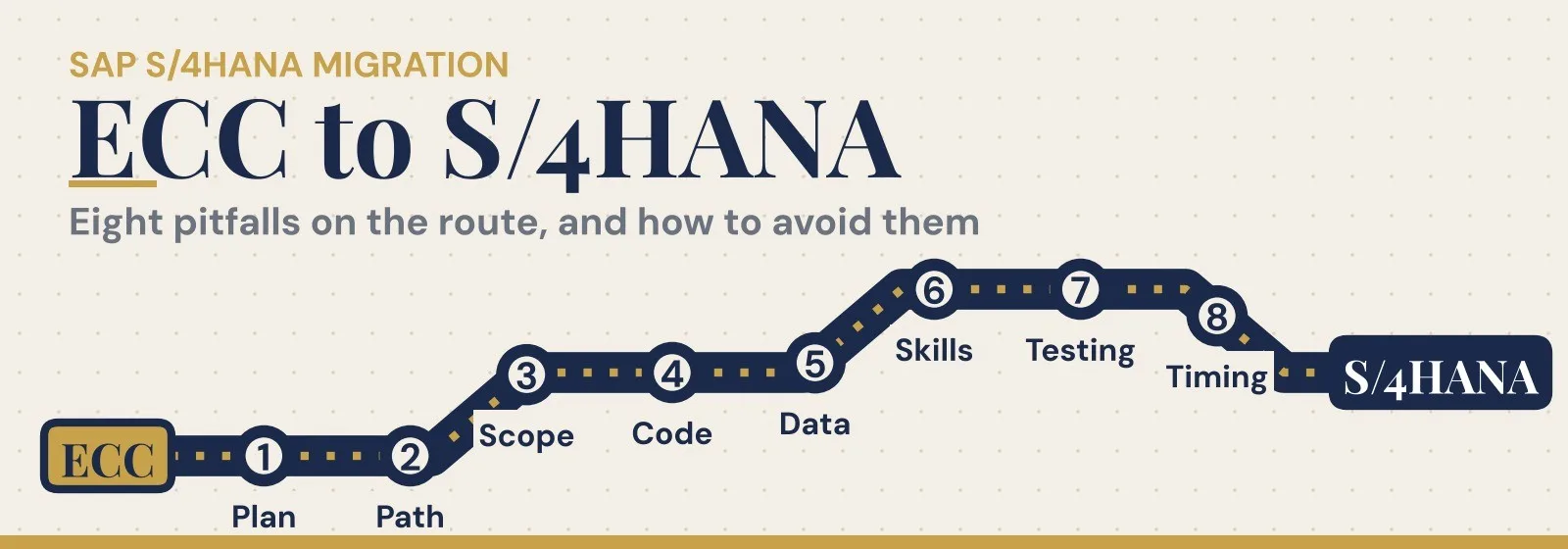
SAP ECC to S/4HANA Migration: 8 Pitfalls
and How to Avoid Them
and How to Avoid Them
Most pitfalls in an SAP ECC to S/4HANA migration are visible months before they
cost anything. The projects that avoid them look early, decide deliberately and staff
for the work.
cost anything. The projects that avoid them look early, decide deliberately and staff
for the work.
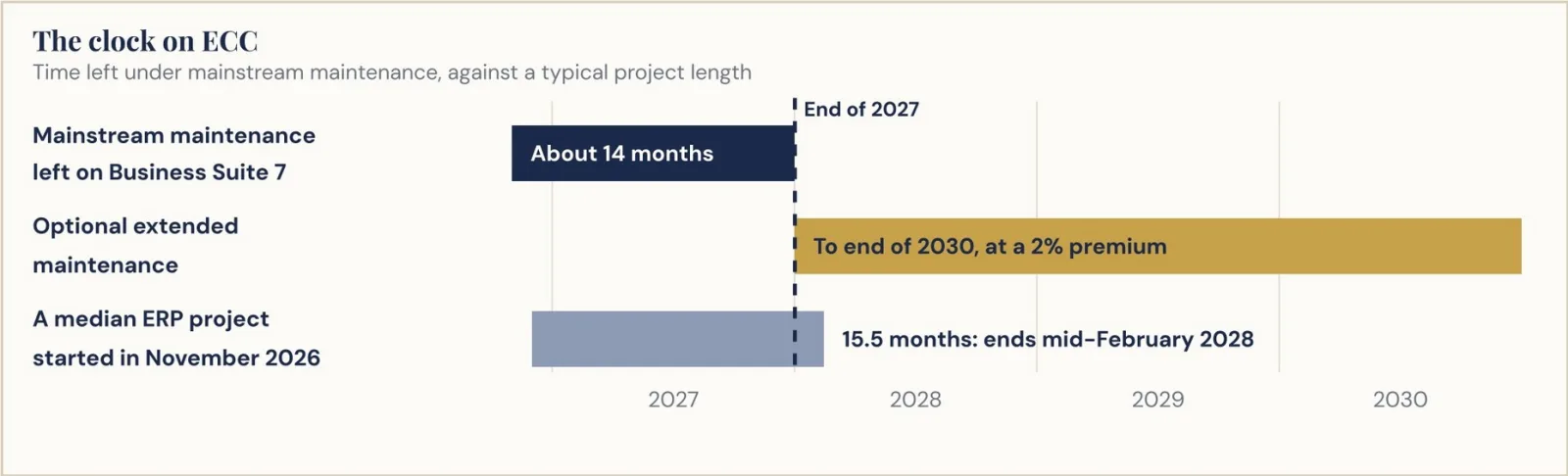
For any SAP ECC to S/4HANA migration, the date that matters is the end of 2027. SAP has committed to mainstream maintenance for Business Suite 7 core applications, the family
that includes the SAP ERP Central Component (ECC), through that date, with optional
extended maintenance through 2030
[1]
. Extended maintenance carries a 2 percent
premium
[2]
. The same survey of 198 senior leaders at German-speaking SAP customers
found just 37 percent of ECC users wanting to be on S/4HANA by the end of 2027, and the
report’s headline says about half are set to miss the date
[2]
. In the Americas, research by
the SAP users’ group found 47 percent of 766 members already running S/4HANA or under
way, with a further 22 percent planning to start within two years
[3]
.
The clock is tighter than it looks. Panorama Consulting’s 2024 report puts the median ERP
project at 15.5 months
[4]
. A project of that length started in November 2026 would end
that includes the SAP ERP Central Component (ECC), through that date, with optional
around mid-February 2028, after mainstream maintenance has run out (Figure 1). That is an
illustration, since Panorama’s median covers ERP projects in general, but it explains why avoidable delay matters. The eight pitfalls below are the ones that add months, grouped by where they arise: in the plan, in the system and in the people.
Figure 1.
The clock on ECC. Maintenance dates are from
[1]
, the extended-maintenance premium from
[2]
, and
the project bar assumes the median 15.5-month ERP project from
[4]
starting in November 2026. The project
bar is an illustration, not a forecast.
© Orpington Technologies Inc.
www.orpingtontech.com
Page
1
of
7
illustration, since Panorama’s median covers ERP projects in general, but it explains why avoidable delay matters. The eight pitfalls below are the ones that add months, grouped by where they arise: in the plan, in the system and in the people.
Orpington Technologies | SAP S/4HANA Migration Insights
Key takeaways
The deadline.
Mainstream maintenance for ECC runs to the end of 2027. Optional extended
maintenance runs to 2030 at a 2 percent premium.
The pattern.
The eight pitfalls fall into three groups: the plan, the system and the people.
The fix.
Most pitfalls are visible early. A 90-day fact-finding phase built around SAP
Readiness Check, a custom code review, business partner cleansing and a skills map prevents the expensive surprises.
The safeguard.
Have someone independent review the plan before money is committed.
1. Planning pitfalls: ownership, migration path and readiness
Pitfall 1: Treating the S/4HANA migration as a technical upgrade
It is tempting to hand a conversion to the infrastructure team and wait. SAP’s own delivery
method, SAP Activate, runs through six phases that include requirements gathering, process
design, change management and data tools, not just the technical migration
[5]
. SAPinsider
method, SAP Activate, runs through six phases that include requirements gathering, process
makes the same point from the other side, arguing that brownfield is often mistaken for a purely technical move, when in fact the organization must still adopt mandatory changes
and use S/4HANA’s simplifications
[6]
.
How to avoid it:
name a business owner for each
process area in the first phase, and give them decisions, not just updates.
Pitfall 2: Choosing brownfield or greenfield by habit
Brownfield carries existing processes and data forward, greenfield builds a new system with
room for full process redesign, and selective data transition moves only chosen data and
leaves clutter behind. SAPinsider’s conclusion is that every S/4HANA journey is hybrid in
practice
[6]
.
How to avoid it:
make the choice area by area, using evidence from an
assessment, and keep the decision open until that evidence exists.
Table 1. Three S/4HANA migration approaches and the trade-off in each
Approach
What it does
Trade-off
Brownfield
Carries existing processes and data into
S/4HANA.
room for full process redesign, and selective data transition moves only chosen data and
leaves clutter behind. SAPinsider’s conclusion is that every S/4HANA journey is hybrid in
Mandatory changes and
simplifications still apply.
Greenfield
Builds a new S/4HANA system and
allows full process redesign.
simplifications still apply.
More redesign effort in exchange for
a cleaner start.
a cleaner start.
Selective data
transition
transition
Moves only chosen data and leaves
legacy clutter behind.
legacy clutter behind.
Configuration is data too, so it must
be chosen deliberately.
Pitfall 3: Meeting the simplification items late
be chosen deliberately.
One SAP Community author estimates that a typical system has about 50 to 80 relevant simplification items, some of which can be showstoppers, and advises running the check
early
[7]
. SAP Readiness Check covers simplification items, add-on and business function
compatibility, sizing, interfaces such as business warehouse extractors, custom code and
business partner synchronization
[8]
.
How to avoid it:
run Readiness Check, Maintenance
Planner and the simplification item check in the first weeks, while a surprise can still change
the scope.
© Orpington Technologies Inc.
www.orpingtontech.com
Page
2
of
7
the scope.
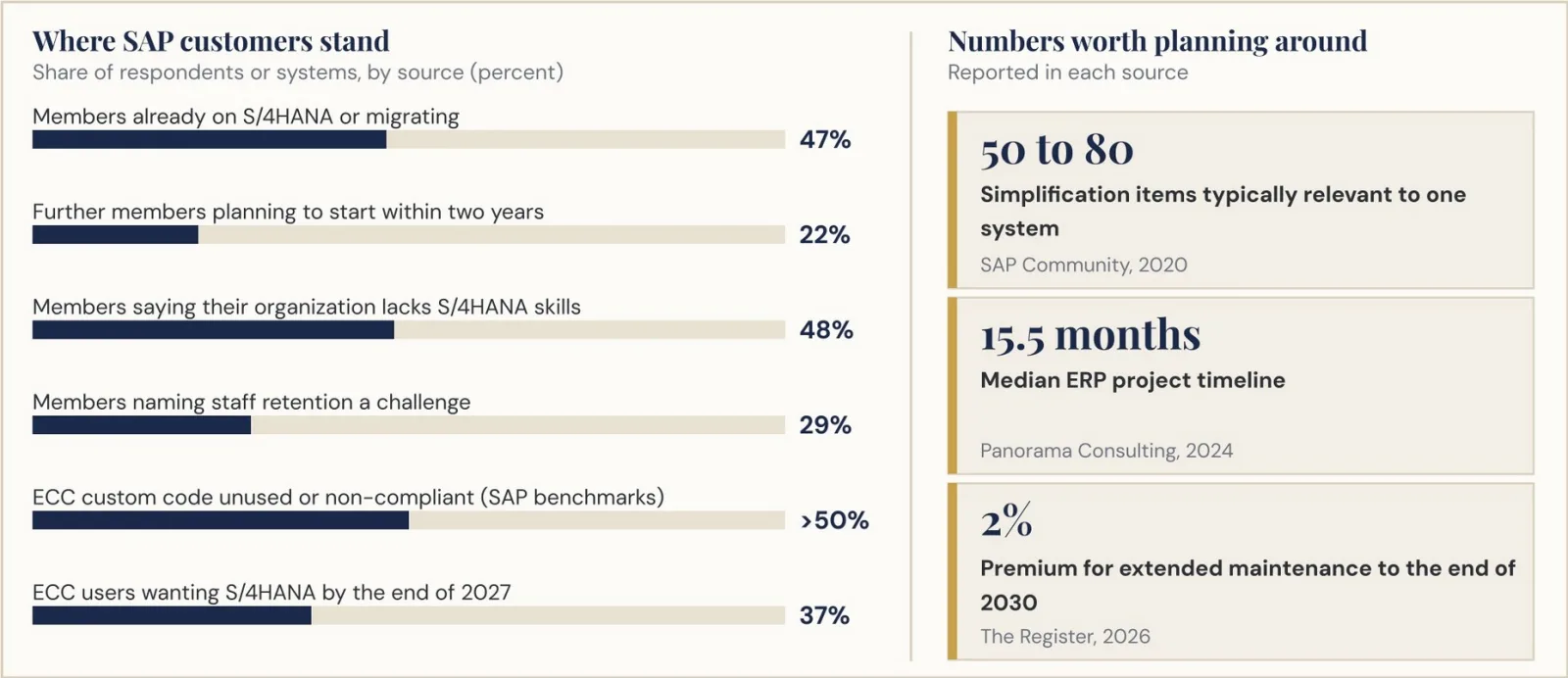
SAP benchmarks cited by SAPinsider put the share of ECC custom code that is unused or not compliant with S/4HANA standards at more than 50 percent. The same article reports that 77 percent of companies that remediated early cut cutover downtime by more than 40
percent
[9]
. Another SAP Community author warns that remediation can become a mini-
project, and that not all custom code should move at all
[7]
.
How to avoid it:
pull usage data
first, retire what nobody runs, and sort the rest into fix now, rework in the sandbox and leave
behind.
Pitfall 5: Leaving customer and vendor data until last
behind.
A consultant writing on SAP’s news site calls customer-vendor integration “perhaps the most common ‘gotcha’ in SAP migrations” and notes that the migration cannot proceed
until it is complete
[10]
. In S/4HANA the business partner replaces the separate customer
and vendor objects, and the business partner approach is the mandatory target; classic
customer and vendor transactions are not available in the on-premise edition
[11]
.
How to
avoid it:
audit and de-duplicate records early, treat the work as a business project with
data owners, and rehearse the synchronization before the main conversion.
Figure 2.
Left: Americas’ SAP Users’ Group research, 766 members
[3]
; SAP benchmarks on custom code
reported by SAPinsider
[9]
; and the German-speaking SAP user group survey of 198 leaders
[2]
. Right: typical
simplification items
[7]
, median ERP project length
[4]
and the extended-maintenance premium
[2]
.
3. People pitfalls: skills, testing and deadlines
Pitfall 6: Assuming the S/4HANA skills will be there
In the Americas research, 48 percent of members said their organization lacked S/4HANA
skills, and 29 percent named keeping knowledgeable staff a challenge
[3]
. A 2021 Gartner
survey found 64 percent of information technology executives naming talent shortage as
the biggest barrier to adopting emerging technologies
[12]
.
How to avoid it:
map the skills
each phase needs, hire for the permanent core and augment the rest. Deloitte’s 2024
Global Outsourcing Survey found 80 percent of executives planning to maintain or increase
their investment in third-party services
[13]
, and
Orpington Technologies’ ERP staff
augmentation
exists for exactly this gap.
© Orpington Technologies Inc.
www.orpingtontech.com
Page
3
of
7
Global Outsourcing Survey found 80 percent of executives planning to maintain or increase
Panorama’s 2024 report found fewer than half of organizations with an intense focus on
organizational change management, and resource constraints, staffing or budget, as the
most common cause of schedule overruns
[4]
.
How to avoid it:
test with real business data,
organizational change management, and resource constraints, staffing or budget, as the
rehearse the cutover on a copy of production, and train users before go-live rather than
after.
Pitfall 8: Planning from the wrong end of the deadline
Dates feel fixed, but they are choices with prices. Extended maintenance buys time at a 2
percent premium
[2]
. Starting late and hoping to compress the plan usually trades the
premium for cutting corners on data, testing and training.
How to avoid it:
plan backward
after.
from a realistic date, decide now whether extended maintenance is a strategy or a fallback,
and size the team to match.
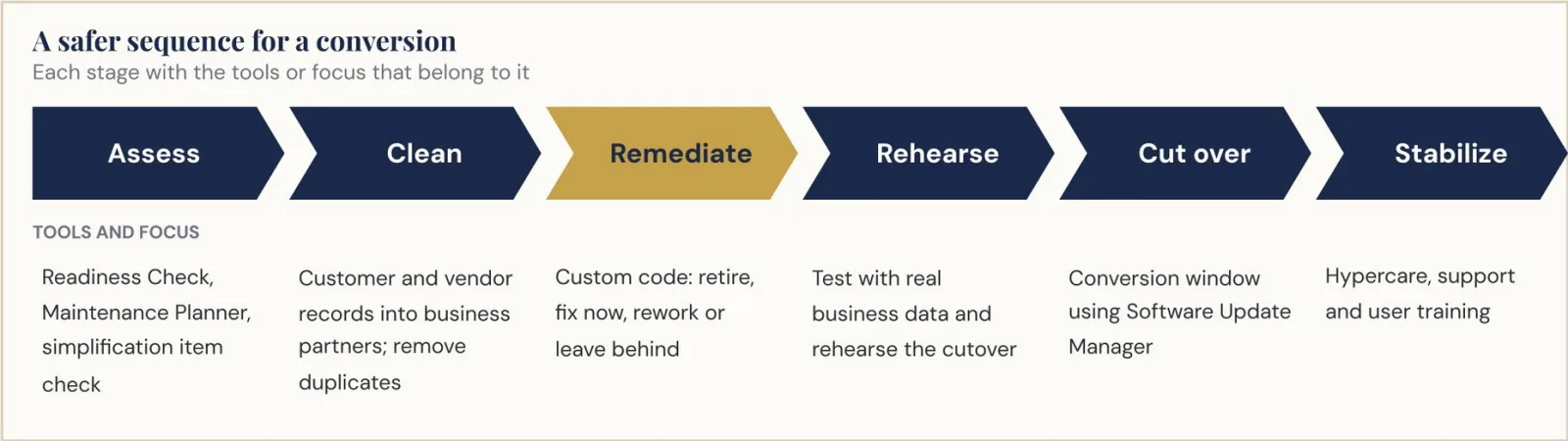
Figure 3.
A safer sequence for an ECC to S/4HANA conversion. Tools and focus areas are drawn from
[7]
,
[8]
,
[9]
and
[10]
; the order is a typical practice, not a method SAP prescribes.
Table 2. The eight S/4HANA migration pitfalls at a glance
Pitfall
Early warning sign
How to avoid it
1. Technical upgrade
No business owner named per
process area
Assign owners in the first phase
2. Path by habit
Approach fixed before any
assessment
Decide area by area, on evidence
and size the team to match.
3. Late simplification
items
No Readiness Check results yet
Run the checks in the first weeks
4. Custom code
No usage data on custom programs
Retire, fix now, rework or leave
behind
items
5. Customer and vendor
data
Duplicates and no data owners
Clean early; rehearse synchronization
6. Skills
Key roles unfilled or single-
threaded
data
Map skills by phase; augment the
peaks
7. Testing and change
Training planned after go-live
Real-data tests and cutover
rehearsals
8. Deadline
Plan built forward from today
Plan backward from a realistic date
4. Your first 90 days of an ECC to S/4HANA migration
peaks
A sound S/4HANA migration plan starts with 90 days of fact-finding. Knowing the pitfalls is useful only if it changes what happens on Monday morning. The first 90 days decide
whether the eight pitfalls stay theoretical, and none of the steps below needs a signed
integrator contract.
© Orpington Technologies Inc.
www.orpingtontech.com
Page
4
of
7
whether the eight pitfalls stay theoretical, and none of the steps below needs a signed
integrator contract.
Orpington Technologies | SAP S/4HANA Migration Insights
Days 1 to 30: establish the facts
Run the SAP Readiness Check against the production system so that simplification items,
add-on compatibility and custom code are counted rather than guessed
[8]
. Inventory
interfaces, reports and authorizations, and name a business owner for every process area. Agree in writing which of the three paths in Table 1 is being pursued and why, so the
decision survives a change of sponsor.
Days 31 to 60: clean and decide
Start the custom code review and retire what nobody uses
[9]
. Begin business partner
cleansing in the source system, where duplicates are cheapest to remove
[11]
. Compare the
decision survives a change of sponsor.
skills the plan needs with the people available, and decide which gaps will be closed by training, by hiring and by borrowing credentialed practitioners.
Days 61 to 90: commit with evidence
Build the timeline backward from a realistic cutover window and price extended
maintenance as a deliberate option rather than a rescue
[2]
. Put test strategy, data
migration rehearsals and change management on the same plan as the technical work, and agree how progress will be reported to the steering group in plain language. An organization
that reaches day 90 with these in hand can negotiate with an integrator as an informed buyer.
that reaches day 90 with these in hand can negotiate with an integrator as an informed buyer.
Two habits keep the 90 days honest. First, every assumption in the plan gets an owner and
a date by which it will be proven or dropped. Second, someone who does not benefit from
the size of the project reviews the plan before money is committed. That second habit is
the one most often skipped, and it is the gap the next section addresses.
5. How Orpington Technologies supports your S/4HANA migration
Know where you stand before you spend.
Orpington’s
Implementation Confidence
Diagnostic
is free, takes about 15 minutes with no sign-up, and returns a confidence score
with the top three risk flags
[14]
. It is a low-cost first look for a team still deciding whether to
start.
Findings backed by evidence.
The Full ERP Diagnostic Report checks every self-reported
answer against real evidence, and a certified platform expert reviews the result. The scoring
is built on Gartner research, and the assumptions behind it are disclosed
[15]
.
Review by practitioners.
Orpington describes a structure with no pyramid, so the people
reviewing a client’s work are certified SAP practitioners rather than junior staff
[15]
. On an
SAP conversion, that is the difference between a checklist and a judgment.
A cost you know in advance.
Pricing is a fixed fee per stage, with no day rates or retainers
[15]
. The cost of each decision is therefore known before it is made.
Oversight from selection to hypercare.
The Full ERP Implementation Partnership provides
independent oversight from platform selection through hypercare
[15]
, and Orpington can
a date by which it will be proven or dropped. Second, someone who does not benefit from
the size of the project reviews the plan before money is committed. That second habit is
the one most often skipped, and it is the gap the next section addresses.
also lead the migration as the accountable delivery partner. Two further services cover
specific situations: Implementation Risk Remediation gives focused advisory sprints to close a known risk, and Stalled Implementation Recovery steps in when milestones slip or a
dispute with the integrator stalls the work.
Extra hands when you need them.
Through
ERP staff augmentation
, three matched
candidates arrive roughly four weeks after the engagement fee is confirmed. Every
© Orpington Technologies Inc.
www.orpingtontech.com
Page
5
of
7
specific situations: Implementation Risk Remediation gives focused advisory sprints to close a known risk, and Stalled Implementation Recovery steps in when milestones slip or a
dispute with the integrator stalls the work.
Orpington Technologies | SAP S/4HANA Migration Insights
candidate is credentialed by a certified practitioner, stays on Orpington’s payroll, works remotely and takes direction from the client’s project lead. A 90-day replacement guarantee covers the fit risk, and a single all-inclusive monthly invoice replaces payroll and
benefits administration
[16]
. Orpington’s own estimate puts the loaded cost of a direct hire
at 1.25 to 1.4 times base salary.
For an organization facing the 2027 date, the sensible first step is the free diagnostic. If it confirms the plan is sound, it cost 15 minutes; if it finds a flag, the flag was found while it
could still be fixed
[14]
.
6. Frequently asked questions about ECC to S/4HANA migration
When does SAP ECC mainstream maintenance end?
SAP’s commitment to mainstream maintenance for ECC, part of Business Suite 7, runs
through the end of 2027. Optional extended maintenance is available through 2030
[1]
, at a
2 percent premium
[2]
.
How long does an ECC to S/4HANA migration take?
The median ERP project runs 15.5 months, according to Panorama Consulting’s 2024 report
[4]
. That figure covers ERP projects in general, so use it as a planning reference rather than a
forecast. Started in November 2026, a project of that length would finish around mid-
February 2028, after mainstream maintenance has ended.
What is the difference between brownfield, greenfield and selective data transition?
February 2028, after mainstream maintenance has ended.
Brownfield converts the existing system and carries processes and data forward. Greenfield
builds a fresh S/4HANA system and allows full process redesign. Selective data transition
moves only chosen data and leaves legacy clutter behind. SAPinsider concludes that every
S/4HANA journey is hybrid in practice
[6]
, so decide area by area (see Table 1).
How many simplification items should we expect?
A typical system has about 50 to 80 relevant simplification items, according to one SAP
Community author, and some can be showstoppers
[7]
. SAP Readiness Check reports on
these items along with add-on compatibility, sizing, interfaces, custom code and business
partner synchronization
[8]
, so run it in the first weeks of the project.
Why do customer and vendor data have to move to business partners?
In S/4HANA the business partner replaces the separate customer and vendor objects, and
classic customer and vendor transactions are not available in the on-premise edition
[11]
.
Auditing and de-duplicating records early makes the synchronization far easier to rehearse.
What should we do first?
Run SAP Readiness Check against the production system, name a business owner for every
process area and agree in writing which migration path you are pursuing
[8]
. For a quick first
look at your risk, Orpington’s free Implementation Confidence Diagnostic takes about 15
minutes
[14]
.
Sources & Further Reading
[1] LeverX – “SAP ECC End of Support 2027 UK: What UK Businesses Need to Do Now”
[2] The Register – “Half of German-speaking SAP users set to blow past 2027 ECC support deadline,”
February 2026
© Orpington Technologies Inc.
www.orpingtontech.com
Page
6
of
7
builds a fresh S/4HANA system and allows full process redesign. Selective data transition
moves only chosen data and leaves legacy clutter behind. SAPinsider concludes that every
Orpington Technologies | SAP S/4HANA Migration Insights
[3] The Register – “American SAP shops ramp up S/4HANA migrations” (report on research by the
Americas’ SAP Users’ Group, 766 members), April 2024
[4] Panorama Consulting Group – “The 2024 ERP Report”
[5] SAP Learning – “Describing the Deployment Process and the SAP Activate Methodology”
[6] SAPinsider – “All SAP S/4HANA Journeys Are Hybrid,” February 2023
[7] SAP Community – “Tools to Support SAP S/4HANA Conversion Project,” Hafizur Rahman, July 2020
[8] SAP Community – “SAP Readiness Check 2.0: Insights and Flavors,” Paresh Shrivastava, May 2020
[9] SAPinsider – “How to Prepare SAP Custom Code for S/4HANA,” Bindiya Kour, February 2026
[10] SAP News Center – “The SAP Migration Mistake Most Companies Make,” Tracy Gore, October 2025
[11] SAP Community – “Business Partner Approach in SAP S/4HANA,” January 2018
[12] Gartner – “Gartner Survey Reveals Talent Shortages as Biggest Barrier to Emerging Technologies
Adoption,” September 2021
[13] Deloitte – “Global Outsourcing Survey 2024”
[14] Orpington Technologies – Implementation Confidence Diagnostic
[15] Orpington Technologies – Services overview
[16] Orpington Technologies – “ERP Staff Augmentation”
© Orpington Technologies Inc.
www.orpingtontech.com
Page
7
of
7