
Building a Realistic Migration Timeline Before It's Too Late
Work backward from December 2027, account for how long these projects actually take, and the amount of runway left starts to look a lot shorter than it feels.

Building a Realistic Migration Timeline
Before It's Too Late
Before It's Too Late
Work backward from December 2027, account for how long these projects actually take, and the amount of runway left starts to look a lot shorter than it feels.
Most of the research covered in this series eventually points to the same practical question: given how long these projects actually take, how much time is genuinely left? The honest
answer depends heavily on your organization's complexity, but the industry's own estimates leave less margin than most planning conversations assume.
answer depends heavily on your organization's complexity, but the industry's own estimates leave less margin than most planning conversations assume.
Duration estimates from independent research cluster in a wide but informative range. Gartner has told clients to expect migration projects lasting anywhere from three to seven years for
the most complex, heavily customized global landscapes, particularly where a genuine process
redesign and change-management effort are involved rather than a like-for-like technical
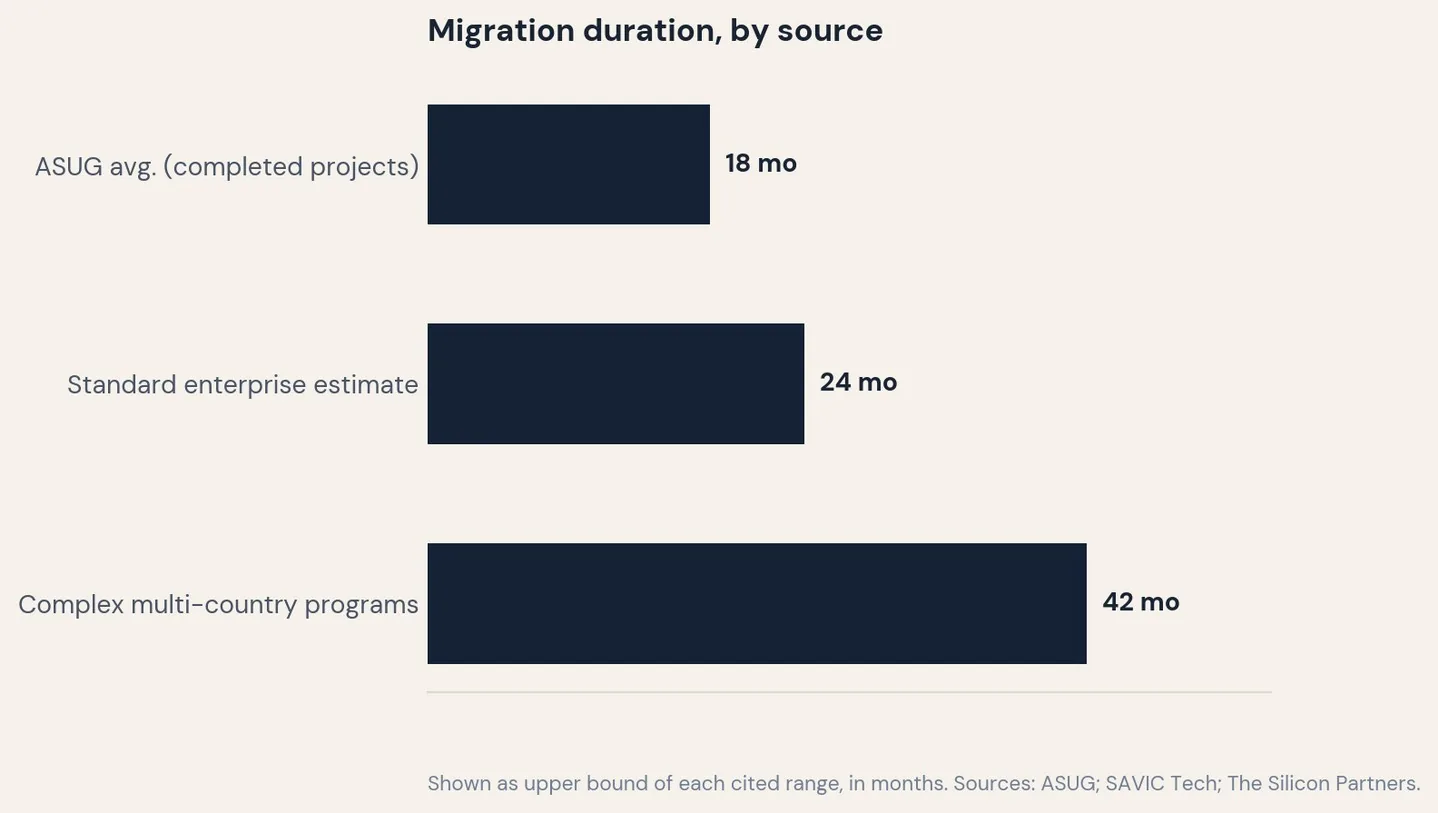
conversion. More typical estimates for a standard enterprise migration put the range at 12 to 24 months, while complex, multi-country programs with significant custom code tend to run
30 to 42 months from kickoff to stabilized go-live. ASUG's member survey, drawing on real completed projects, found an average duration of roughly one and a half years — useful as a planning anchor, though it likely understates the true range given how many respondents are
past the most complex end of the distribution.
© Orpington Technologies Inc.
www.orpingtontech.com
Page
1
of
3
the most complex, heavily customized global landscapes, particularly where a genuine process
redesign and change-management effort are involved rather than a like-for-like technical
conversion. More typical estimates for a standard enterprise migration put the range at 12 to 24 months, while complex, multi-country programs with significant custom code tend to run
30 to 42 months from kickoff to stabilized go-live. ASUG's member survey, drawing on real completed projects, found an average duration of roughly one and a half years — useful as a planning anchor, though it likely understates the true range given how many respondents are
past the most complex end of the distribution.
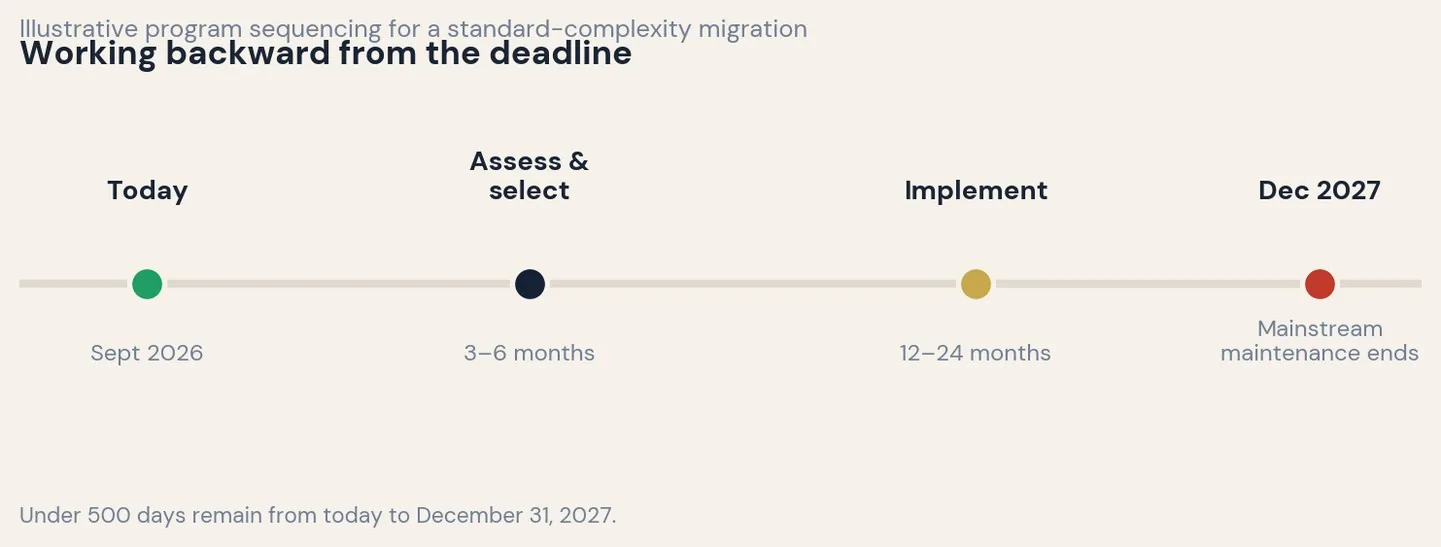
Run that arithmetic against the actual calendar. From today, there are well under 500 days remaining before SAP's mainstream maintenance for ECC ends on December 31, 2027. An organization with a moderately complex landscape planning on an 18-to-24-month program, and building in a realistic assessment and vendor-selection phase before the technical work
even starts, is already looking at a start date that needed to be months ago — not a start date still comfortably in the future. For any organization with a genuinely complex, heavily customized landscape looking at the 30-to-42-month range some research cites, the honest
read of the calendar is that a 2027 go-live may no longer be achievable at all, which makes extended maintenance planning, covered elsewhere in this research, a near-term necessity rather than a hypothetical fallback.
This is exactly the mistake industry analysis keeps flagging under different names: “decision compression,” the gradual narrowing of strategic options that happens when organizations
delay planning until deadline pressure forces rushed choices. It manifests in a predictable sequence — experienced talent becomes unavailable as early movers lock down the best consultants, rates climb 30 to 50% as demand peaks, and scope decisions get made by default rather than by design, typically collapsing toward the fastest brownfield option chosen
for speed rather than fit. Organizations that complete a formal landscape assessment before committing to an approach consistently resolve scope disputes in weeks rather than months, and avoid the mid-program blueprint revisions that account for the majority of the cost overruns documented throughout this research.
© Orpington Technologies Inc.
www.orpingtontech.com
Page
2
of
3
delay planning until deadline pressure forces rushed choices. It manifests in a predictable sequence — experienced talent becomes unavailable as early movers lock down the best consultants, rates climb 30 to 50% as demand peaks, and scope decisions get made by default rather than by design, typically collapsing toward the fastest brownfield option chosen
for speed rather than fit. Organizations that complete a formal landscape assessment before committing to an approach consistently resolve scope disputes in weeks rather than months, and avoid the mid-program blueprint revisions that account for the majority of the cost overruns documented throughout this research.
Orpington Technologies | SAP S/4HANA Migration Insights
A realistic timeline, built honestly, usually looks something like this: three to six months for
landscape assessment, business-case development and vendor selection; twelve to twenty-
four months for the core implementation, depending on approach and complexity; and a
further stabilization period after go-live before the organization is genuinely realizing the value
it migrated for. Working backward from December 2027 with that structure in mind is the
single most useful exercise most organizations still on ECC haven't yet done on paper.
None of this is intended to induce panic — it's intended to replace a vague sense of urgency with an actual plan. The organizations that come through this transition well are, without exception, the ones that turned “we need to migrate eventually” into a dated, resourced, sequenced program while there was still enough calendar left to execute it properly.
This is the exercise Orpington Technologies Inc. runs with every new client before any
migration work begins — the Canadian ERP advisory and delivery firm builds the realistic,
working-backward timeline first, precisely so a client knows, with real dates attached, whether 2027 is still achievable or whether extended maintenance needs to be part of the plan from day one.
migration work begins — the Canadian ERP advisory and delivery firm builds the realistic,
working-backward timeline first, precisely so a client knows, with real dates attached, whether 2027 is still achievable or whether extended maintenance needs to be part of the plan from day one.
The deadline was never going to move. The only variable left is whether your timeline gets built
deliberately, with room to do the work well, or gets built for you by however much calendar happens to be left when the decision finally gets made.
Migration duration, by source
Source
Typical duration cited
ASUG member survey (completed projects)
~1.5 years average
Industry estimate, standard enterprise migration
12–24 months
deliberately, with room to do the work well, or gets built for you by however much calendar happens to be left when the decision finally gets made.
Industry estimate, complex multi-country
programs
30–42 months
Gartner, most complex global landscapes
3–7 years
Sources & Further Reading
[1]
SAVIC Tech – “SAP ECC to S/4HANA Migration Before 2027,” April 20, 2026
[2]
The Silicon Partners – “SAP S/4HANA Migration: Why 2026 is the Decision Year,” May 28,
2026
[3]
ASUG – “SAP S/4HANA Adoption Trends, Insights, and Advice,” 2026
© Orpington Technologies Inc.
www.orpingtontech.com
Page
3
of
3
programs