
Change Management: Why Technical Success Still Isn't Enough
A flawless technical cutover doesn't matter much if the people who have to use the new system every day were never brought along. The survey data says this is where migrations quietly fail.

Change Management: Why Technical Success
Still Isn't Enough
Still Isn't Enough
A flawless technical cutover doesn't matter much if the people who have to use the new system every day were never brought along. The survey data says this is where migrations quietly fail.
It is possible to run a technically excellent S/4HANA migration — clean data, well-remediated custom code, a go-live weekend that closes without a single critical incident — and still watch
the project fail to deliver its promised value, because the people expected to use the new system every day never really adopted it. This isn't a hypothetical risk; it shows up consistently in the survey data on what actually determines whether a migration succeeds.
the project fail to deliver its promised value, because the people expected to use the new system every day never really adopted it. This isn't a hypothetical risk; it shows up consistently in the survey data on what actually determines whether a migration succeeds.
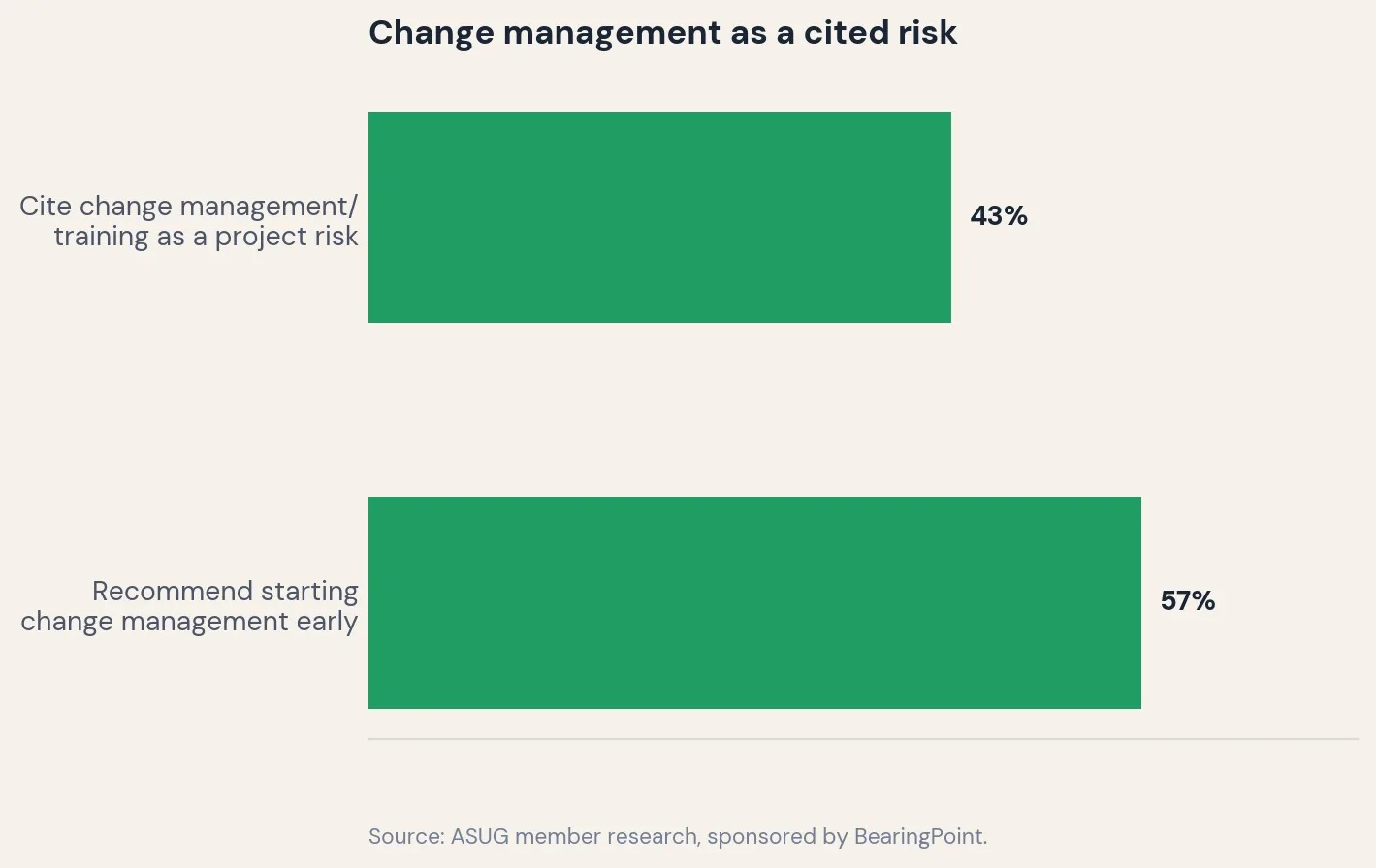
ASUG's member research, developed with BearingPoint, found that 43% of respondents cited
change management — training and user adoption specifically — as a genuine project risk.
More tellingly, 57% recommended starting change management work early in the program, a
figure that itself rose 7 percentage points from the year before, suggesting organizations that have already been through a migration are learning this lesson the hard way and passing the advice forward.
© Orpington Technologies Inc.
www.orpingtontech.com
Page
1
of
3
change management — training and user adoption specifically — as a genuine project risk.
More tellingly, 57% recommended starting change management work early in the program, a
figure that itself rose 7 percentage points from the year before, suggesting organizations that have already been through a migration are learning this lesson the hard way and passing the advice forward.
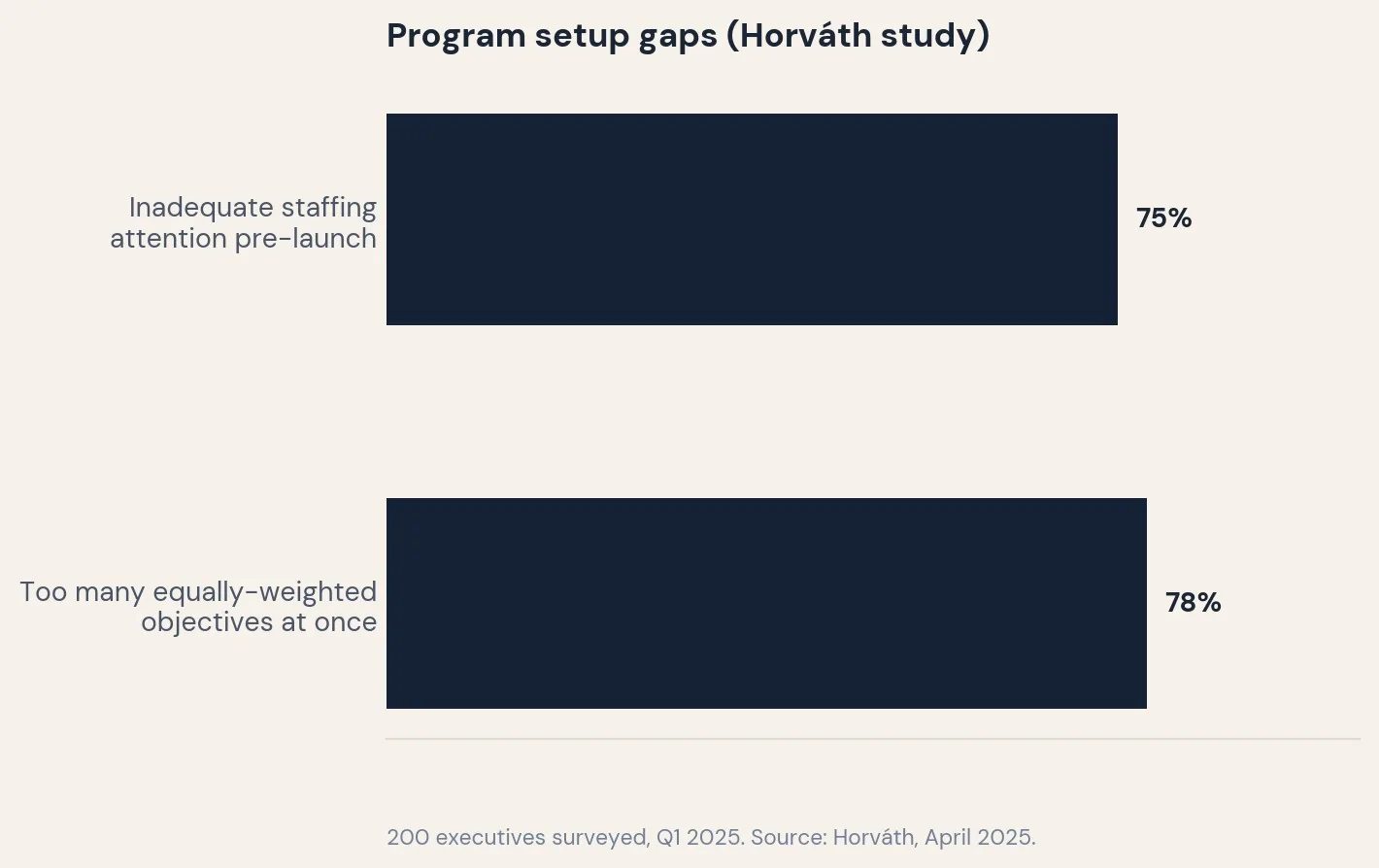
The Horváth study of 200 executives points at a related but distinct failure mode: three-quarters of respondents said the selection and availability of project managers and staff didn't
receive adequate attention before the project started, and 78% said too many objectives were treated as equally important, with nothing meaningfully sequenced or prioritized. Both findings
describe the same underlying problem from different angles — organizations underinvesting in
the human side of program setup relative to the technical side, and then being surprised when the human side is what determines the outcome.
One ASUG respondent, quoted anonymously in the research, described delaying go-live for
more than a year specifically because risks like change management, external-resource
dependencies, testing and business-process documentation weren't addressed early enough. Another described the difficulty more plainly: “we have some basic needs but getting alignment on overall business benefit is difficult.” That is not a technology problem. It is an organizational-alignment problem wearing a technology project's clothing.
© Orpington Technologies Inc.
www.orpingtontech.com
Page
2
of
3
more than a year specifically because risks like change management, external-resource
dependencies, testing and business-process documentation weren't addressed early enough. Another described the difficulty more plainly: “we have some basic needs but getting alignment on overall business benefit is difficult.” That is not a technology problem. It is an organizational-alignment problem wearing a technology project's clothing.
Orpington Technologies | SAP S/4HANA Migration Insights
The good news buried in this research is that the fix is well understood, even if it's inconsistently applied: start change management and training work in parallel with technical design rather than after it, invest specifically in self-service training materials and reference
guides (one ASUG respondent specifically credited developing these well in advance of go-live), and treat user adoption metrics with the same seriousness as technical cutover metrics
in the program's steering governance. None of that is expensive relative to the cost of a
technically successful migration that limps for a year afterward because nobody actually
wanted to use the new system.
This is a discipline that shows up as much in how a migration partner structures a program as
in any single deliverable. Orpington Technologies Inc., the Canadian ERP advisory and delivery
firm, builds change management workstreams into its S/4HANA engagements from the very
start of the program rather than as a late addition, on the view that user adoption is as much a
determinant of ROI as the technical cutover itself.
A go-live weekend that closes cleanly is a milestone, not the finish line. The finish line is the day
your finance, supply chain and operations teams stop describing S/4HANA as “the new system”
and just call it the system — and that day is decided long before go-live, not after it.
What ASUG's survey found about change management
Finding
Figure
your finance, supply chain and operations teams stop describing S/4HANA as “the new system”
and just call it the system — and that day is decided long before go-live, not after it.
Cite change management/training as a project
risk
43%
Recommend starting change management early
57% (+7 pts vs. prior year)
risk
Cite project-staffing attention as inadequate
before go-live (Horváth)
75%
before go-live (Horváth)
Cite too many equally-weighted objectives at
once (Horváth)
78%
Sources & Further Reading
[1]
ASUG – “SAP S/4HANA Adoption Trends, Insights, and Advice,” 2026 (sponsored by
BearingPoint)
[2]
Horváth – “Study shows: SAP S/4HANA transformations rarely go as planned,” April 10, 2025
© Orpington Technologies Inc.
www.orpingtontech.com
Page
3
of
3
once (Horváth)