
Seven Problems You Will Meet Moving from ECC to S/4HANA, and the Fix for Each
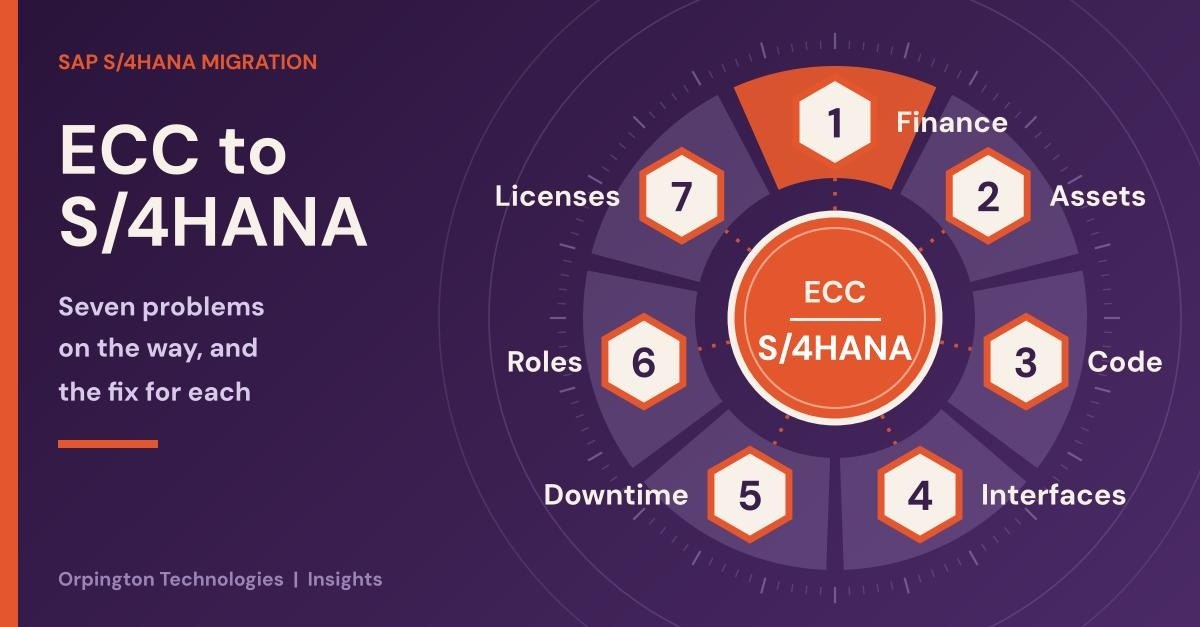
Mainstream maintenance for SAP ERP 6.0 ends at the close of 2027, so most organizations still running ECC now have a fixed horizon for moving to S/4HANA. This article sets out seven problems that conversions meet again and again, and the practical fix for each, drawing on SAP’s own guidance, practitioner write-ups and the latest Precisely and Americas’ SAP Users’ Group research.
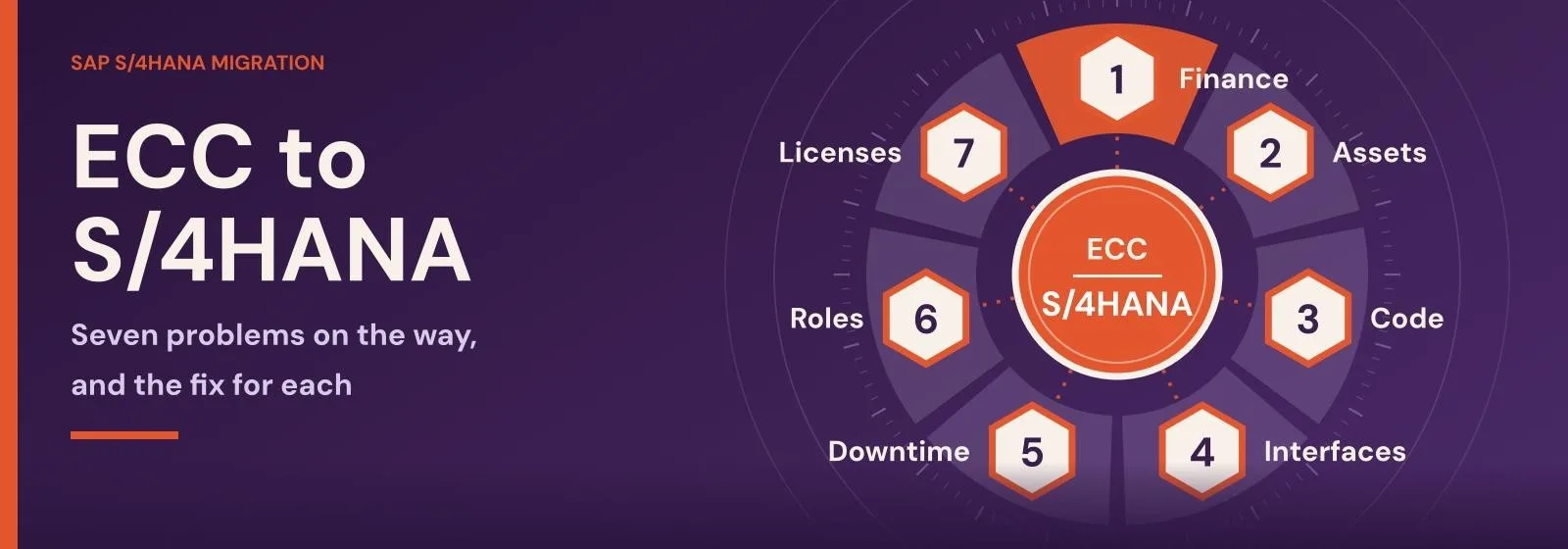
Seven Problems You Will Meet Moving from
ECC to S/4HANA, and the Fix for Each
ECC to S/4HANA, and the Fix for Each
The software is rarely what goes wrong. Finance, custom code, interfaces, downtime,
security and contracts are where conversions stall, and every one of them has a
known fix that costs least when it is applied early.
Orpington Technologies
|
Insights
security and contracts are where conversions stall, and every one of them has a
known fix that costs least when it is applied early.
For most organizations still running ECC, the question in late 2026 is no longer whether to move to S/4HANA but how to do it without an expensive surprise. Mainstream maintenance
for SAP ERP 6.0 ends at the close of 2027, and extended maintenance through 2030 carries
a premium of two percentage points on the maintenance basis
[1]
. The market is moving:
for SAP ERP 6.0 ends at the close of 2027, and extended maintenance through 2030 carries
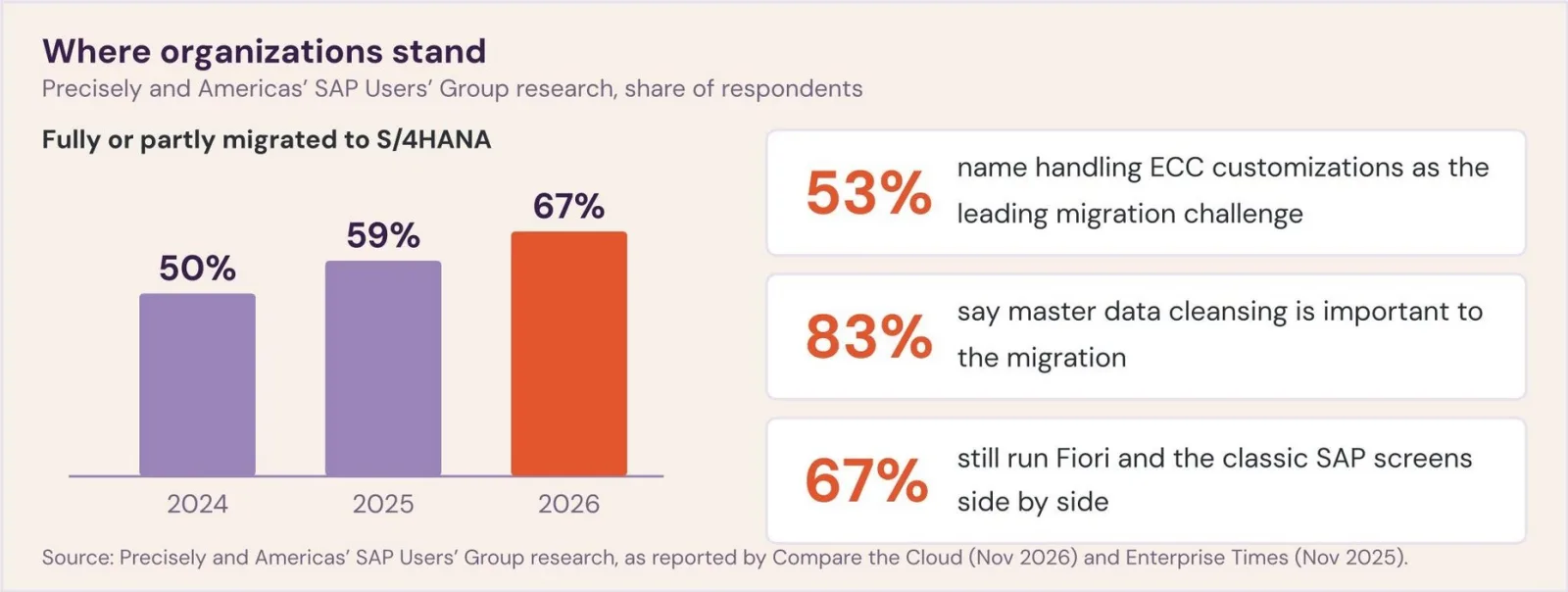
research from Precisely and the Americas’ SAP Users’ Group found 67 percent of respondents fully or partially migrated, up from 59 percent in 2025 and 50 percent in 2024
[2]
[3]
.
Moving later has one advantage, which is that the people who went first have left a clear
record. The same research puts the handling of ECC customizations at the top of the challenge list at 53 percent, and 83 percent of respondents call master data cleansing
important to the migration
[2]
. The seven problems below are the ones that SAP’s own
record. The same research puts the handling of ECC customizations at the top of the challenge list at 53 percent, and 83 percent of respondents call master data cleansing
guidance and practitioners return to most often. They are arranged in the order a project meets them: four in design, then three at cutover and after.
Figure 1.
Where organizations stand. Migration progress by year and three findings from the 2026 Precisely and
Americas’ SAP Users’ Group research
[2]
[3]
.
© Orpington Technologies Inc.
www.orpingtontech.com
Page
1
of
6
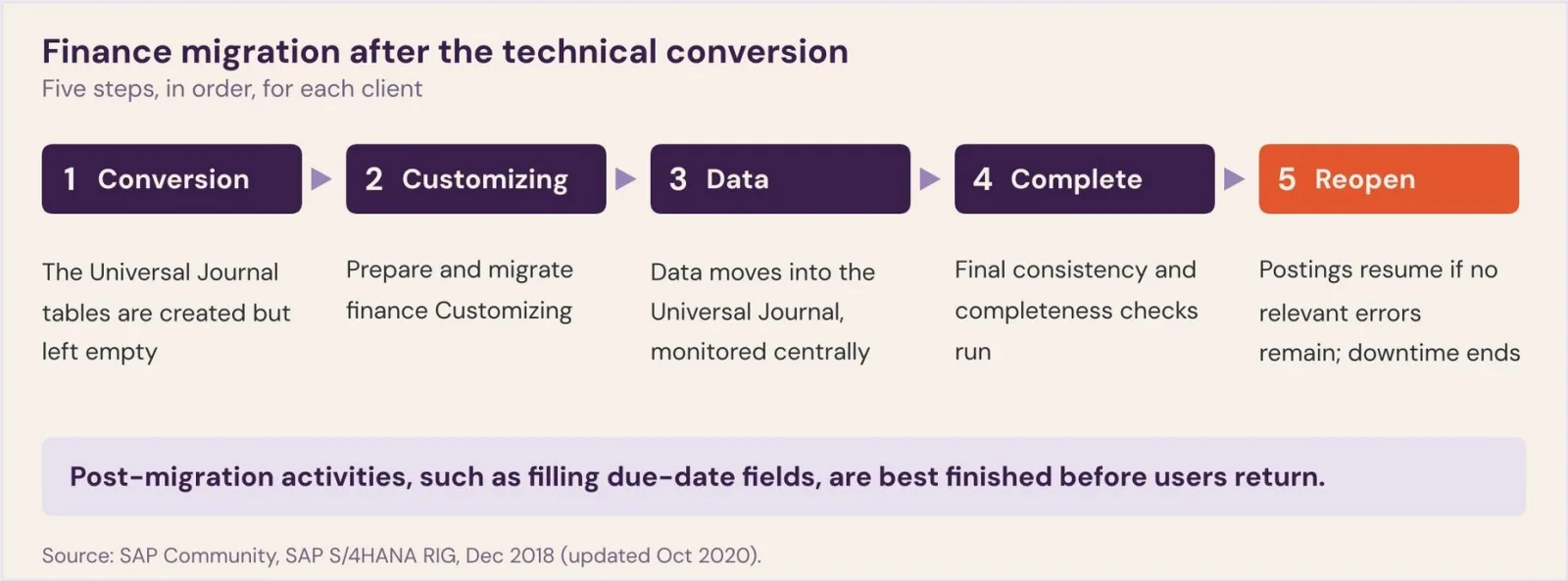
the Software Update Manager creates the Universal Journal tables but leaves them empty.
Finance data migration is a separate, manual stage that runs afterward, once for each client,
in three steps that must be completed in sequence: Customizing, data, and post-migration
activities
[4]
. The author of SAP’s own community post argues that this stage can take more
effort and runtime than the technical conversion, so a plan that treats finance as a footnote
understates the work
[4]
. Two details cause most of the surprises. Individual company
Finance data migration is a separate, manual stage that runs afterward, once for each client,
in three steps that must be completed in sequence: Customizing, data, and post-migration
codes cannot be left out of the migration; the options are to archive them fully beforehand or to mark obsolete ones as templates, and the template setting only affects the general
ledger checks, not areas such as asset accounting
[4]
. And a classic general ledger source
yields only core new general ledger functions: parallel ledgers and document splitting are
not switched on automatically
[4]
.
How to avoid it: put the finance workstream on the plan in the first month. Clean data inconsistencies and retire obsolete company codes in the source system, activate the new
depreciation engine and implement new asset accounting ahead of the conversion, and run
the finance migration in every test conversion rather than only the last one
[4]
[8]
. The same
post suggests starting with about 10 parallel jobs and tuning from there, because too few
slow the run and too many cause memory problems and short dumps
[4]
.
Problem 2: Fixed assets reconcile in total and are wrong in detail.
S/4HANA no longer
supports classic asset accounting, and postings land in the Universal Journal
[5]
. Only one
fiscal year may remain open in asset accounting at the time of migration, and the periodic
runs must finish cleanly before the conversion starts
[5]
. The consultants at LeverX describe
depreciation engine and implement new asset accounting ahead of the conversion, and run
the kinds of errors that follow. A balance of $4.8 million in acquisition and production cost
against $4.75 million in the general ledger leaves a $50,000 gap that traces back to a historical adjustment. Two assets with $25,000 errors in opposite directions leave the totals looking correct, so only asset-level checks catch them. International and local
valuations can legitimately differ, so reports have to be compared on the same basis before
anyone chases a difference
[5]
.
against $4.75 million in the general ledger leaves a $50,000 gap that traces back to a historical adjustment. Two assets with $25,000 errors in opposite directions leave the totals looking correct, so only asset-level checks catch them. International and local
valuations can legitimately differ, so reports have to be compared on the same basis before
How to avoid it: run SAP’s asset reconciliation check programs named in SAP Note 2896400
before the conversion. They find problems but do not fix them, so record a baseline of
balances and reporting dates first, and afterward validate at asset level and by accounting
view rather than only in total
[5]
. Keep a written note of each investigation, because auditors
will ask.
Figure 2.
The finance migration runs after the technical conversion and is not part of it. Order and wording follow
SAP’s community guidance
[4]
.
© Orpington Technologies Inc.
www.orpingtontech.com
Page
2
of
6
before the conversion. They find problems but do not fix them, so record a baseline of
balances and reporting dates first, and afterward validate at asset level and by accounting
Orpington Technologies | SAP S/4HANA Migration Insights
Problem 3: Custom code arrives by default.
A conversion carries years of modifications
and custom developments forward unless someone decides otherwise. SAP’s clean core principle, as LeverX summarizes it, keeps the core close to standard so that it stays
maintainable and upgrade-stable; it is a governance rule, not a ban on custom code
[6]
.
Customizations are the most-cited challenge in the Americas’ SAP Users’ Group research,
at 53 percent
[2]
. The guidance is not to move legacy code by default but to use the
migration to remove what no longer adds value
[6]
.
How to avoid it: inventory every custom development, modification, report, workflow and
interface, and record who owns it and whether anyone still uses it. Score each one on business value, technical risk, standard alternatives and long-term ownership, then choose
one of five outcomes: retain, remediate, replace, redesign as an extension, or retire. Review first the modifications that SAP’s extension levels class as not recommended. There are three supported places for extensions: key-user tools in the application, developer
extensibility inside S/4HANA, and side-by-side applications on SAP Business Technology
Platform. Choose the simplest option that meets the need, and avoid both extremes of
deleting everything or carrying everything across unchanged
[6]
.
Problem 4: Interfaces that nobody listed.
Connections to manufacturing execution,
warehouse, supplier, customer relationship and tax systems can break during a migration,
and they tend to surface late, during testing or cutover
[7]
[6]
. The gap is usually
documentation: the interface exists, works, and was built by someone who has since left.
interface, and record who owns it and whether anyone still uses it. Score each one on business value, technical risk, standard alternatives and long-term ownership, then choose
one of five outcomes: retain, remediate, replace, redesign as an extension, or retire. Review first the modifications that SAP’s extension levels class as not recommended. There are three supported places for extensions: key-user tools in the application, developer
extensibility inside S/4HANA, and side-by-side applications on SAP Business Technology
Platform. Choose the simplest option that meets the need, and avoid both extremes of
How to avoid it: build a complete interface inventory covering dependencies, data ownership and error handling, replace fragile point-to-point links with standardized
interface patterns where practical, and start integration testing early
[7]
. SAP’s guidance on
test cycles asks for at least one cycle that includes the connected satellite systems, not
only the SAP landscape
[8]
. Where the plan needs extra hands for this work, such as a
consultant who knows the finance and logistics interfaces,
Orpington Technologies’ ERP
staff augmentation
places credentialed S/4HANA specialists inside the client team
[12]
.
Table 1. What changes in security and roles when ECC moves to S/4HANA
Area
What changes
What to do
Customer and vendor
transactions
transactions
54 transactions are unavailable and
Business Partner integration is
mandatory
Business Partner integration is
mandatory
Rebuild roles around the Business
Partner
Partner
Display transaction
FD03
No longer exists
Use the Business Partner
FD03
transaction and update every role
that contains it
Fiori apps
Depend on services that must be
authorized separately
that contains it
Add service authorizations to the
role design
Changed objects
More than 5,500 objects may affect
authorizations
role design
Compare roles with the
Simplification List using SAP’s
tools
Simplification List using SAP’s
tools
Protection of custom
code
code
Object keys are unavailable, so
protection relies on the developer
authorization object
protection relies on the developer
authorization object
Review who may develop and
debug
debug
Direct database
access
access
Needs database privileges, not
standard roles
Review as a separate item
© Orpington Technologies Inc.
www.orpingtontech.com
Page
3
of
6
standard roles
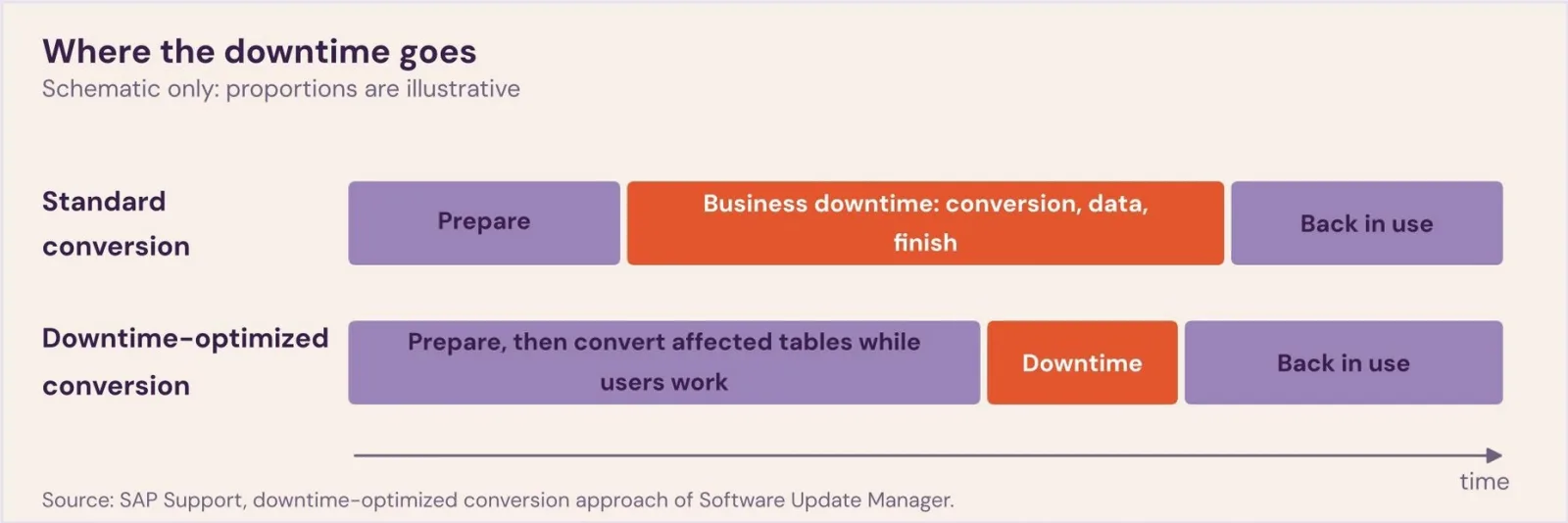
happens while the business is stopped. SAP’s downtime-optimized approach moves that
work into the uptime phase: data conversion and the migration of affected tables run while users keep working, large application tables that the new data model does not affect are migrated in uptime, and changes users make in the meantime are captured with database
triggers and replayed later
[9]
. It is not free. SAP notes that planning is more complex, that
work into the uptime phase: data conversion and the migration of affected tables run while users keep working, large application tables that the new data model does not affect are migrated in uptime, and changes users make in the meantime are captured with database
extra test runs and impact analysis are needed, that production needs a Customizing freeze and a lock on development activity before downtime, and that it is not normally used for
development systems
[9]
.
How to avoid it: let rehearsals set the window instead of hopeful arithmetic. SAP’s guidance on test cycles has the first cycle convert a copy of production on production-like hardware to learn the phases, steps and runtimes. Every activity is logged in a runbook with its completion time, and once the first results are in, the business agrees an acceptable outage window and the team chooses between the standard and downtime-optimized approaches
[8]
. Write explicit go and no-go criteria covering technical, data, business and operational
readiness, and define the rollback before the weekend, not during it
[7]
.
Figure 3.
Where the downtime goes. A schematic of SAP’s description of standard and downtime-optimized
conversion; proportions are illustrative, not measured
[9]
.
Problem 6: Roles and screens that worked in ECC do not survive the move.
SAP changed
more than 5,500 objects that can affect authorizations, and several familiar transactions no
longer exist
[10]
. Roles that carry excessive access or segregation-of-duties conflicts will
probably get worse after migration, not better
[10]
. People are the second half of this
problem: 81 percent of the Americas’ SAP Users’ Group respondents use Fiori in some form,
yet 67 percent still run Fiori and the classic screens side by side
[2]
, and LeverX notes that
redesigned processes and Fiori workflows can meet resistance
[7]
.
How to avoid it: involve the security team in the first month, so that they can size the work, and decide deliberately when to redesign roles. Redesigning before the migration is often
recommended; doing it during the migration is risky
[10]
. Update the segregation-of-duties
rule set before designing roles so that new roles do not inherit old conflicts
[10]
. Pair the role
work with role-based training and early involvement of key users
[7]
.
Problem 7: The license conversion was never in the business case.
According to Redress
Compliance, an advisory firm that specializes in SAP contracts, SAP does not automatically
carry ECC licenses over to S/4HANA. New licenses are bought outright or obtained through a conversion program, and the credit for existing licenses is typically less than one for one. Unused licenses earn little or no credit, converting inactive named users inflates the cost, and verbal promises of credits or extended support are worth little unless they are written into the contract. Bundled cloud pricing can also hide storage and user-count costs, and
© Orpington Technologies Inc.
www.orpingtontech.com
Page
4
of
6
carry ECC licenses over to S/4HANA. New licenses are bought outright or obtained through a conversion program, and the credit for existing licenses is typically less than one for one. Unused licenses earn little or no credit, converting inactive named users inflates the cost, and verbal promises of credits or extended support are worth little unless they are written into the contract. Bundled cloud pricing can also hide storage and user-count costs, and
Orpington Technologies | SAP S/4HANA Migration Insights
document-based indirect access can grow into a charge if it is not monitored
[11]
. This is
one adviser’s view, so check the specifics against your own contract.
How to avoid it: begin the license review at the same time as the technical assessment, not after the integrator is chosen. Budget licenses separately from project costs, clean up inactive and light users before converting, get every incentive in writing, and start planning
12 to 18 months before go-live
[11]
.
Table 2. The seven problems at a glance
Problem
Early warning sign
The fix
1. Finance conversion
Plan ends at “technical conversion
complete”
Start finance in month one;
migrate it in every test
2. Fixed assets
Totals tie, detail does not
Run SAP’s checks first; validate
asset by asset
3. Custom code
Nobody can say who uses what
Inventory, score, then retain,
migrate it in every test
remediate, replace, extend or
retire
4. Interfaces
No complete list exists
Inventory; test with connected
systems early
5. Downtime
A window chosen before any
rehearsal
retire
Rehearse; let measured runtimes
set the window
6. Roles and adoption
Roles copied from ECC unchanged
Redesign before migrating; train
by role
7. Licenses
Licenses absent from the business
case
set the window
Review early; clean user lists; write
incentives down
3. Where Orpington Technologies fits
incentives down
The seven problems share a pattern. Each was visible weeks or months before it hurt, and each needed someone who had seen it before. That gives a simple test for a migration partner: afterward, could the client say the following? The statements are written in a client’s voice. Each is followed by what Orpington Technologies publishes about how it
works, so that the statement can be checked rather than taken on faith.
“Finance and the other hard parts were on the table before we signed anything.”
Orpington’s Free Confidence Diagnostic gives an instant self-reported score and the top
three risk flags at no cost
[13]
. Finance conversion, code, interfaces and cutover are the kind
of areas where a flag is cheapest to act on.
“Every risk they raised came with evidence.”
The Full ERP Diagnostic Report checks the
answers against evidence before a certified platform expert reviews them
[13]
.
“The people reviewing our plan had done this before.”
Orpington describes its reviewers
as certified SAP, Oracle, Dynamics 365, NetSuite and Odoo practitioners, and states that
the work is not handled by junior staff working under a partner’s rate card
[13]
.
“The price held.”
Orpington prices by fixed fee per stage, with no day rates and no open-
ended retainers, and confirms the fee in writing before work begins
[13]
.
“Someone stayed accountable from selection to hypercare.”
Its Full ERP Implementation
Partnership provides independent oversight from platform selection through hypercare
[13]
,
works, so that the statement can be checked rather than taken on faith.
and Orpington can also lead the migration as the accountable delivery partner. Implementation Risk Remediation offers focused advisory sprints to close a known risk, and Stalled Implementation Recovery addresses scope creep, missed milestones and integrator
disputes
[13]
.
© Orpington Technologies Inc.
www.orpingtontech.com
Page
5
of
6
Orpington Technologies | SAP S/4HANA Migration Insights
“When we needed hands, they arrived.”
Through
ERP staff augmentation
, a shortlist of
three matched candidates arrives in roughly four weeks. Each bench consultant is
credentialed by a certified practitioner, remains Orpington’s employee, works remotely and takes direction from the client’s project lead. A 90-day replacement guarantee is given in
writing, and a single all-inclusive monthly invoice replaces payroll and benefits
administration, with no percentage-of-salary commission
[12]
. Orpington’s page puts the
typical cost of a direct hire at 1.25 to 1.4 times base salary and the search at 8 to 12 weeks
[12]
.
credentialed by a certified practitioner, remains Orpington’s employee, works remotely and takes direction from the client’s project lead. A 90-day replacement guarantee is given in
writing, and a single all-inclusive monthly invoice replaces payroll and benefits
For an organization looking at the 2027 date, the sensible first step is the free diagnostic. If
it confirms that the plan is sound, it cost very little; if it raises a flag, the flag was found while
it could still be fixed. Orpington Technologies can be reached at
https://www.orpingtontech.com/
or info@orpingtontech.com.
Sources & Further Reading
[1] SAPinsider – “SAP Support Deadlines: 2027, 2030, 2033,” SAPinsider Staff, September 2026
[2] Compare the Cloud – “Precisely and ASUG survey finds 67% of SAP users have fully or partly migrated
to S/4HANA,” November 2026
[3] Enterprise Times – “Precisely and ASUG see S/4HANA migrations surge as automation stalls,”
November 2025
[4] SAP Community – “Conversion to SAP S/4HANA: Insights into Finance Data Migration,” SAP S/4HANA
RIG, December 2018, updated October 2020
[5] LeverX – “Fixed Asset Migration in SAP S/4HANA: A Technical Guide to Asset Accounting
Reconciliation,” Palina Trokhautsava, April 2026, updated October 2026
[6] LeverX – “SAP Clean Core: What It Is, Why It Matters, and How to Implement It,” September 2026
[7] LeverX – “SAP S/4HANA Migration Challenges: The 10 Biggest Risks and How to Overcome Them,”
August 2026
[8] SAP Community – “Transition to SAP S/4HANA System Conversion: Test Cycles,” June 2020
[9] SAP Support – “Downtime-optimized conversion approach of Software Update Manager”
[10] SAPinsider – “The Impact of SAP S/4HANA On-Premise Migration on SAP Roles and Authorizations,”
Michael Kummer, March 2020
[11] Redress Compliance – “Migrating from SAP ECC to S/4HANA – Licensing Conversion Strategies and
Pitfalls,” Fredrik Filipsson
[12] Orpington Technologies – “ERP Staff Augmentation”
[13] Orpington Technologies – Services overview
© Orpington Technologies Inc.
www.orpingtontech.com
Page
6
of
6
it confirms that the plan is sound, it cost very little; if it raises a flag, the flag was found while
it could still be fixed. Orpington Technologies can be reached at