
The Hidden Cost of Waiting: Why Six in Ten S/4HANA Projects Blow Their Budget
Two independent studies, run a year apart, land on almost the same number. That kind of agreement is rare in ERP research, and it should worry anyone assuming their migration will be the exception.

The Hidden Cost of Waiting: Why Six in Ten
S/4HANA Projects Blow Their Budget
S/4HANA Projects Blow Their Budget
Two independent studies, run a year apart, land on almost the same number. That kind of agreement is rare in ERP research, and it should worry anyone assuming their migration will be the exception.
Ask any group of SAP program managers whether their S/4HANA transformation finished on
time and on budget, and you will get a lot of uncomfortable laughter before anyone actually answers. The data backs up the laughter. A study by the management consultancy Horváth,
surveying 200 executives across the DACH region, Northern and Eastern Europe and the
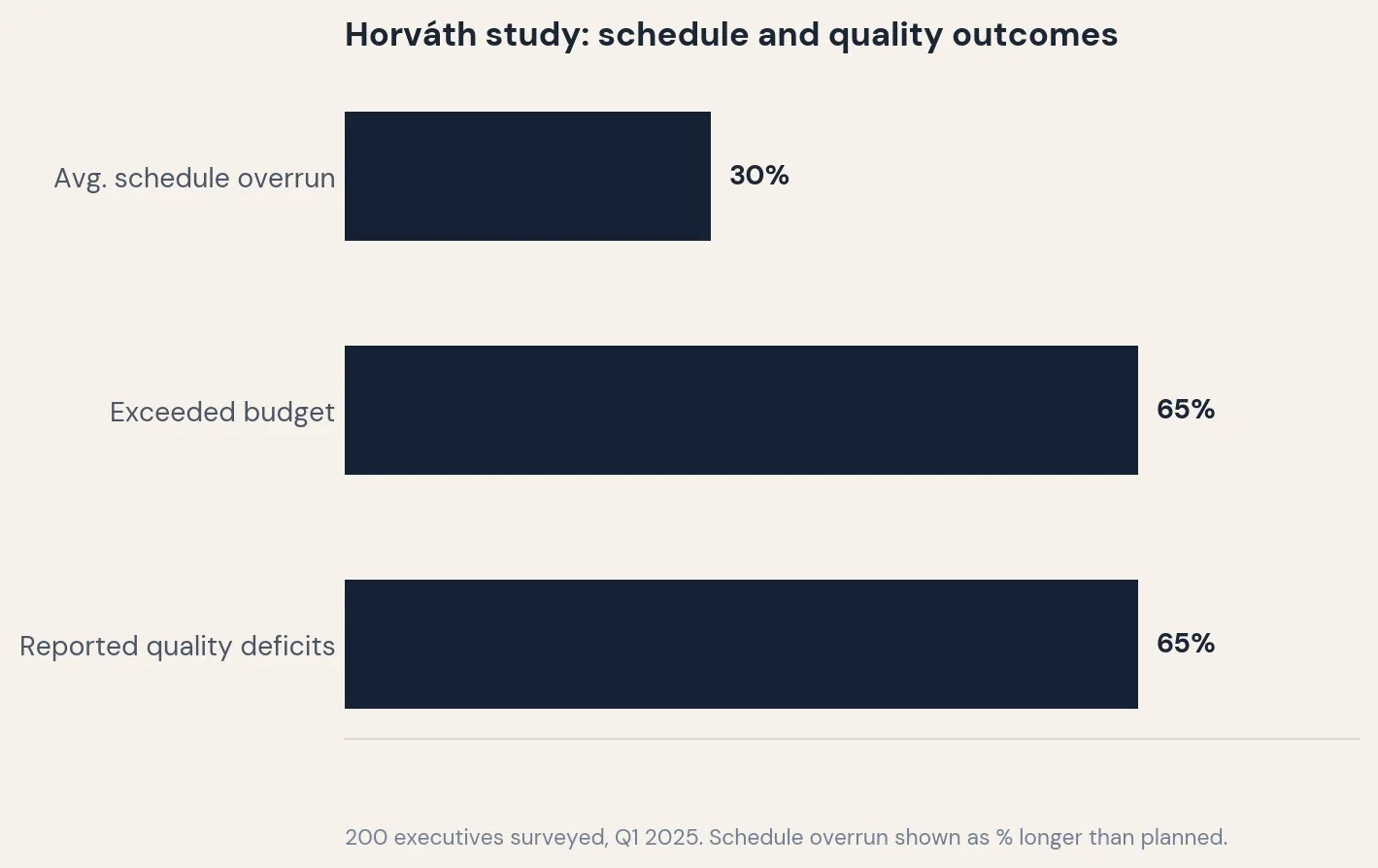
United States in the first quarter of 2025, found that transformations took, on average, 30%
longer than originally planned. Fewer than one in ten companies that had completed their transformation finished without exceeding the schedule at all.
The budget picture in that same study is just as stark. A quarter of the organizations surveyed
reported heavily exceeding their planned budget, and another 40% reported strongly
exceeding it — meaning a clear majority ran over on cost, not just on time. And even among companies that absorbed both the time and cost overruns, the outcome quality often still disappointed: 65% reported strong to very strong deficits in the final result relative to what they'd expected going in.
© Orpington Technologies Inc.
www.orpingtontech.com
Page
1
of
3
reported heavily exceeding their planned budget, and another 40% reported strongly
exceeding it — meaning a clear majority ran over on cost, not just on time. And even among companies that absorbed both the time and cost overruns, the outcome quality often still disappointed: 65% reported strong to very strong deficits in the final result relative to what they'd expected going in.
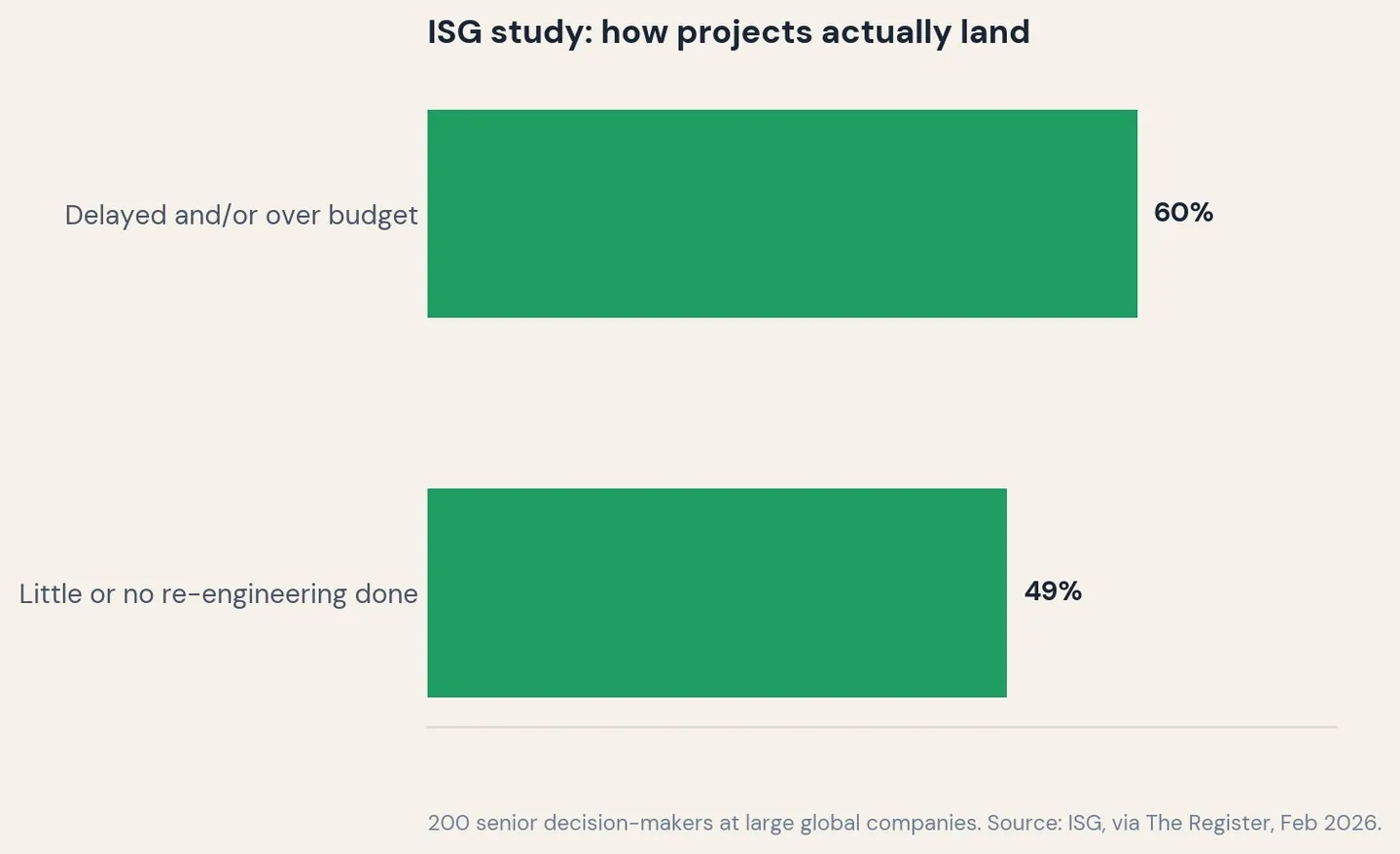
A separate piece of research, from the analyst firm ISG, surveyed 200 senior decision-makers at large global companies and published its findings in February 2026. It landed on a strikingly
similar headline: nearly 60% of SAP migration projects were delayed, over budget, or both. ISG's researchers also found that fewer than one in five organizations actually reimplemented their SAP processes and technology when they moved to S/4HANA — 49% carried out little or no re-
engineering at all, choosing instead to preserve legacy processes and data largely as-is.
That last finding matters more than it might first appear. ISG principal analyst Michael Dornan described a pattern where organizations try to do the fastest, cheapest possible lift-and-shift, then get blindsided by scope creep and changing requirements they hadn't planned for. More than half of ISG's respondents admitted they had over-customized their legacy ERP to a
degree that made standardizing now feel genuinely risky to the business — which is exactly the
kind of inertia that turns a planned six-month project into an eighteen-month one.
degree that made standardizing now feel genuinely risky to the business — which is exactly the
kind of inertia that turns a planned six-month project into an eighteen-month one.
Horváth's researchers trace the root cause back even further, to how these programs get set up in the first place. Three-quarters of the executives they surveyed said the selection and
© Orpington Technologies Inc.
www.orpingtontech.com
Page
2
of
3
Orpington Technologies | SAP S/4HANA Migration Insights
availability of project managers and staff didn't get the attention it deserved before the project
started. And 78% said too many objectives and topics were folded into the transformation
simultaneously — everything rated equally important, nothing sequenced, which is its own kind
of project-management failure mode.
started. And 78% said too many objectives and topics were folded into the transformation
simultaneously — everything rated equally important, nothing sequenced, which is its own kind
of project-management failure mode.
None of this is an argument for delay. If anything, it's the opposite: the deeper problem for
most of these projects wasn't S/4HANA itself, it was inadequate planning time before the
deadline pressure hit. An organization that starts its assessment and scoping now, well ahead
of 2027, has the luxury of building in realistic testing and data-migration timelines instead of compressing them under a shrinking calendar — which the same research identifies as one of the most common causes of both delay and cost overrun.
This is precisely the gap a delivery partner with real program-management discipline is meant
to close. Orpington Technologies Inc., the Saskatchewan-based advisory and delivery firm,
structures its S/4HANA engagements specifically around the failure patterns this research
keeps surfacing — realistic staffing plans, sequenced scope, and testing windows sized for the
work rather than for the calendar.
Six in ten projects going over budget or schedule is not a reason to avoid migrating. It's a
reason to migrate with eyes open, and with more lead time than the average project in these studies actually had.
What two independent studies found
Finding
Horváth (200 execs, Q1 2025)
ISG (200 execs, published Feb
2026)
Average schedule overrun
30% longer than planned
—
Finished on schedule
< 1 in 10 completed projects
—
Over budget or over schedule
~65% exceeded budget
~60% delayed and/or over
budget
Little or no re-engineering done
—
49% of organizations
Reported strong quality deficits
65%
—
Sources & Further Reading
[1]
Horváth – “Study shows: SAP S/4HANA transformations rarely go as planned,” April 10, 2025
[2]
The Register – “Most SAP migrations bust budgets and project timelines, research finds,”
February 5, 2026 (citing ISG)
© Orpington Technologies Inc.
www.orpingtontech.com
Page
3
of
3
reason to migrate with eyes open, and with more lead time than the average project in these studies actually had.