
SAP Joule and AI Agents, 7 Mistakes to Avoid Before You Buy
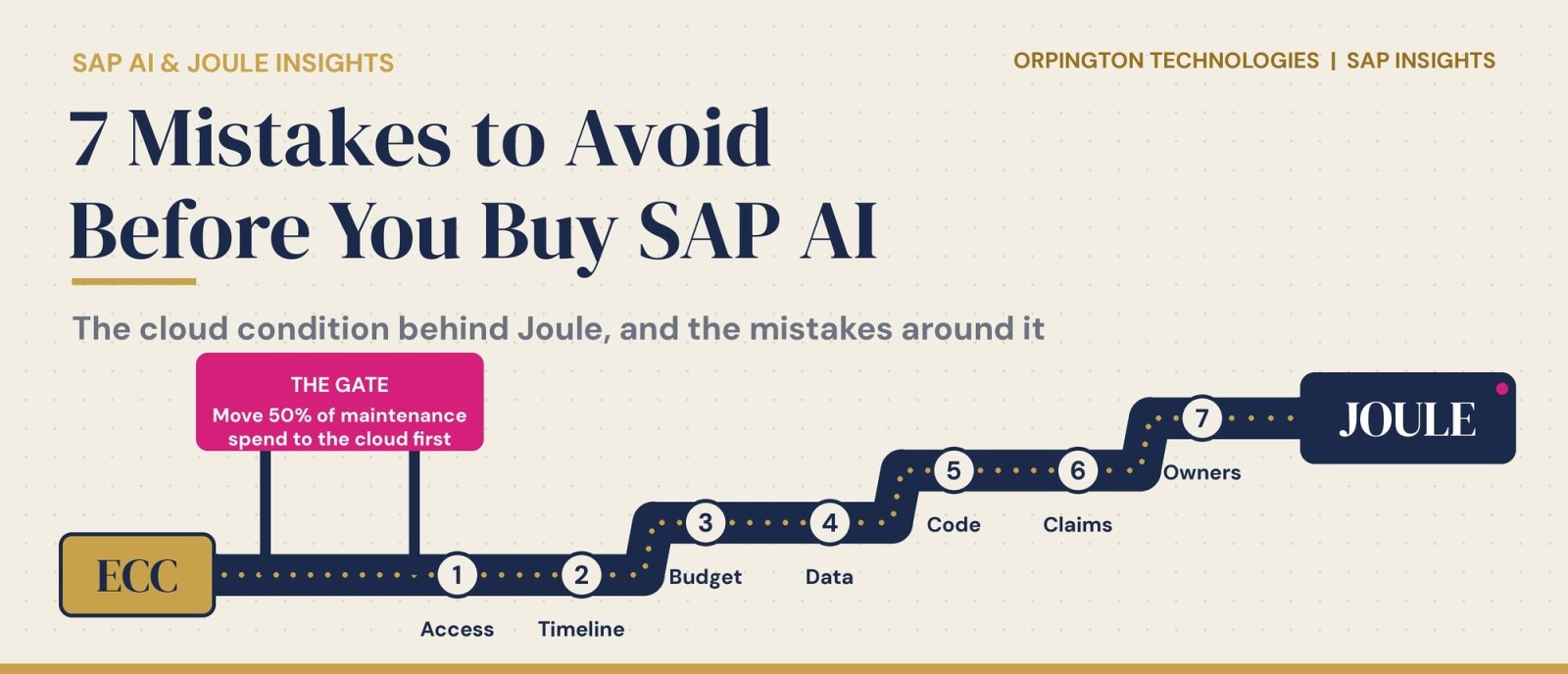
SAP Joule has grown from a 2023 generative AI copilot into a family of assistants, AI agents, a workspace (Joule Work) and an agent builder (Joule Studio), and it is designed for the cloud.
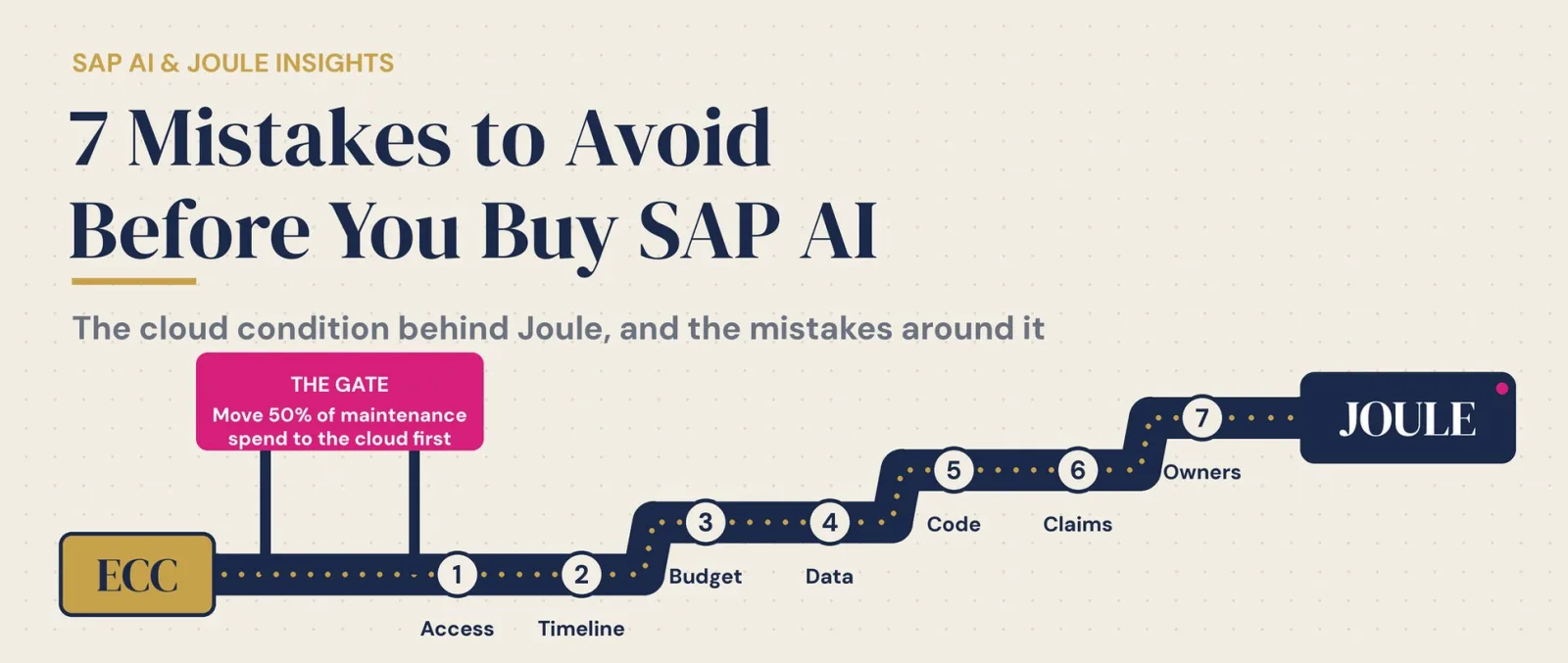
SAP Joule and AI Agents: 7 Mistakes to Avoid
Before You Buy
Before You Buy
SAP is selling Joule and its AI agents with a condition attached, and most of the
costly mistakes are visible before any money is spent. The organizations that avoid
them read the fine print, fix their data and staff for the work.
ORPINGTON TECHNOLOGIES
|
SAP INSIGHTS
In short:
SAP Joule, SAP’s generative AI assistant, has grown from a 2023 copilot into a family
of assistants, AI agents, a workspace and an agent builder
[1]
,
[2]
. It is designed for the cloud,
and ECC and other on-premise customers can enable its assistants only after moving at least
half of their maintenance spending to cloud services
[3]
. That condition is shaping decisions
now, and the mistakes that follow from it are avoidable.
The clock is shorter than it looks. The Joule Studio agent builder is free only until December
2026 and becomes a premium feature afterward
[4]
. Premium AI is paid for with AI Units,
prepaid credits that expire after 12 months if unused
[5]
. Gartner expects more than 40
percent of agentic AI projects to be canceled by the end of 2027, citing escalating costs,
unclear business value and inadequate risk controls
[6]
.
costly mistakes are visible before any money is spent. The organizations that avoid
them read the fine print, fix their data and staff for the work.
Customers are buying the vision regardless. In the quarter ended September 30, 2026, SAP’s cloud revenue rose 26 percent to €6.67 billion and its current cloud backlog reached €24.1
billion
[7]
, and about 45,000 cloud customers now use its AI solutions
[4]
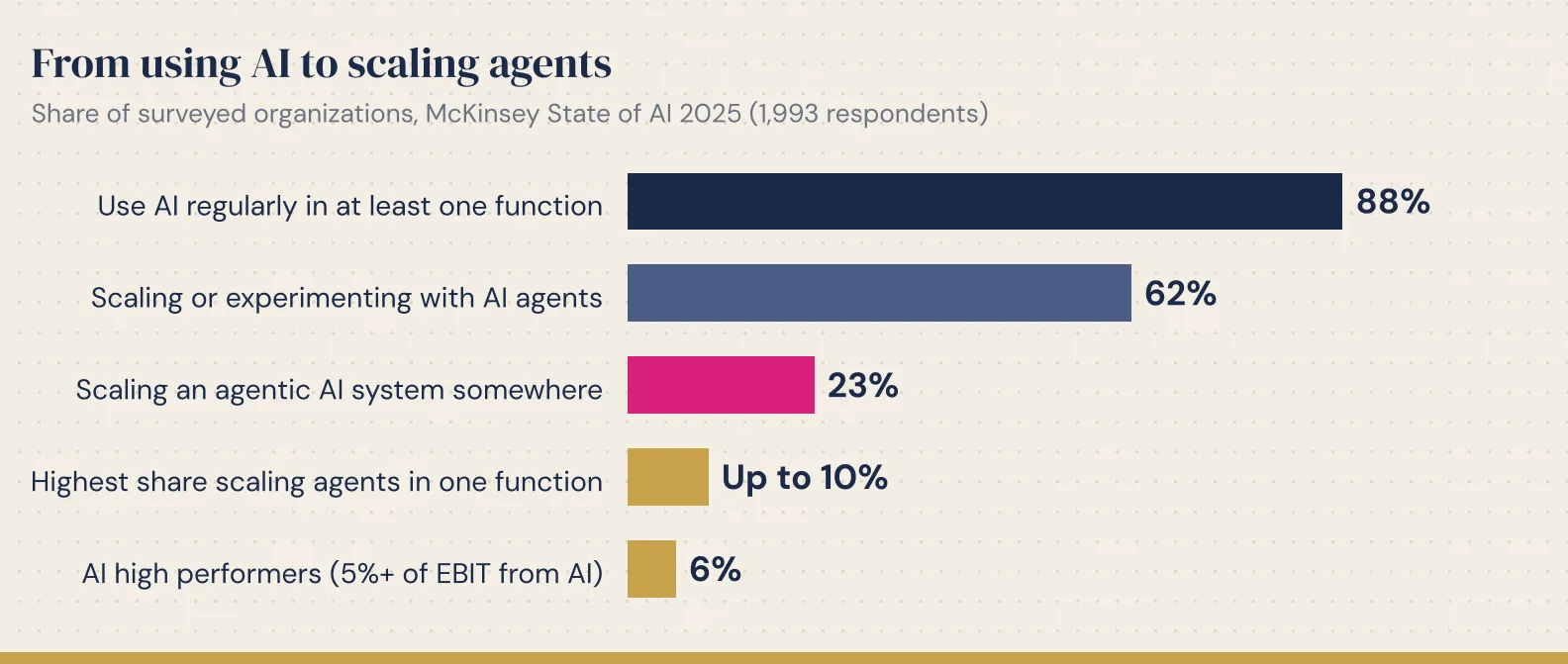
. Yet McKinsey found
88 percent of organizations using AI and only 23 percent scaling an agentic AI system
anywhere
[8]
(Figure 1). The mistakes that widen that gap fall into three groups: the deal, the
data and the people.
Key takeaways
The gate.
Joule is designed for the cloud. On-premise and ECC customers can enable
assistants only after moving at least 50 percent of their maintenance spending to the cloud.
The pattern.
Seven mistakes in three groups: the deal (what you are actually buying), the data
(what agents run on) and the people (who is accountable).
© Orpington Technologies Inc.
www.orpingtontech.com
Page
1
of
7
2027, and much of SAP’s roadmap, as announced at Sapphire 2026, is still planned rather than
shipped.
The fix.
A 90-day phase: map your entitlements, test your data, then pilot one measurable
process with a named owner for every agent.
The safeguard.
Have someone independent review the plan before money is committed.
Figure 1.
The distance between using AI and scaling AI agents. Source: McKinsey, The state of AI in 2025
[8]
. “Up
shipped.
to 10%” reflects McKinsey’s finding that in any single business function no more than 10 percent of organizations
report scaling agents.
1. What SAP Joule is, and what it now includes
SAP launched Joule in September 2023 as a generative AI copilot to be embedded
throughout its cloud applications, starting with SAP SuccessFactors and SAP Start
[1]
. Today
report scaling agents.
the name covers four layers, and the first question to ask of any AI proposal is which layer it
actually touches.
Joule Assistants.
Domain helpers for finance, spend, supply chain, HR and customer
experience that coordinate groups of agents. SAP’s financial closing assistant, for example,
uses seven agents
[4]
.
Joule Agents.
Specialized AI workers that perform defined steps of a process, such as
accounts receivable or tax compliance
[4]
.
Joule Work.
An intent-driven workspace that interprets what a person wants and
coordinates assistants and agents across SAP and non-SAP systems
[9]
.
Joule Studio.
The tool for designing, building and managing custom agents, with no-code and
pro-code options
[10]
.
actually touches.
At Sapphire in May 2026, SAP had said its Autonomous Suite would draw on more than 200
specialized agents to power more than 50 assistants, backed by a new SAP Business AI
Platform and a €100 million partner fund
[2]
.
2. Mistakes in the deal
Mistake 1: Treating Joule as a feature you can switch on
SAP’s position is that Joule is designed for the cloud. Joule base comes at no extra charge
with an active subscription to a supported SAP cloud solution
[5]
, customers on SAP’s Cloud
© Orpington Technologies Inc.
www.orpingtontech.com
Page
2
of
7
specialized agents to power more than 50 assistants, backed by a new SAP Business AI
How to avoid it: list the Joule entitlements each subscription already carries before the first AI
conversation with SAP, and get the answer in writing.
Mistake 2: Letting AI access set your modernization timeline
conversation with SAP, and get the answer in writing.
At Sapphire 2026, SAP offered on-premise and ECC customers a route to Joule assistants, on
one condition: they must first move at least 50 percent of their maintenance spending to the
cloud, which SAP confirmed
[3]
. Analysts see leverage in this. IDC’s Mickey North Rizza called
one condition: they must first move at least 50 percent of their maintenance spending to the
AI “the new carrot and stick,” and an ASUG 2026 survey found S/4HANA migration is members’ biggest challenge, citing budget constraints (61 percent) and integration struggles
(48 percent)
[3]
.
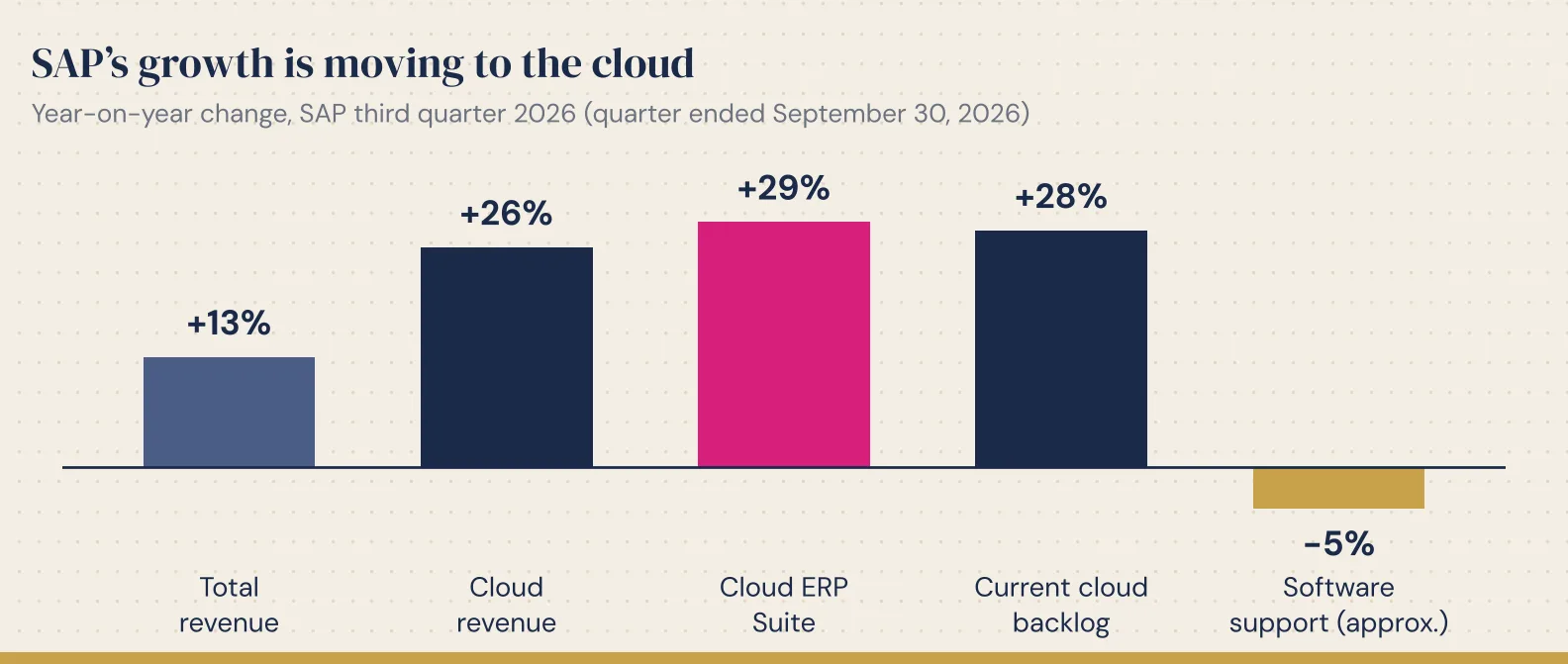
The money is already moving. In the third quarter of 2026, the Cloud ERP Suite grew 29
percent while software support revenue fell about 5 percent (Figure 2)
[7]
,
[12]
. How to avoid it:
treat AI access as one input to the timeline, not the whole reason for it, and build the cloud business case on its own numbers first.
Figure 2.
Year-on-year change in SAP’s third quarter of 2026. Revenue, Cloud ERP Suite and backlog figures
from SAP’s quarterly statement
[7]
; the software support decline is approximate and reported by Tech Times
[12]
. The statement notes that one-time catch-up effects helped cloud growth.
Mistake 3: Budgeting AI as a license instead of a variable cost
SAP prices AI in two tiers. Base AI, including Joule base, is included in standard cloud subscriptions. Premium AI runs on AI Units, prepaid credits that expire after 12 months if unused, priced per user per month or by consumption. Joule Premium packages use volume tiers from 8 down to 1 AI Unit per user per month, and Document Grounding consumes 0.005
AI Units per record
[5]
. The Joule Studio agent builder is free until December 2026 and
becomes a premium feature afterward
[4]
. A pilot that looks free in November can carry a
price in January. How to avoid it: forecast AI Units for each process before pilots scale, and decide who owns that budget line.
© Orpington Technologies Inc.
www.orpingtontech.com
Page
3
of
7
Orpington Technologies | SAP AI & Joule Insights
3. Mistakes in the data and the build
Mistake 4: Feeding agents data nobody owns
Agents are only as good as the context they are given. SAP’s answer is the SAP Business AI Platform, which combines the AI foundation, SAP Business Data Cloud and SAP Business Technology Platform around a context layer built on the SAP Knowledge Graph. Joule supports the Model Context Protocol and Agent-to-Agent protocols so agents can work with
non-SAP systems
[11]
.
None of that repairs the records underneath. Duplicate customer and vendor records,
undocumented custom code and unowned processes confuse an agent exactly as they confuse a new hire. How to avoid it: test the data behind each candidate process for duplicates and unclear ownership before choosing the pilot.
Mistake 5: Generating extensions faster than you can govern them
undocumented custom code and unowned processes confuse an agent exactly as they confuse a new hire. How to avoid it: test the data behind each candidate process for duplicates and unclear ownership before choosing the pilot.
Joule Studio lets users describe a goal in natural language and generates requirements,
specifications, code scaffolding and tests. Sony reports that it produced an end-to-end
solution in 10 to 15 minutes in place of three to four days of manual work
[10]
. The tooling also
specifications, code scaffolding and tests. Sony reports that it produced an end-to-end
targets the people who deliver SAP projects: Joule for Consultants cites up to 19 percent higher productivity and a 50 percent cut in design iterations and rework, and Wipro reports a
40 percent reduction in development effort
[4]
. These are vendor-reported estimates and
early claims.
When code can be generated this quickly, clean-core discipline matters more, not less.
Without it, AI-built extensions simply create technical debt faster. How to avoid it: set extension rules before the first generated line reaches production, and review what the agent built, not just whether it runs.
Mistake 6: Buying announcements instead of outcomes
Without it, AI-built extensions simply create technical debt faster. How to avoid it: set extension rules before the first generated line reaches production, and review what the agent built, not just whether it runs.
Announcements are not deployments. Timing is as stated by SAP at Sapphire in May 2026 and in its October 2026 release notes. It may have moved since, so confirm current status before planning around any date.
Table 1. Selected Joule and Business AI capabilities, by SAP’s stated timing
Capability
What it does
SAP’s stated timing
Joule Studio
Builds agents and skills, no-code
and pro-code
Announced May 2026; free design-time
access through 2026
[10]
Joule Work (mobile)
Intent-driven workspace across
SAP and non-SAP systems
Generally available
[9]
Joule Work
(desktop)
Same workspace on desktop
General availability planned for the
second half of 2026
[9]
(desktop)
Agent-to-agent
(A2A)
Lets agents work across systems
General availability planned for Q4 2026
[9]
Autonomous HCM
Assistants for payroll, hiring and
HR workflows
Planned for November 2026
[2]
AI Agent Hub
Governance for SAP and non-SAP
agents
Registry available; observability and
identity planned for Q3 2026
[9]
Mistral models
Run on the SAP Business AI
Platform
Available; fully sovereign version planned
for early 2027
[4]
© Orpington Technologies Inc.
www.orpingtontech.com
Page
4
of
7
(A2A)
Orpington Technologies | SAP AI & Joule Insights
Vendor claims need the same scrutiny. Of the thousands of agentic AI vendors, Gartner
estimates only about 130 are real, the rest being “agent washing”
[6]
. McKinsey found that only
39 percent of respondents attribute any enterprise-level EBIT impact to AI
[8]
. SAP describes
its Autonomous Close Assistant as designed to compress the financial close from weeks to
days, which is a goal rather than a measured result
[2]
. How to avoid it: buy outcomes, not
announcements, and ask every vendor which parts are generally available today.
4. Mistakes in the people
Mistake 7: Deploying agents without owners or skills
As agents take on process steps, governance becomes a design task. SAP lists assistants for
financial closing, accounts receivable, accounts payable, billing, treasury, tax compliance and
international trade, each backed by several agents
[4]
, and says the suite is built under an
ISO-certified process designed for SOX audit compatibility
[11]
. SAP’s AI Agent Hub, housed in
SAP LeanIX, extends governance to SAP and non-SAP agents
[11]
. Every agent is still a new
control owner: someone must be named accountable for what it does.
financial closing, accounts receivable, accounts payable, billing, treasury, tax compliance and
The scarce resource is people who understand both the process and the platform. McKinsey
found only about 6 percent of organizations qualify as AI high performers, and most have not
embedded AI deeply enough in their workflows and processes
[8]
. How to avoid it: name an
found only about 6 percent of organizations qualify as AI high performers, and most have not
accountable owner for every agent, map the skills each phase needs, hire for the permanent
core and augment the rest.
Table 2. The seven SAP AI mistakes at a glance
Mistake
Early warning sign
How to avoid it
1. Feature switch
No list of Joule entitlements by
contract
Map entitlements in writing first
2. AI-driven timeline
Cloud move justified by AI access
alone
Build the case on its own numbers
3. License thinking
No AI Unit forecast per process
Forecast and assign the budget line
4. Unowned data
Duplicates and no data owners
Test data before choosing the pilot
core and augment the rest.
5. Ungoverned
extensions
No rules for generated code
Set clean-core rules; review output
extensions
6. Buying
announcements
announcements
Features not yet generally
available
Buy outcomes; confirm availability
available
7. No owners or
skills
skills
Agents with no accountable
owner
Name owners; map skills by phase
5. Your first 90 days with SAP AI
Days 1 to 30: map the starting point
Confirm which SAP edition and cloud subscriptions you hold and which Joule entitlements
already come with them
[5]
. List three candidate processes, such as financial close, accounts
owner
payable or procurement, and test their data for duplicates, undocumented custom code and unclear ownership. Decide whether your current ERP landscape belongs in the move to the
cloud, and on what business case. Orpington Technologies’ free
Implementation
Confidence Diagnostic
offers a 15-minute first look at implementation risk
[13]
.
© Orpington Technologies Inc.
www.orpingtontech.com
Page
5
of
7
Orpington Technologies | SAP AI & Joule Insights
Days 31 to 60: pilot one process
Choose one process with a measurable result, name an accountable owner for every agent, and define guardrails and escalation rules before go-live. Budget AI Units and design-time
costs up front, since pricing moves from free to premium for some tools after 2026
[4]
.
Days 61 to 90: decide with evidence
Stop pilots that cannot show value, because cost, unclear value and weak risk controls are the
reasons Gartner expects projects to be canceled
[6]
. Plan the skills for the next phase and
align the AI roadmap with the cloud timeline. Have someone with no stake in the outcome
review the plan before more money is committed.
6. How Orpington Technologies supports your SAP AI decisions
An independent first look.
The free Implementation Confidence Diagnostic takes about 15
minutes with no sign-up and returns a confidence score with the top three risk flags
[13]
.
Evidence, not opinion.
The Full ERP Diagnostic Report checks every self-reported answer
against real evidence, and a certified platform expert reviews the result
[14]
.
A cost you know in advance.
Pricing is a fixed fee per stage, with no day rates or retainers, so
the cost of each decision is known before it is made
[14]
.
Delivery or oversight.
The Full ERP Implementation Partnership provides independent
oversight from platform selection through hypercare, and Orpington can lead the migration as
the accountable delivery partner
[14]
.
Skills on demand.
Three matched, credentialed candidates join through
ERP staff
augmentation
roughly four weeks after the engagement fee is confirmed, working remotely
under the client’s project lead, backed by a 90-day replacement guarantee and a single
monthly invoice
[15]
.
review the plan before more money is committed.
Before the next AI conversation with SAP, ask one question: if we said yes today, could we
name the owner, the data and the budget for the first agent? If the answer is “not yet,” the free
15-minute Implementation Confidence Diagnostic will show which of the seven mistakes you
are closest to
[13]
.
7. Frequently asked questions about SAP Joule and AI
What is SAP Joule?
SAP Joule is SAP’s generative AI assistant, launched in 2023 and now a family of assistants,
agents, a workspace (Joule Work) and an agent builder (Joule Studio)
[1]
,
[9]
.
Is SAP Joule free?
Joule base is included at no extra charge in standard SAP cloud subscriptions. Premium
capabilities use AI Units, priced per user per month or by consumption
[5]
.
Do I need to move to the cloud to use SAP Joule?
name the owner, the data and the budget for the first agent? If the answer is “not yet,” the free
15-minute Implementation Confidence Diagnostic will show which of the seven mistakes you
Joule is designed for the cloud. SAP said at Sapphire 2026 it would enable many assistants and agents to work with on-premise S/4HANA and ECC for customers committed to
transformation
[11]
, and it confirmed they must first move at least 50 percent of maintenance
spending to the cloud
[3]
.
© Orpington Technologies Inc.
www.orpingtontech.com
Page
6
of
7
Orpington Technologies | SAP AI & Joule Insights
What are Joule agents?
Joule agents are specialized AI workers that perform steps of a business process. SAP says
more than 200 of them sit behind more than 50 Joule assistants in its Autonomous Suite
[2]
.
What is the SAP Business AI Platform?
It combines SAP’s AI foundation, SAP Business Data Cloud and SAP Business Technology
Platform around the SAP Knowledge Graph, to build, deploy and govern agents
[2]
,
[11]
.
Will AI replace SAP consultants?
SAP’s own figures point to augmentation: Joule for Consultants cites up to 19 percent higher
productivity
[4]
, and Gartner expects 15 percent of day-to-day work decisions, not all of
them, to be autonomous by 2028
[6]
. Orpington Technologies’ view is that value shifts toward
practitioners who can judge what an agent proposes.
Is agentic AI ready for SAP production use?
Partly. Some assistants are generally available, others are planned, and McKinsey found only
23 percent of organizations scaling agents anywhere
[8]
. Start with one measurable process.
Sources & Further Reading
[1] Constellation Research – “SAP launches Joule generative AI copilot, goes to 2-year S/4HANA Cloud
major release,” September 2023
[2] Reworked – “SAP Unveils Autonomous Enterprise & Joule AI Assistants for HR at Sapphire 2026,” May
2026
[3] CIO – “SAP’s AI offer to legacy customers comes with a catch,” Stephanie Overby, May 2026
[4] SAP News Center – “AI Release Highlights Q3 2026,” October 2026
[5] SAP – “SAP Business AI packages and pricing”
[6] Gartner, via SD Times – “Gartner: More than 40% of agentic AI projects will be canceled in next few
years,” June 2025
[7] SAP – “Quarterly Statement Q3 2026,” October 21, 2026
[8] McKinsey – “The state of AI in 2025: Agents, innovation, and transformation,” November 2025
[9] SAP – “SAP Sapphire Innovation News Guide 2026”
[10] SAP News Center – “Announcing New Joule Studio for Enterprise Scale Agentic Development,” May
2026
[11] SAPinsider – “SAP Sapphire 2026: The Autonomous Enterprise and AI Agent Guardrails”
[12] Tech Times – “SAP Crosses €10 Billion Quarterly Revenue as Joule AI Agents Drive Cloud Backlog to
Record,” October 2026
[13] Orpington Technologies – Implementation Confidence Diagnostic
[14] Orpington Technologies – Services overview
[15] Orpington Technologies – “ERP Staff Augmentation”
© Orpington Technologies Inc.
www.orpingtontech.com
Page
7
of
7