
Agentic AI Arrives in ERP: What Oracle Fusion's AI Agents Mean
"Agentic AI" has become one of those phrases that shows up in nearly every enterprise software keynote, often without much precision about what it actually means in practice.
 ORACLE FUSION CLOUD ERP FOR GROWING BUSINESSES
Agentic AI Arrives in ERP: What Oracle Fusion's AI Agents Mean for SMBs
Separating what's actually shipping from what's still a slide in a keynote
"Agentic AI" has become one of those phrases that shows up in nearly every enterprise software keynote, often without much precision about what it actually means in practice. Stripped of the marketing language, the idea is fairly specific: instead of AI that answers a question or drafts a suggestion for a human to review, an "agent" is software that can carry out a multi-step task on its own — checking a condition, taking an action, checking the result, and adjusting — within boundaries a person has set up in advance. It's the difference between a tool that tells you a customer's invoice is overdue and one that actually attempts to collect it, following whatever process and escalation rules you've defined, and only flags a human when something falls outside those rules.
Oracle has been moving fast here, and it's worth understanding what's actually shipped rather than assuming it's all still roadmap.
What Oracle has actually released
In March 2026, Oracle introduced Fusion Agentic Applications — 22 new applications built specifically around this "coordinated teams of specialized AI agents" model, running on Oracle Cloud Infrastructure and built through Oracle's AI Agent Studio. Named examples include a Workforce Operations agentic application, a Design-to-Source Workspace tool aimed at procurement, a
© Orpington Technologies Inc.
www.orpingtontech.com
Page No. 1 of 4
Cross-Sell Program Workspace for sales, and a Collectors Workspace for accounts receivable. The framing Oracle uses is "outcome-driven" and "reasoning-based" applications that operate with governance controls built in, rather than a single chatbot bolted onto the existing interface.
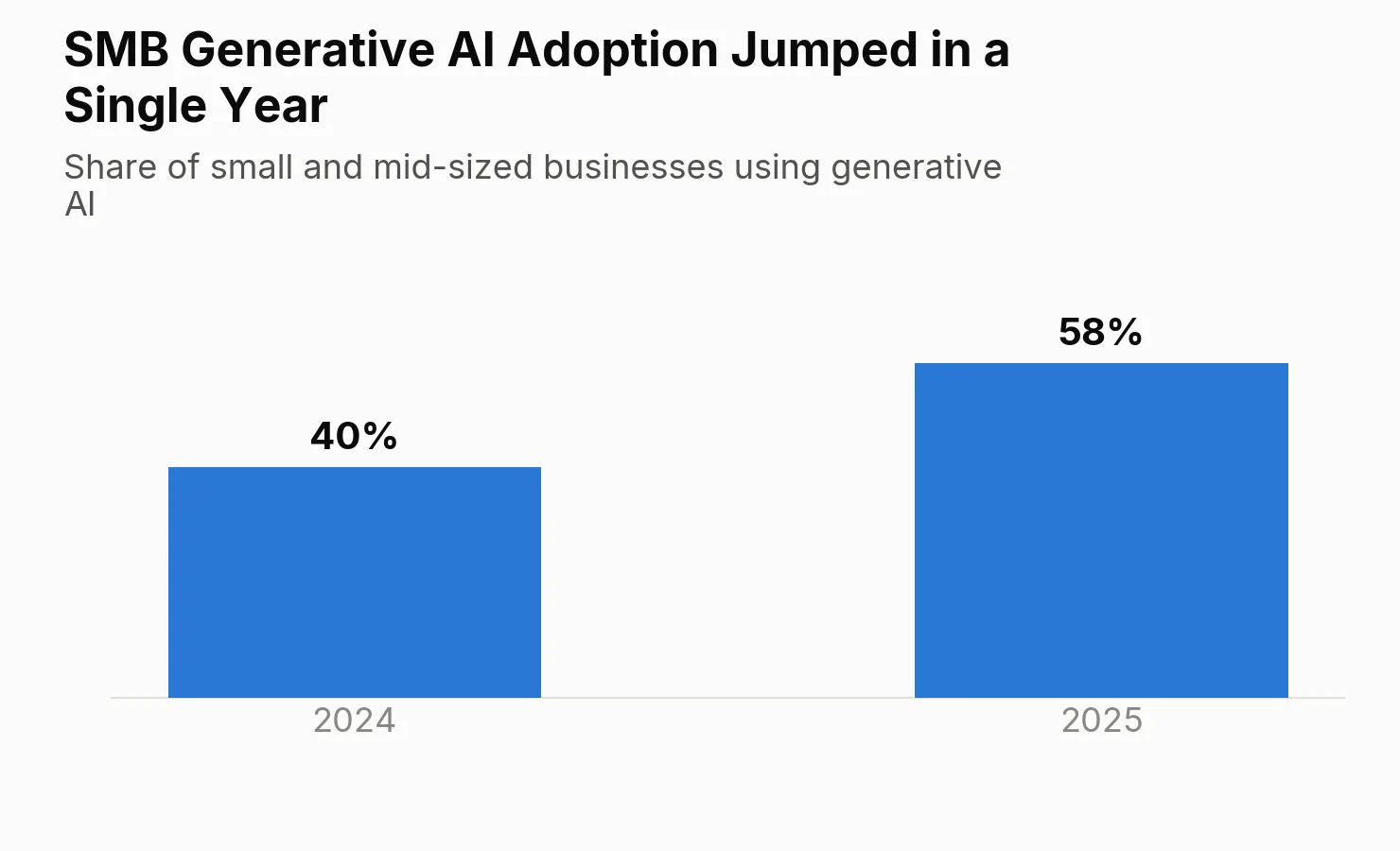
SMB adoption of generative AI accelerated sharply in a single year, setting the stage for agentic capabilities to follow the same
curve. Source: KreativeCoreTech, 2026.
That last point — governance — is the detail worth paying closest attention to if you're evaluating this for a small or mid-sized business rather than a Fortune 500 IT department. An accounts receivable agent that can autonomously decide which overdue accounts to contact and how is genuinely useful, but only if it operates within clearly defined rules about tone, escalation thresholds, and when a human needs to step in — a large customer with a payment dispute is not the same situation as a small one who simply forgot an invoice, and the agent needs to be configured to know the difference.
Why this is landing now, and why SMBs specifically matter to the story
Generative AI adoption among small and mid-sized businesses nearly doubled in scope over a single year, from roughly 40% in 2024 to 58% in 2025 — a faster curve of adoption than most people assume happens outside large enterprises with dedicated AI teams. That context matters, because it means SMBs aren't a market Oracle is targeting as an afterthought with agentic capability; they're already comfortable enough with AI tools broadly that agentic features built into a platform they already use represent a much smaller leap than building or buying a separate AI tool from scratch.
© Orpington Technologies Inc.
www.orpingtontech.com
Page No. 2 of 4
 65%
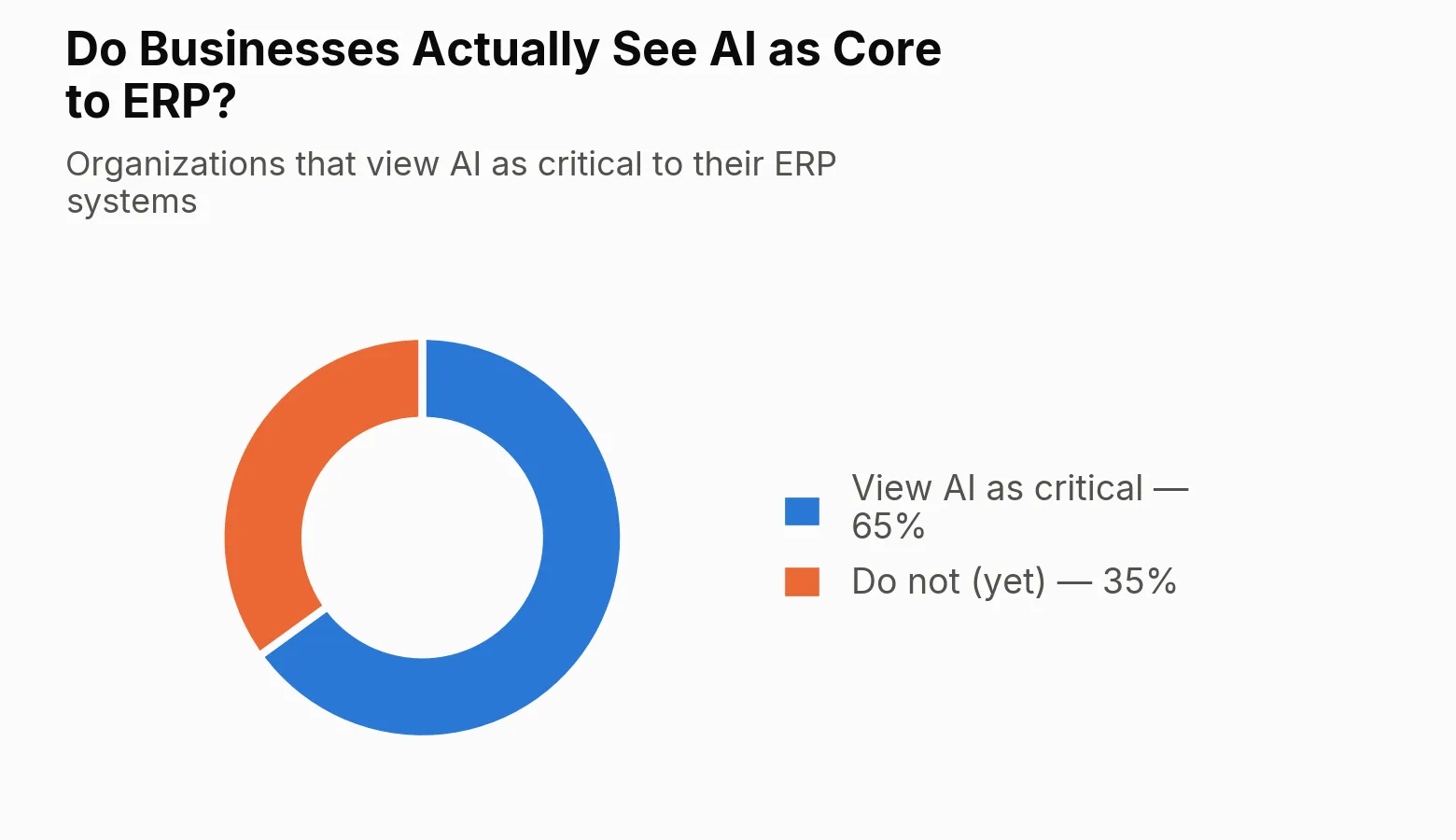
65%
of organizations now consider AI critical to their ERP systems — up sharply from a few years ago, when AI features were viewed mainly as a nice-to-have add-on.
Source: KreativeCoreTech, 2026
The efficiency numbers around AI-embedded ERP more broadly give a sense of the ceiling here: organizations using AI-embedded solutions report roughly 25% faster delivery times and about 15% lower operational costs, alongside the 20% forecasting accuracy improvement and 35% faster decision-making covered in the previous article. Agentic AI specifically is positioned to push those numbers further, by not just informing a decision faster but actually executing the routine parts of it.
A clear majority of organizations now see AI as a core, not peripheral, part of their ERP strategy. Source: KreativeCoreTech,
2026.
Where a healthy dose of skepticism is warranted
It would be irresponsible to write about agentic AI in ERP without being honest about the maturity curve it's on. As of this writing, Oracle's own announcements describe the agentic applications' capabilities in fairly general terms — "outcome-driven," "reasoning-based," operating "at enterprise scale" — without yet publishing the kind of hard, third-party-verified performance benchmarks that would let a CFO model a confident ROI case the way they could for, say, close-time automation, which has years of documented results behind it. That's not a criticism specific to Oracle; it's the honest state of agentic AI across the entire enterprise software industry right now. Early adopters are, by definition, operating ahead of the point where the technology has been fully proven out at scale.
© Orpington Technologies Inc.
www.orpingtontech.com
Page No. 3 of 4
For a small or mid-sized business, the practical implication is straightforward: agentic AI features are worth evaluating and piloting, especially in lower-risk areas like collections follow-up or routine procurement workflows, but they're not yet a reason on their own to justify an ERP decision, and they're certainly not something to deploy without careful configuration of the guardrails around what the agent is and isn't allowed to do autonomously. The companies getting genuine value from early agentic deployments tend to be the ones treating it as a carefully scoped pilot with clear success metrics, not a wholesale handoff of a business process to software.
What this means practically
If you're already running or evaluating Oracle Fusion Cloud ERP, the agentic applications are worth a serious look for specific, bounded, repetitive workflows — the kind of task that's high-volume, rules-based, and currently consuming real human time without requiring much judgment. They're a poor fit, at least for now, for anything involving nuanced customer relationships, ambiguous exceptions, or decisions with real financial or legal consequence if the agent gets it wrong.
Next up
AI agents that can take autonomous action on financial and operational data raise an obvious follow-up question: how well-protected is that data in the first place? That's exactly where this series turns next — security and compliance, and what small and mid-sized companies specifically need to get right before trusting any cloud system, agentic features or not, with their most sensitive information.
Sources
1. 58 Must-Know ERP Statistics for 2026, KreativeCoreTech —
https://kreativecoretech.com/erp-statistics/
2. Oracle Introduces Fusion Agentic Applications, Oracle Newsroom —
https://www.oracle.com/news/announcement/oracle-introduces-fusion-agentic-applications-2026-03-24/
© Orpington Technologies Inc.
www.orpingtontech.com
Page No. 4 of 4