
From Data to Decisions: Real-Time Analytics and Reporting in Oracle Fusion Cloud
There's a specific kind of meeting that happens at a lot of growing companies, and it's more revealing than anyone likes to admit. Someone asks a question — what's our gross margin by product line this quarter, say — and three people pull up three different numbers, from three different reports, none of which quite agree.
 ORACLE FUSION CLOUD ERP FOR GROWING BUSINESSES
From Data to Decisions: Real-Time
Analytics and Reporting in Oracle
Fusion Cloud
Most companies aren't short on data. They're short on trustworthy answers.
Analytics and Reporting in Oracle
Fusion Cloud
There's a specific kind of meeting that happens at a lot of growing companies, and it's more
revealing than anyone likes to admit. Someone asks a question — what's our gross margin by
product line this quarter, say — and three people pull up three different numbers, from three different
reports, none of which quite agree. Nobody's lying. Each number is "correct" according to whatever
system and whatever export produced it. The problem isn't honesty. It's that the business doesn't
have one version of the truth, so it has several, and meetings spend their first ten minutes reconciling
reports instead of making decisions.
This is the quiet cost of fragmented systems, and it's a big part of why analytics and reporting show
up as one of the more consistently cited reasons companies move to a unified ERP platform like
Oracle Fusion Cloud.
The data isn't the problem. The pipes are.
up as one of the more consistently cited reasons companies move to a unified ERP platform like
Oracle Fusion Cloud.
Most companies of any real size aren't short on data — they're often drowning in it. The average
enterprise runs on the order of 897 separate applications, and only about 28% of them are integrated
with each other in any meaningful way. That fragmentation means most of the "data prep" work
analysts do isn't analysis at all — industry research suggests data scientists and analysts spend as
© Orpington Technologies Inc. www.orpingtontech.com
Page No. 1 of 4
enterprise runs on the order of 897 separate applications, and only about 28% of them are integrated
with each other in any meaningful way. That fragmentation means most of the "data prep" work
analysts do isn't analysis at all — industry research suggests data scientists and analysts spend as
much as 80% of their time simply preparing and reconciling data before they can do anything useful
with it, leaving a fraction of their actual working hours for the interpretation that's supposed to be the
point.
80%
with it, leaving a fraction of their actual working hours for the interpretation that's supposed to be the
point.
of a typical data analyst's time goes toward preparing and reconciling data before any actual
analysis happens — a direct consequence of running fragmented, poorly integrated systems.
Source: DreamFactory, 2026
analysis happens — a direct consequence of running fragmented, poorly integrated systems.
An ERP system doesn't eliminate the need for good data discipline, but it removes a large share of
the reconciliation burden by design, because financials, operations, procurement, and (where
applicable) HR data all originate from the same underlying system rather than getting stitched
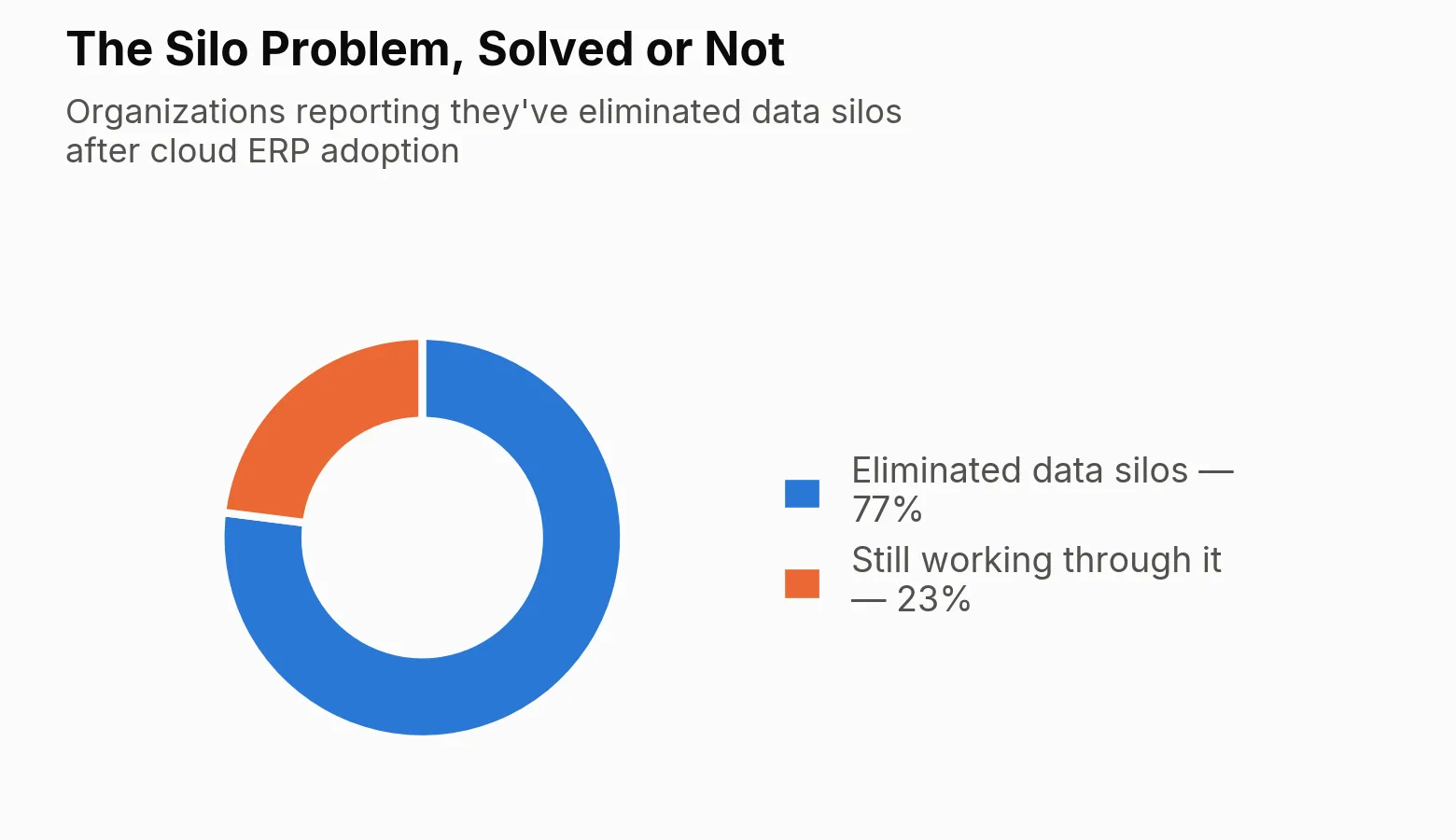
together after the fact. Companies that make this shift report meaningful results: 77% say they've
eliminated the kind of data silos that used to make a simple question take a week to answer, and
78% report genuinely improved productivity as a result — not just faster reporting, but fewer hours
lost to reconciling conflicting numbers in the first place.
A large majority of organizations report eliminating data silos after adopting integrated cloud ERP. Source: Anchor Group
Technology, 2026.
What real-time actually changes about decision-making
the reconciliation burden by design, because financials, operations, procurement, and (where
applicable) HR data all originate from the same underlying system rather than getting stitched
together after the fact. Companies that make this shift report meaningful results: 77% say they've
eliminated the kind of data silos that used to make a simple question take a week to answer, and
78% report genuinely improved productivity as a result — not just faster reporting, but fewer hours
lost to reconciling conflicting numbers in the first place.
The phrase "real-time reporting" gets used loosely enough that it's worth being precise about what it
means in practice inside Fusion Cloud. Dashboards and reports pull from live transactional data
rather than a batch export that ran overnight, which means a sales leader looking at a pipeline report
© Orpington Technologies Inc. www.orpingtontech.com
Page No. 2 of 4
means in practice inside Fusion Cloud. Dashboards and reports pull from live transactional data
rather than a batch export that ran overnight, which means a sales leader looking at a pipeline report
during a Tuesday morning meeting is looking at Tuesday morning's actual numbers, not Monday
night's snapshot. For a fast-moving business, that gap — even just twelve or twenty-four hours — is
often the difference between catching a problem while there's time to act and discovering it after the
window has closed.
night's snapshot. For a fast-moving business, that gap — even just twelve or twenty-four hours — is
often the difference between catching a problem while there's time to act and discovering it after the
window has closed.
Embedded AI and machine learning layered on top of that real-time data are where some of the more
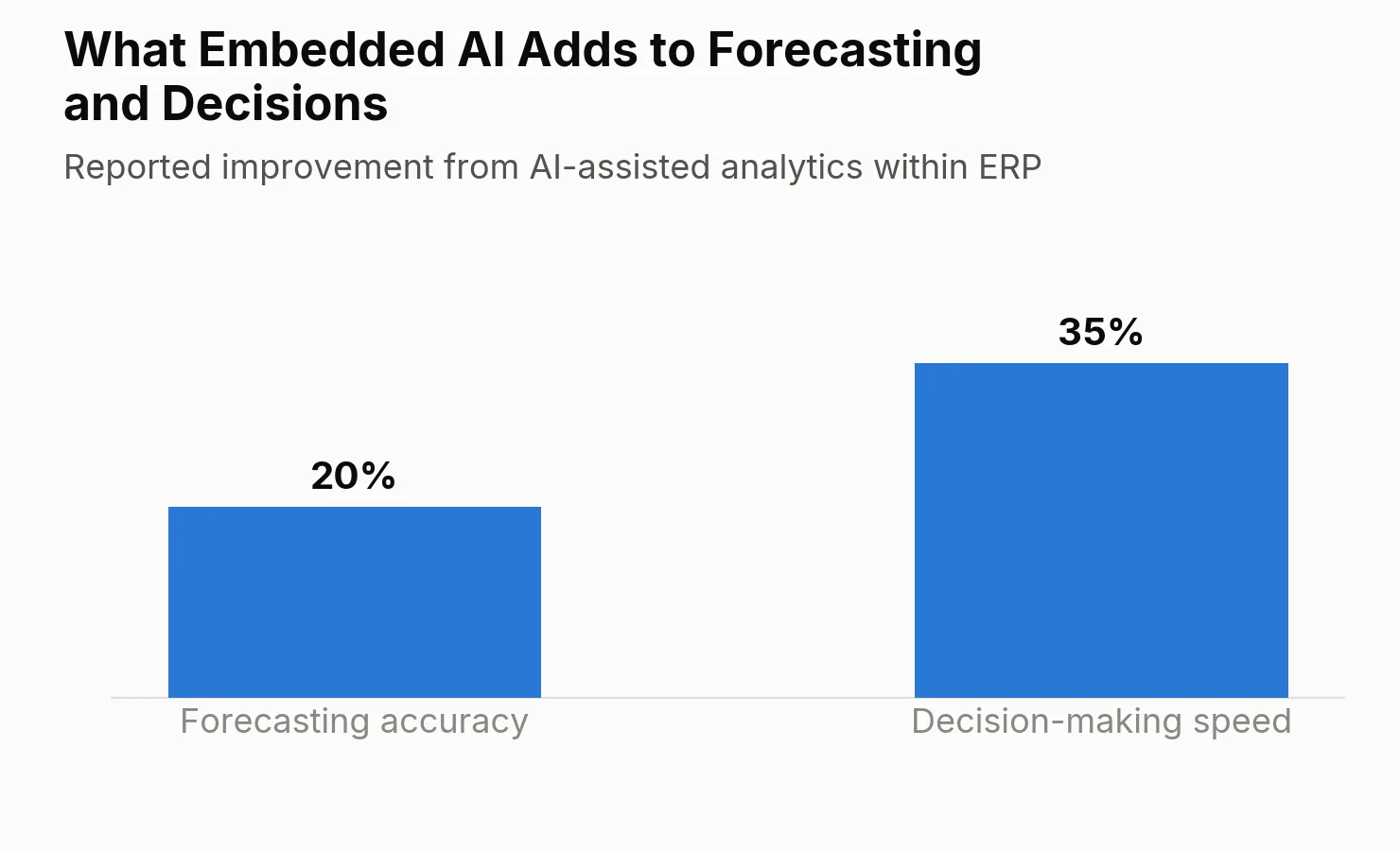
interesting gains show up. Organizations using AI-assisted forecasting within their ERP report an
average 20% improvement in forecasting accuracy, and a 35% improvement in the speed of
decision-making generally — a meaningful gain when the alternative is waiting for someone to
manually build a forecast model in a spreadsheet, using data that was already a few days old by the
time it got pulled.
AI-assisted analytics improves both the accuracy of forecasts and the speed at which decisions get made. Source: Anchor
Group Technology, 2026.
Self-service reporting, and its real limits
interesting gains show up. Organizations using AI-assisted forecasting within their ERP report an
average 20% improvement in forecasting accuracy, and a 35% improvement in the speed of
decision-making generally — a meaningful gain when the alternative is waiting for someone to
manually build a forecast model in a spreadsheet, using data that was already a few days old by the
time it got pulled.
One of the more genuinely useful shifts in modern ERP analytics is the move toward self-service
reporting — giving a department head or a finance analyst the ability to build their own dashboard or
report without filing an IT ticket and waiting two weeks. Done well, this meaningfully reduces the
bottleneck that used to sit between "I have a business question" and "I have an answer."
reporting — giving a department head or a finance analyst the ability to build their own dashboard or
report without filing an IT ticket and waiting two weeks. Done well, this meaningfully reduces the
bottleneck that used to sit between "I have a business question" and "I have an answer."
It's worth being realistic about where self-service reporting still needs guardrails, though. Without
some governance over what data definitions mean — what counts as a "customer," how "revenue" is
calculated for a partially shipped order — self-service tools can just as easily recreate the original
problem, producing multiple technically-correct-but-inconsistent answers to the same question, just
faster than before. The companies that get the most value from self-service analytics tend to be the
ones that invest upfront in a shared, agreed-upon set of metric definitions, rather than assuming
© Orpington Technologies Inc. www.orpingtontech.com
Page No. 3 of 4
some governance over what data definitions mean — what counts as a "customer," how "revenue" is
calculated for a partially shipped order — self-service tools can just as easily recreate the original
problem, producing multiple technically-correct-but-inconsistent answers to the same question, just
faster than before. The companies that get the most value from self-service analytics tend to be the
ones that invest upfront in a shared, agreed-upon set of metric definitions, rather than assuming
better tools alone will produce better alignment.
The adoption curve is real
It's also fair to note that better reporting tools don't automatically translate into better decisions. A
dashboard is only useful if the people who need it actually look at it, trust it, and know how to
interpret it — which means analytics rollouts benefit from the same attention to training and change
management that any other part of an ERP implementation needs. A beautifully built executive
dashboard that three people know how to use isn't a transformation; it's a expensive PDF generator.
Where the series goes from here
dashboard is only useful if the people who need it actually look at it, trust it, and know how to
interpret it — which means analytics rollouts benefit from the same attention to training and change
management that any other part of an ERP implementation needs. A beautifully built executive
dashboard that three people know how to use isn't a transformation; it's a expensive PDF generator.
Real-time data and embedded AI in reporting are really a preview of a bigger shift already underway
across the Oracle Fusion Cloud platform: the move from "AI that helps you analyze" to "AI that takes
action on your behalf." That's the subject of the next article — the emergence of agentic AI inside
ERP, what Oracle has actually shipped so far, and what it realistically means for a small or mid-sized
business trying to separate genuine capability from hype.
Sources
1. Cloud ERP Statistics for 2026 & Beyond, Anchor Group Technology —
https://www.anchorgroup.tech/blog/cloud-based-erp-statistics
2. 37 Enterprise Data Integration Statistics (2026), DreamFactory —
https://www.dreamfactory.com/hub/enterprise-data-integration-statistics/
© Orpington Technologies Inc. www.orpingtontech.com
Page No. 4 of 4
across the Oracle Fusion Cloud platform: the move from "AI that helps you analyze" to "AI that takes
action on your behalf." That's the subject of the next article — the emergence of agentic AI inside
ERP, what Oracle has actually shipped so far, and what it realistically means for a small or mid-sized
business trying to separate genuine capability from hype.