
Running Projects and Professional Services on Oracle Fusion Cloud ERP
Every services-driven business — a consultancy, an engineering firm, an agency, or a manufacturer with a large project-installation arm — eventually runs into the same uncomfortable realization. The team looks slammed. Everyone's calendar is full.
 ORACLE FUSION CLOUD ERP FOR GROWING BUSINESSES
Running Projects and Professional
Services on Oracle Fusion Cloud
ERP
Being busy and being profitable are not the same thing
Services on Oracle Fusion Cloud
ERP
Every services-driven business — a consultancy, an engineering firm, an agency, or a manufacturer
with a large project-installation arm — eventually runs into the same uncomfortable realization. The
team looks slammed. Everyone's calendar is full. And yet, when the numbers finally get reconciled at
quarter-end, the actual profitability on client work is thinner than anyone expected, or in some cases
barely there at all. Busy and profitable turn out to be two different things, and the gap between them
is usually invisible until someone goes looking for it.
The most common reason for that gap is unglamorous: time isn't being tracked accurately, project
costs aren't being captured in real time, and by the time anyone reconciles actual hours against the
original project budget, the project is over and there's nothing left to do but note the lesson for next
time.
The utilization number that keeps slipping
costs aren't being captured in real time, and by the time anyone reconciles actual hours against the
original project budget, the project is over and there's nothing left to do but note the lesson for next
time.
Billable utilization — the share of a person's available time that's actually billed to client work — has
long had a rough industry benchmark of around 75%, sometimes described as the "Goldilocks zone"
where a firm is profitable without burning people out. The uncomfortable part is what's actually
happening: the global average utilization rate has slipped to roughly 68.9%, a real decline, and one
© Orpington Technologies Inc. www.orpingtontech.com
Page No. 1 of 4
long had a rough industry benchmark of around 75%, sometimes described as the "Goldilocks zone"
where a firm is profitable without burning people out. The uncomfortable part is what's actually
happening: the global average utilization rate has slipped to roughly 68.9%, a real decline, and one
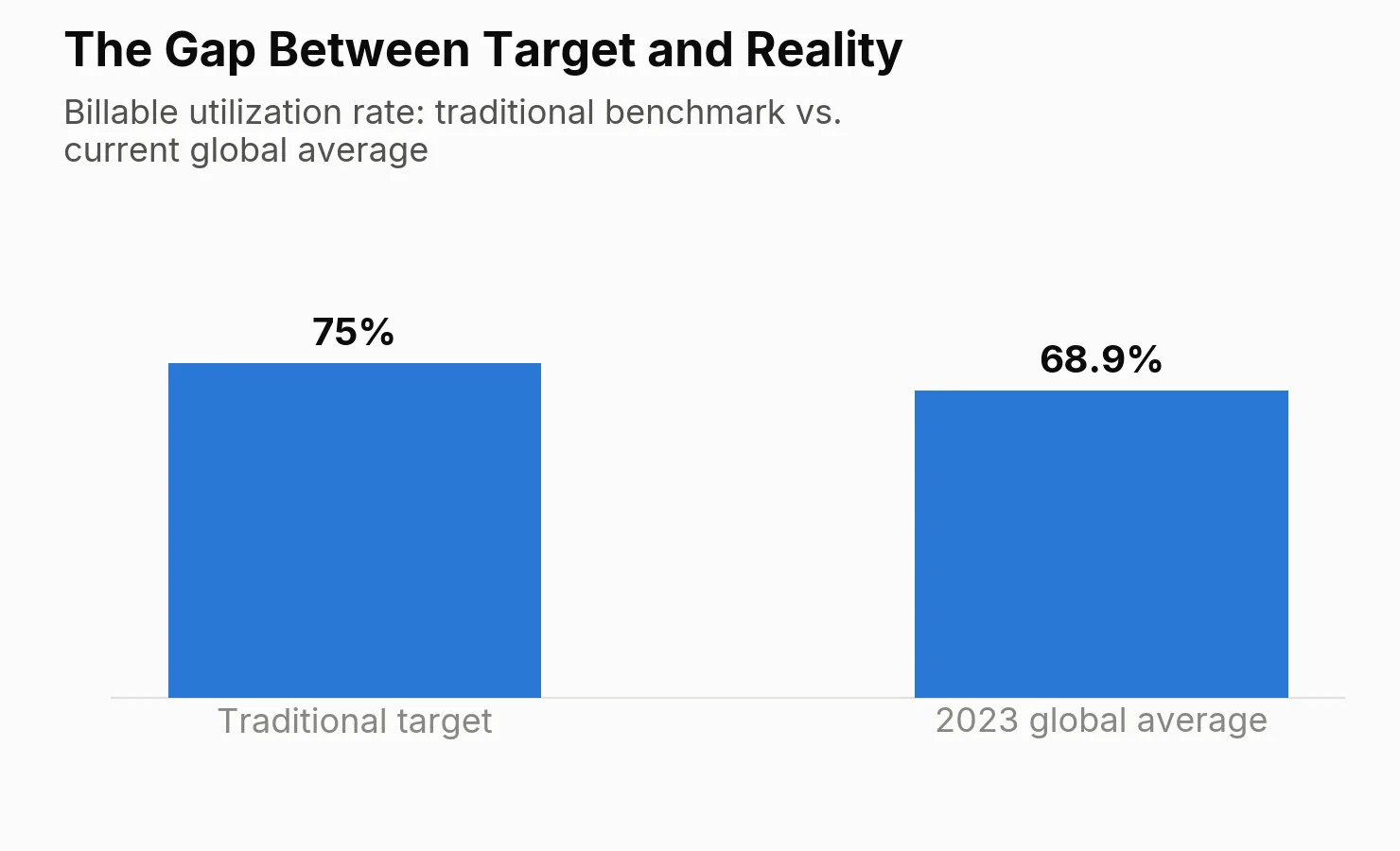
most firms don't have a precise, current number for internally because their tracking isn't good
enough to produce one.
The gap between the traditional utilization benchmark and what firms are actually achieving has widened. Source: Mosaic,
2026.
enough to produce one.
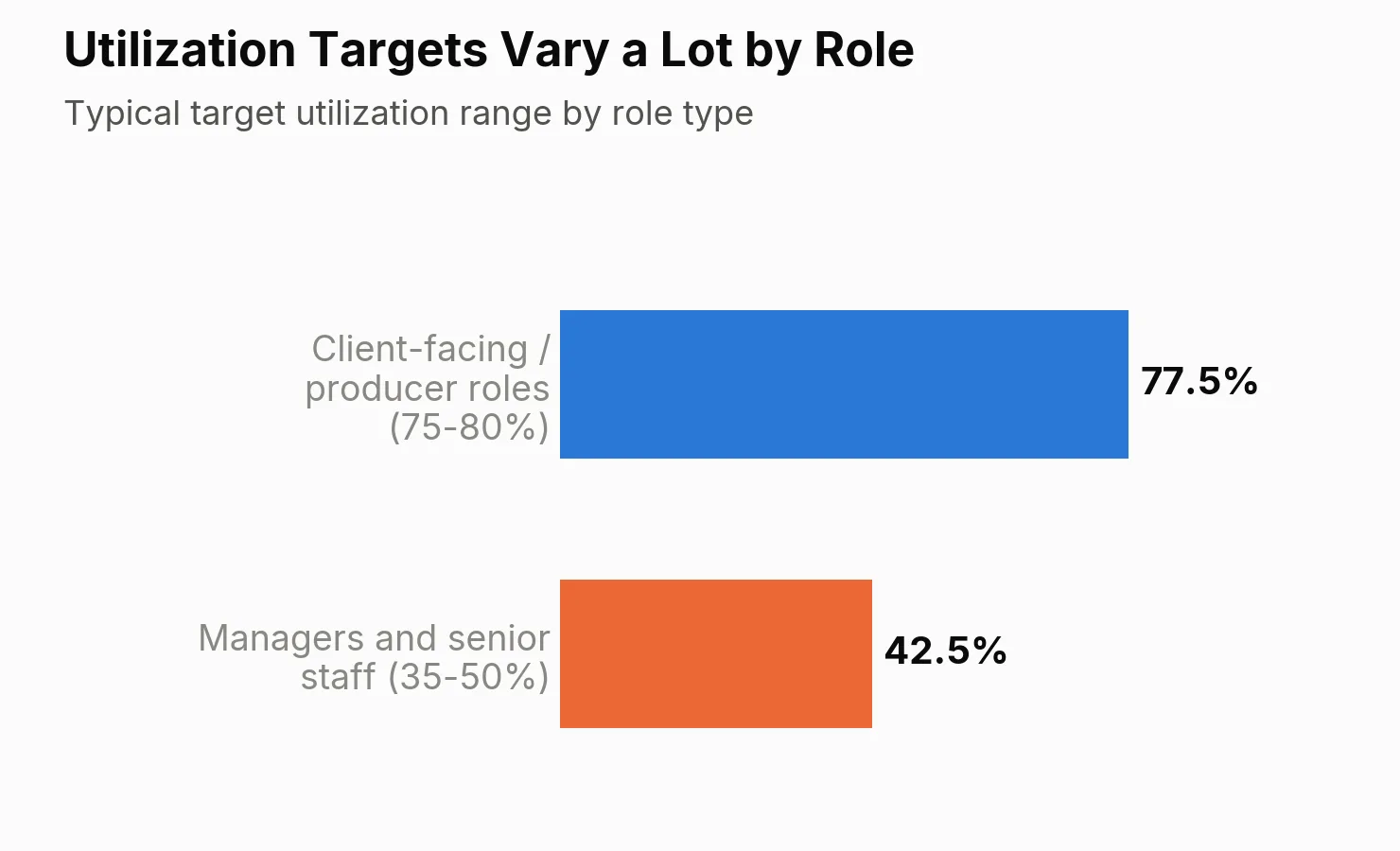
That gap matters more than a few percentage points might suggest. Utilization targets vary
meaningfully by role — client-facing staff are typically expected to hit 75-80%, while managers and
senior staff, who split time between billable work and running the business, are more realistically
targeted at 35-50% — and without accurate, role-specific tracking, it's nearly impossible to tell
whether a shortfall is a staffing problem, a scoping problem, or simply an unrealistic target that was
never achievable in the first place.
68.9%
meaningfully by role — client-facing staff are typically expected to hit 75-80%, while managers and
senior staff, who split time between billable work and running the business, are more realistically
targeted at 35-50% — and without accurate, role-specific tracking, it's nearly impossible to tell
whether a shortfall is a staffing problem, a scoping problem, or simply an unrealistic target that was
never achievable in the first place.
global average billable utilization rate as of 2023, down from a traditional benchmark closer to
75% — a gap that represents real, uncaptured margin for a lot of project-based businesses.
Source: Mosaic, 2026
Where project management inside an ERP earns its keep
75% — a gap that represents real, uncaptured margin for a lot of project-based businesses.
Oracle Fusion Cloud ERP's project management and project accounting capabilities exist specifically
to close this gap, by tying time entry, resource allocation, project budgets, and billing into a single
system rather than leaving them scattered across a separate project management tool, a separate
time-tracking app, and the general ledger. When a consultant logs hours against a specific project
task, that entry doesn't just sit in a timesheet — it flows into project costing in real time, which means
© Orpington Technologies Inc. www.orpingtontech.com
Page No. 2 of 4
to close this gap, by tying time entry, resource allocation, project budgets, and billing into a single
system rather than leaving them scattered across a separate project management tool, a separate
time-tracking app, and the general ledger. When a consultant logs hours against a specific project
task, that entry doesn't just sit in a timesheet — it flows into project costing in real time, which means
a project manager can see burn rate against budget while there's still time to do something about it,
rather than discovering an overrun in a post-mortem.
rather than discovering an overrun in a post-mortem.
The billing side benefits just as directly. Time and expenses captured accurately and in real time
make it possible to invoice clients faster and with fewer disputes, because the backup
documentation is already there rather than reconstructed from memory at month-end. For fixed-fee
or milestone-based engagements, having actual costs tracked against the plan in real time gives a
project lead an early warning when scope creep is quietly eating the margin, instead of finding out
only when the project closes.
The forecasting benefit people underrate
make it possible to invoice clients faster and with fewer disputes, because the backup
documentation is already there rather than reconstructed from memory at month-end. For fixed-fee
or milestone-based engagements, having actual costs tracked against the plan in real time gives a
project lead an early warning when scope creep is quietly eating the margin, instead of finding out
only when the project closes.
One of the less obvious advantages of running projects inside the same system as financials and HR
is resource forecasting. A services firm that can see, across every active and pipeline project, exactly
how much of each team member's capacity is already committed can make much better decisions
about hiring, about which new opportunities to pursue, and about when to say no to a deal that would
overextend the team. Without that visibility, resourcing decisions tend to get made reactively —
someone says yes to a new project and then scrambles to figure out who has time, often discovering
the answer is nobody.
This is also where the utilization-by-role distinction becomes genuinely actionable rather than
theoretical. A system that tracks actual hours against role-specific targets can flag, in close to real
time, whether a specific team or practice area is running under target — giving leadership the chance
to address a staffing or pipeline issue while there's still a quarter left to fix it, rather than after the
annual numbers are already locked in.
Realistic utilization targets differ sharply by role — a single company-wide benchmark tends to mislead more than it helps.
Source: Mosaic, 2026.
© Orpington Technologies Inc. www.orpingtontech.com
Page No. 3 of 4
theoretical. A system that tracks actual hours against role-specific targets can flag, in close to real
time, whether a specific team or practice area is running under target — giving leadership the chance
to address a staffing or pipeline issue while there's still a quarter left to fix it, rather than after the
annual numbers are already locked in.
What's genuinely hard about this
Project accounting is one of the more configuration-intensive parts of an ERP implementation,
because every firm's billing arrangements, cost structures, and margin targets tend to be at least a
little different, and a generic setup rarely fits well without real tailoring. Firms that rush this part of
implementation — reusing a template built for a different kind of business, or under-investing in
getting project templates and billing rules right — often end up with a system that technically works
but doesn't produce numbers anyone trusts enough to actually manage against, which defeats much
of the purpose.
It's also worth acknowledging that software alone doesn't fix a utilization problem rooted in sales
overpromising delivery timelines, or in chronic understaffing relative to the pipeline. What it does is
make the problem visible fast enough to act on, which is a meaningfully different — and more
valuable — thing than most companies currently have.
What's next
overpromising delivery timelines, or in chronic understaffing relative to the pipeline. What it does is
make the problem visible fast enough to act on, which is a meaningfully different — and more
valuable — thing than most companies currently have.
Professional services firms aren't the only ones wrestling with the gap between planned and actual
performance. Manufacturers face a strikingly similar problem on the shop floor, measured differently
but rooted in the same issue: not knowing, in real time, how efficiently resources are actually being
used. That's the subject of the next article in this series.
Sources
1. Billable Utilization Rate Statistics in Professional Services Firms, Mosaic —
https://www.mosaicapp.com/post/billable-utilization-rate-statistics-in-professional-services-firms
© Orpington Technologies Inc. www.orpingtontech.com
Page No. 4 of 4
performance. Manufacturers face a strikingly similar problem on the shop floor, measured differently
but rooted in the same issue: not knowing, in real time, how efficiently resources are actually being
used. That's the subject of the next article in this series.