
Change Management: Winning Employee Buy-In for a New ERP System
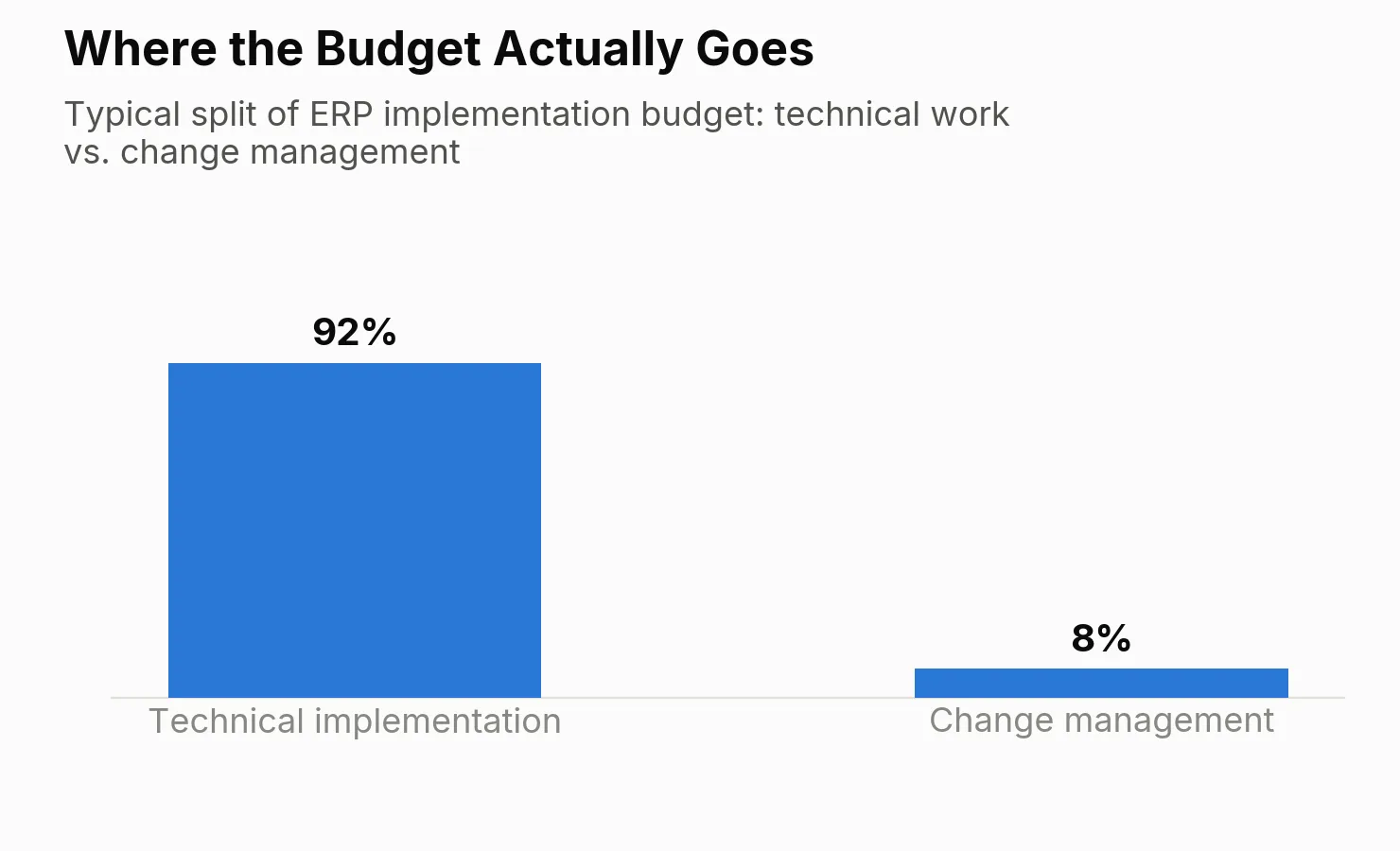
Here's a number worth sitting with: organizations typically spend about 92% of their ERP implementation budget on technical activities — software, infrastructure, configuration, data — and just 8% on change management, the work of actually getting people to understand, accept, and correctly use the new system.
 ORACLE FUSION CLOUD ERP FOR GROWING BUSINESSES
Change Management: Winning
Employee Buy-In for a New ERP
System
The software is the easy 92% of the budget. It's not the hard 100% of the outcome.
Employee Buy-In for a New ERP
System
Here's a number worth sitting with: organizations typically spend about 92% of their ERP
implementation budget on technical activities — software, infrastructure, configuration, data — and
just 8% on change management, the work of actually getting people to understand, accept, and
correctly use the new system. And yet Prosci's research, one of the more established bodies of work
on organizational change, finds that human factors matter roughly six times more than technical
factors in determining whether an ERP implementation actually delivers its promised benefits.
Put those two facts side by side, and the mismatch is stark. Companies are pouring the
overwhelming majority of their budget into the part of the project that matters least for whether the
investment pays off, and treating the part that matters most as an afterthought.
overwhelming majority of their budget into the part of the project that matters least for whether the
investment pays off, and treating the part that matters most as an afterthought.
Why "the software works" isn't the same as "the project
succeeded"
It's entirely possible for an ERP implementation to be a technical success and a business failure at
the same time. The system goes live on schedule, the data migrated correctly, the integrations
function as designed — and six months later, half the sales team is still keeping a shadow
spreadsheet because they never really trusted or learned the new CRM module, a chunk of the
© Orpington Technologies Inc. www.orpingtontech.com
Page No. 1 of 4
the same time. The system goes live on schedule, the data migrated correctly, the integrations
function as designed — and six months later, half the sales team is still keeping a shadow
spreadsheet because they never really trusted or learned the new CRM module, a chunk of the
warehouse staff are working around the new inventory process because nobody explained why it
changed, and the promised efficiency gains never materialize because the old habits never actually
went away.
6x
changed, and the promised efficiency gains never materialize because the old habits never actually
went away.
how much more human factors matter than technical factors in determining whether an ERP
implementation delivers its promised benefits, according to Prosci's research.
Source: Prosci, via prosci.com/blog/your-erp-adoption-rate-guide
implementation delivers its promised benefits, according to Prosci's research.
This is why Gartner's oft-cited finding that more than 70% of ERP initiatives fail to meet their original
business case shouldn't be read purely as a technology problem. A meaningful share of that failure
rate traces back to adoption — a system that works exactly as designed, being used incorrectly,
incompletely, or not at all by the people it was built for.
The budget split between technical work and change management is dramatically lopsided relative to their actual impact on
outcomes. Source: Prosci, 2026.
business case shouldn't be read purely as a technology problem. A meaningful share of that failure
rate traces back to adoption — a system that works exactly as designed, being used incorrectly,
incompletely, or not at all by the people it was built for.
What actually predicts whether people adopt a new
system
Prosci's research offers a genuinely useful, counterintuitive finding here: projects that track their
change management progress with rigorous, well-defined metrics are 2.5 times more likely to exceed
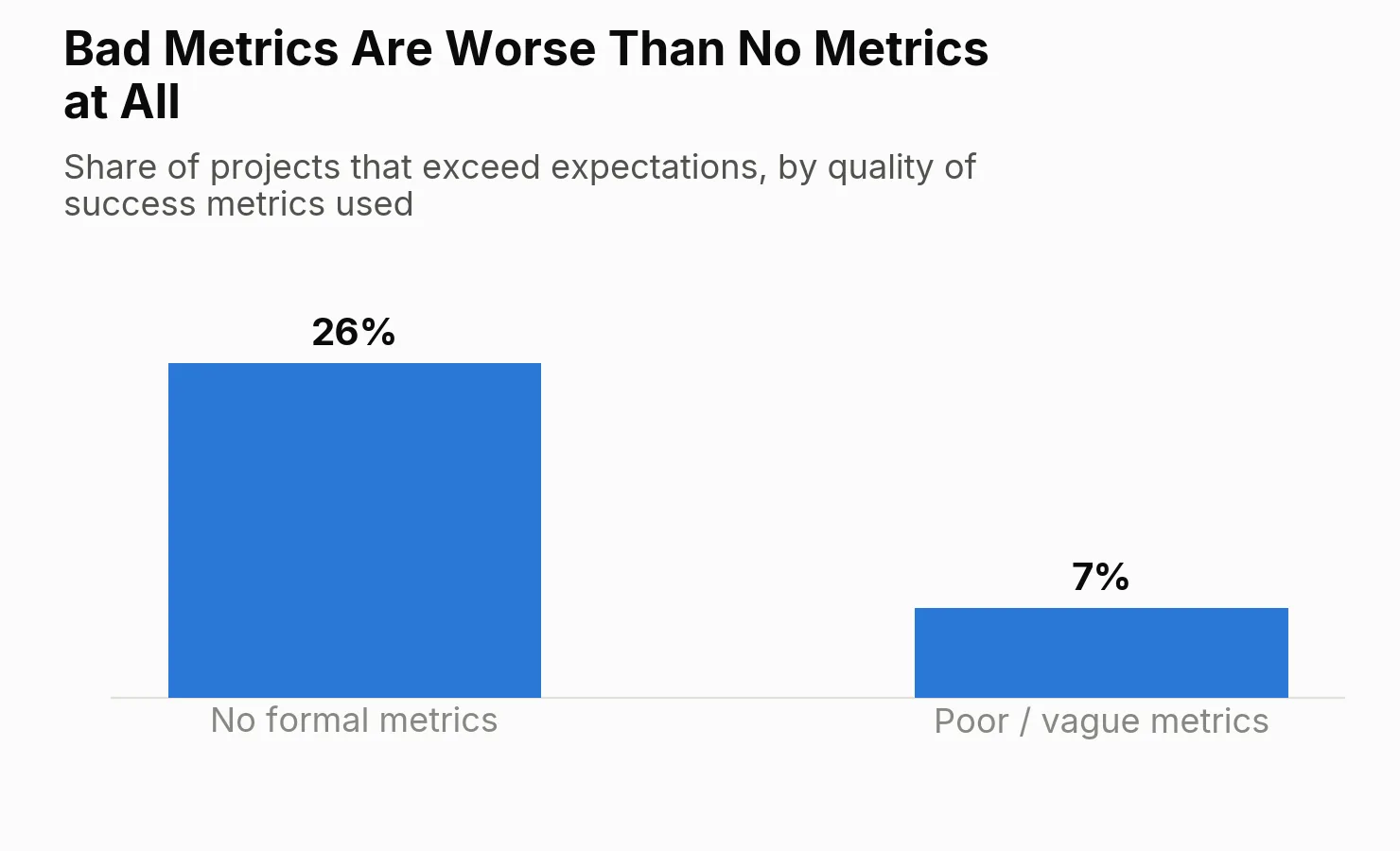
expectations than those that don't. More surprising is what happens with weak metrics — projects
using poor or vague success metrics succeed only about 7% of the time, a lower rate than projects
using no formal metrics at all, which land around 26%. The lesson isn't "metrics don't matter" — it's
© Orpington Technologies Inc. www.orpingtontech.com
Page No. 2 of 4
change management progress with rigorous, well-defined metrics are 2.5 times more likely to exceed
expectations than those that don't. More surprising is what happens with weak metrics — projects
using poor or vague success metrics succeed only about 7% of the time, a lower rate than projects
using no formal metrics at all, which land around 26%. The lesson isn't "metrics don't matter" — it's
that a bad measurement framework can be actively worse than an honest absence of one, because it
creates false confidence that adoption is on track when it isn't.
Vague or poorly designed success metrics correlate with worse outcomes than tracking no formal metrics at all. Source:
Prosci, 2026.
creates false confidence that adoption is on track when it isn't.
The practical adoption targets worth aiming for are fairly concrete: roughly 90% user engagement
within the first 30 days after go-live, and sustained adoption at a similar level within three months.
Falling meaningfully short of those benchmarks is an early warning sign worth acting on
immediately, not a metric to revisit at the next quarterly review once the pattern is already
entrenched.
within the first 30 days after go-live, and sustained adoption at a similar level within three months.
Falling meaningfully short of those benchmarks is an early warning sign worth acting on
immediately, not a metric to revisit at the next quarterly review once the pattern is already
entrenched.
What good change management actually looks like in
practice
None of this requires an elaborate program. The elements that consistently show up in successful
ERP rollouts are fairly grounded: clear, honest communication from leadership about why the change
is happening and what problem it solves, delivered before the system goes live rather than as an
afterthought once people are already confused; role-specific training that reflects how each group of
employees will actually use the system day to day, rather than a generic overview session that covers
everything superficially and nothing well; visible, accessible support in the first few weeks after
go-live, when people are most likely to hit friction and most likely to revert to old habits if that friction
isn't addressed quickly; and genuine two-way feedback channels, so that legitimate problems with
the new process get identified and fixed rather than quietly worked around.
The common thread is that people adopt new systems faster when they understand why the change
is happening and feel like their concerns during the transition are being heard, not just tolerated until
the rollout is officially declared complete.
© Orpington Technologies Inc. www.orpingtontech.com
Page No. 3 of 4
is happening and feel like their concerns during the transition are being heard, not just tolerated until
the rollout is officially declared complete.
Why this is exactly the kind of thing worth measuring
independently
Change management readiness is one of the harder things for a company to assess objectively
about itself, precisely because the people closest to a project — the internal team that's been living
and breathing it for months — often have the least clear-eyed view of whether adoption is genuinely
on track or just looks that way in status meetings. This is one of the specific variables Orpington
Technologies scores as part of its independent ERP readiness diagnostic, alongside governance,
testing discipline, and data migration — precisely because change management is so consistently
under-resourced and over-assumed, and because an outside, evidence-based view tends to catch
adoption risk earlier than an internal team invested in the project's success is likely to catch it on its
own.
Continuing on
about itself, precisely because the people closest to a project — the internal team that's been living
and breathing it for months — often have the least clear-eyed view of whether adoption is genuinely
on track or just looks that way in status meetings. This is one of the specific variables Orpington
Technologies scores as part of its independent ERP readiness diagnostic, alongside governance,
testing discipline, and data migration — precisely because change management is so consistently
under-resourced and over-assumed, and because an outside, evidence-based view tends to catch
adoption risk earlier than an internal team invested in the project's success is likely to catch it on its
own.
Change management determines whether people actually use the new system well. The next article
covers a related but more technical risk that determines whether they have accurate information to
work with in the first place: data migration, and why moving historical information into a new ERP
system correctly is a much harder problem than most project plans assume.
Sources
1. Your ERP Adoption Rate Guide, Prosci —
https://www.prosci.com/blog/your-erp-adoption-rate-guide
© Orpington Technologies Inc. www.orpingtontech.com
Page No. 4 of 4
covers a related but more technical risk that determines whether they have accurate information to
work with in the first place: data migration, and why moving historical information into a new ERP
system correctly is a much harder problem than most project plans assume.