
What Oracle Fusion Cloud ERP Really Costs: TCO and ROI for SMBs
Every ERP sales conversation eventually arrives at the cost question, and every vendor has an answer that sounds more reassuring than the number a CFO will actually see on an invoice eighteen months later. That's not necessarily dishonesty — it's more that "how much does this cost" is a genuinely complicated question, with an answer that depends heavily on scope, company size, data complexity, and how disciplined the implementation stays.
 ORACLE FUSION CLOUD ERP FOR GROWING BUSINESSES
What Oracle Fusion Cloud ERP
Really Costs: TCO and ROI for SMBs
The honest math behind the sales pitch
Really Costs: TCO and ROI for SMBs
Every ERP sales conversation eventually arrives at the cost question, and every vendor has an answer
that sounds more reassuring than the number a CFO will actually see on an invoice eighteen months
later. That's not necessarily dishonesty — it's more that "how much does this cost" is a genuinely
complicated question, with an answer that depends heavily on scope, company size, data complexity,
and how disciplined the implementation stays. It's worth working through the real numbers rather
than the pitch-deck version.
The baseline figures
that sounds more reassuring than the number a CFO will actually see on an invoice eighteen months
later. That's not necessarily dishonesty — it's more that "how much does this cost" is a genuinely
complicated question, with an answer that depends heavily on scope, company size, data complexity,
and how disciplined the implementation stays. It's worth working through the real numbers rather
than the pitch-deck version.
Across mid-sized organizations, average ERP implementation costs run around $450,000 in total, or
roughly $9,000 per user — figures that blend software licensing, implementation services, data
migration, training, and the internal staff time that rarely gets fully accounted for in the initial budget.
Those are averages, not caps; a company with more complex requirements, more locations, or more
legacy data to migrate can land well above them, and a simpler implementation with clean data and
fewer customizations can land meaningfully below.
© Orpington Technologies Inc. www.orpingtontech.com
Page No. 1 of 4
roughly $9,000 per user — figures that blend software licensing, implementation services, data
migration, training, and the internal staff time that rarely gets fully accounted for in the initial budget.
Those are averages, not caps; a company with more complex requirements, more locations, or more
legacy data to migrate can land well above them, and a simpler implementation with clean data and
fewer customizations can land meaningfully below.
 $450,000
average total implementation cost for a mid-sized organization adopting cloud ERP — a figure
that includes software, implementation services, data migration, and training, but often
understates internal staff time.
Source: KreativeCoreTech, 2026
The part every vendor undersells: overruns
that includes software, implementation services, data migration, and training, but often
understates internal staff time.
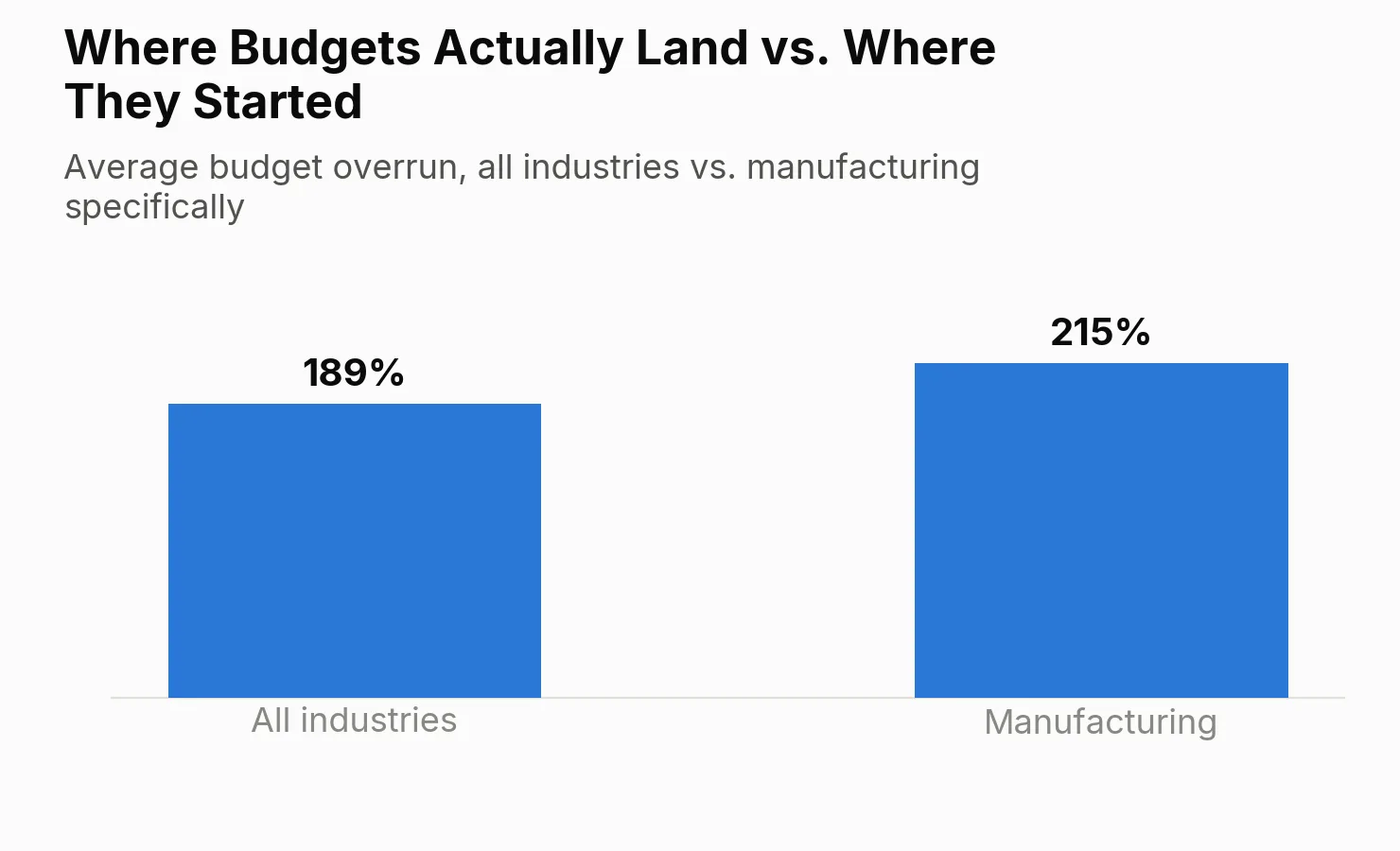
Here's where the honest math diverges sharply from the pitch. The average ERP project overruns its
original budget by 189% across industries, and by an even steeper 215% in manufacturing
specifically — meaning the "typical" project doesn't come in a little over budget, it very often comes in
at nearly three times the original estimate. This isn't a fringe outcome affecting a few unlucky
companies; it's close to the statistical norm, which means any cost conversation that only cites the
initial estimate is, in a meaningful sense, incomplete from the start.
Budget overruns of this magnitude are common enough to be treated as the expected case, not the exception. Source:
KreativeCoreTech, 2026.
original budget by 189% across industries, and by an even steeper 215% in manufacturing
specifically — meaning the "typical" project doesn't come in a little over budget, it very often comes in
at nearly three times the original estimate. This isn't a fringe outcome affecting a few unlucky
companies; it's close to the statistical norm, which means any cost conversation that only cites the
initial estimate is, in a meaningful sense, incomplete from the start.
The gap between planned and actual cost tends to come from a predictable handful of sources: data
migration turning out to be more complex than the original scoping assumed, customization
requests that accumulate during the project as users discover the standard configuration doesn't
quite fit their process, and timeline extensions that add months of additional consulting fees and
internal staff time that weren't in the original plan. None of these are unusual or unpredictable in the
abstract — which is exactly why a rigorous, independently validated cost estimate before signing a
contract is worth far more than an optimistic one from whoever is trying to win the deal.
© Orpington Technologies Inc. www.orpingtontech.com
Page No. 2 of 4
migration turning out to be more complex than the original scoping assumed, customization
requests that accumulate during the project as users discover the standard configuration doesn't
quite fit their process, and timeline extensions that add months of additional consulting fees and
internal staff time that weren't in the original plan. None of these are unusual or unpredictable in the
abstract — which is exactly why a rigorous, independently validated cost estimate before signing a
contract is worth far more than an optimistic one from whoever is trying to win the deal.
 What the return side of the ledger actually looks like
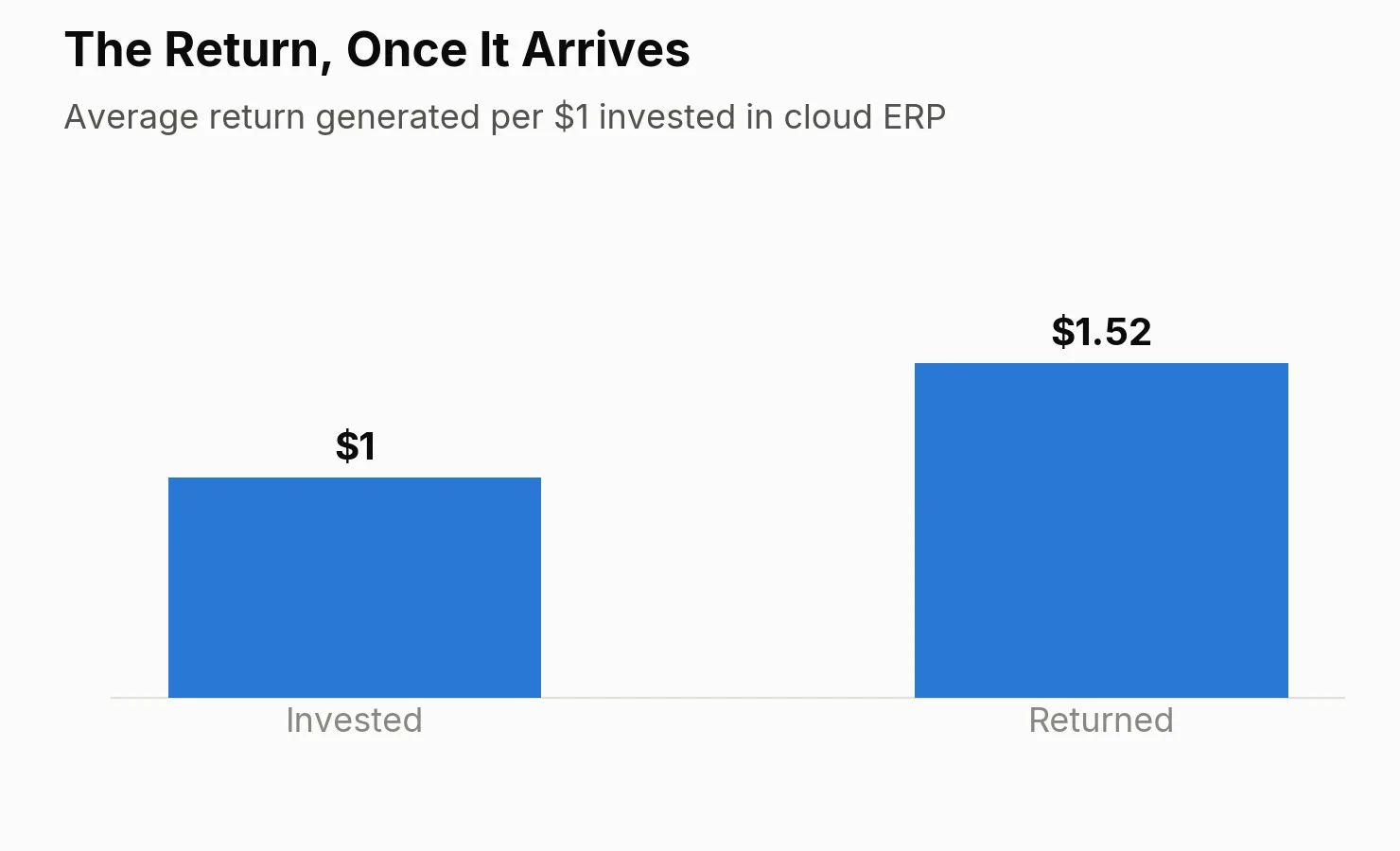
The good news, and it's genuine good news, is that the return on a well-executed cloud ERP
implementation tends to be real. Organizations report an average ROI of about 52%, meaning roughly
$1.52 returned for every dollar invested, and 83% say they've met or exceeded their own ROI
expectations. The typical payback period runs around two and a half years — a real, meaningful
investment horizon, but one that a majority of companies do eventually clear.
Averaged across adopters, cloud ERP returns roughly $1.52 for every dollar invested. Source: Anchor Group Technology, 2026.
implementation tends to be real. Organizations report an average ROI of about 52%, meaning roughly
$1.52 returned for every dollar invested, and 83% say they've met or exceeded their own ROI
expectations. The typical payback period runs around two and a half years — a real, meaningful
investment horizon, but one that a majority of companies do eventually clear.
Where that return comes from varies by company, but it typically shows up across several categories
at once: reduced costs in purchasing and inventory management (62% of adopters report gains
here), efficiency improvements across operations generally (a reported 66% average improvement),
and the harder-to-quantify but very real value of fewer errors, faster closes, and management
decisions made on current rather than stale data.
Why TCO conversations need to include more than the
initial project
Total cost of ownership doesn't end at go-live, and treating it as if it does is one of the more common
ways companies underestimate the real, ongoing commitment. Cloud ERP subscription costs
typically scale with usage — more users, more transaction volume, additional modules — which is
generally more predictable than the capital-intensive upgrade cycles of on-premise software, but it
still needs to be modeled honestly over a three-to-five-year horizon rather than judged solely on the
sticker price of implementation. Ongoing costs also include continued training as staff turn over,
periodic reconfiguration as the business changes, and the internal resources needed to actually own
and maintain the system rather than assuming the vendor handles everything indefinitely.
© Orpington Technologies Inc. www.orpingtontech.com
Page No. 3 of 4
ways companies underestimate the real, ongoing commitment. Cloud ERP subscription costs
typically scale with usage — more users, more transaction volume, additional modules — which is
generally more predictable than the capital-intensive upgrade cycles of on-premise software, but it
still needs to be modeled honestly over a three-to-five-year horizon rather than judged solely on the
sticker price of implementation. Ongoing costs also include continued training as staff turn over,
periodic reconfiguration as the business changes, and the internal resources needed to actually own
and maintain the system rather than assuming the vendor handles everything indefinitely.
Why boards increasingly want a defensible number, not a
vendor's number
Given how wide the gap can be between projected and actual cost, it's become increasingly common
for CFOs and boards to insist on an independent, evidence-based cost and risk assessment before
committing to a specific implementation plan — rather than relying solely on the estimate provided
by the systems integrator who stands to win the work. This is precisely the kind of documentation
firms like Orpington Technologies specialize in producing: a defensible, quantified readiness and
cost-risk assessment that a board can actually stand behind, built from evidence rather than
optimism. It doesn't replace the vendor's proposal, but it gives leadership an independent check on it
before real money is committed.
Where this leads next
for CFOs and boards to insist on an independent, evidence-based cost and risk assessment before
committing to a specific implementation plan — rather than relying solely on the estimate provided
by the systems integrator who stands to win the work. This is precisely the kind of documentation
firms like Orpington Technologies specialize in producing: a defensible, quantified readiness and
cost-risk assessment that a board can actually stand behind, built from evidence rather than
optimism. It doesn't replace the vendor's proposal, but it gives leadership an independent check on it
before real money is committed.
Cost overruns and ROI shortfalls rarely happen because of the software itself — they happen because
of how the project is planned and run. That's the exact subject of the next article: why so many ERP
projects go over budget and behind schedule, the specific patterns behind it, and what separates the
projects that stay on track from the ones that don't.
Sources
1. 58 Must-Know ERP Statistics for 2026, KreativeCoreTech —
https://kreativecoretech.com/erp-statistics/
2. Cloud ERP Statistics for 2026 & Beyond, Anchor Group Technology —
https://www.anchorgroup.tech/blog/cloud-based-erp-statistics
© Orpington Technologies Inc. www.orpingtontech.com
Page No. 4 of 4
of how the project is planned and run. That's the exact subject of the next article: why so many ERP
projects go over budget and behind schedule, the specific patterns behind it, and what separates the
projects that stay on track from the ones that don't.