
People and Payroll: Oracle Fusion Cloud's Workforce Management for Growing Teams
There's a fairly predictable point in a growing company's life where HR stops being something the office manager handles on the side, alongside ordering supplies and managing the lease, and becomes a real operational risk if it's not handled properly.
 ORACLE FUSION CLOUD ERP FOR GROWING BUSINESSES
People and Payroll: Oracle Fusion
Cloud's Workforce Management for
Growing Teams
Why HR software stops being optional somewhere around employee number fifty
Cloud's Workforce Management for
Growing Teams
There's a fairly predictable point in a growing company's life where HR stops being something the
office manager handles on the side, alongside ordering supplies and managing the lease, and
becomes a real operational risk if it's not handled properly. It doesn't happen at a fixed headcount —
sometimes it's thirty people, sometimes it's a hundred and fifty — but it tends to announce itself the
same way: a payroll error that takes half a day to untangle, a new state or country hire that reveals
nobody quite knows the compliance requirements, or a simple question like "how much did we spend
on overtime last quarter" that turns into an afternoon of spreadsheet archaeology.
Human capital management — HCM, in the industry's shorthand — is the part of Oracle Fusion Cloud
ERP built to take that risk off the table, and it's one of the faster-growing corners of the entire ERP
market for a reason that's easy to understand once you've lived through a bad payroll cycle.
The market is voting with its budget
ERP built to take that risk off the table, and it's one of the faster-growing corners of the entire ERP
market for a reason that's easy to understand once you've lived through a bad payroll cycle.
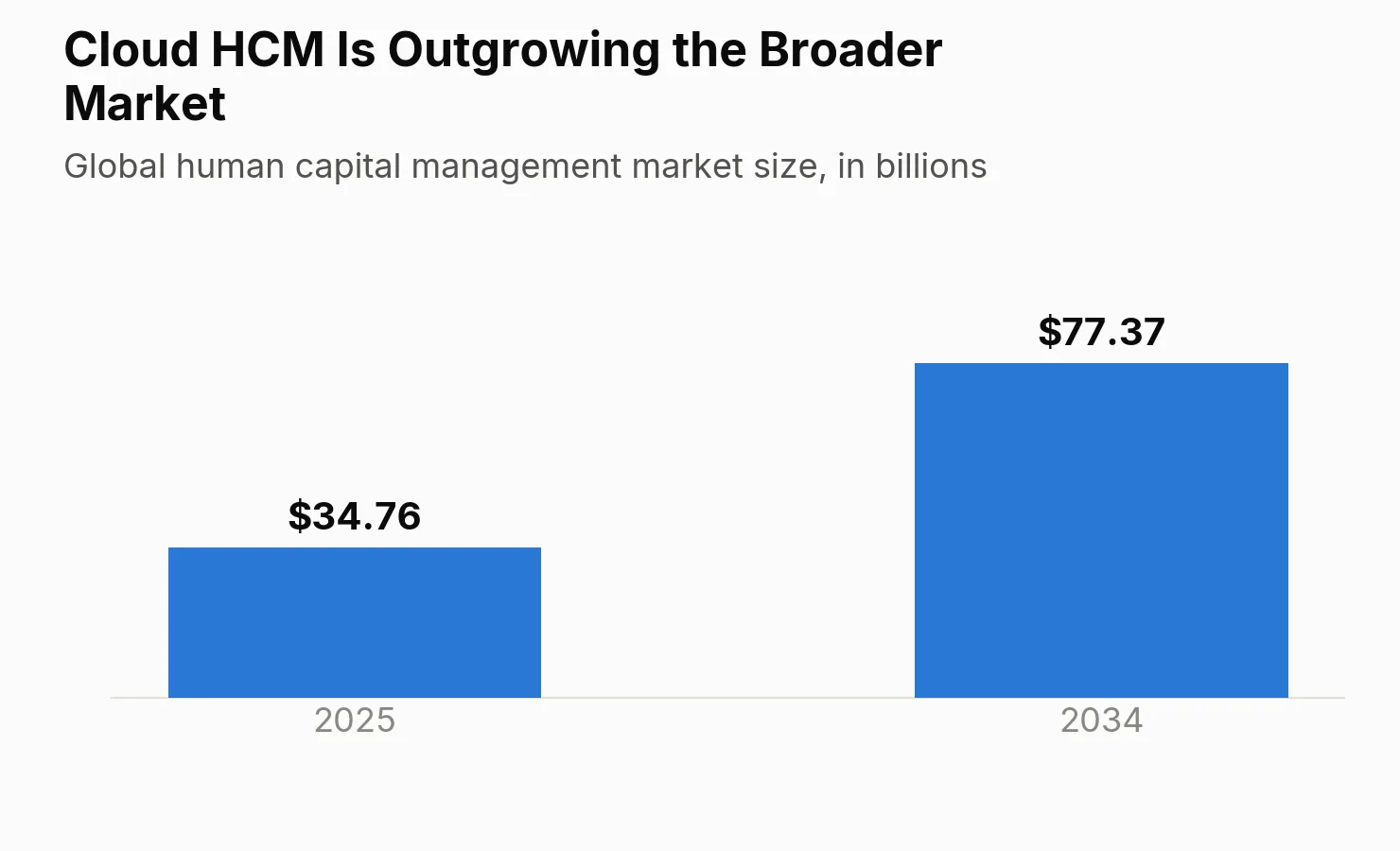
Global spending on HCM software is projected to nearly double this decade, from roughly $34.8
billion in 2025 to about $77.4 billion by 2034 — a compound annual growth rate close to 9.5%. The
cloud segment specifically is growing even faster than that overall figure, and small and mid-sized
businesses represent the fastest-growing customer segment of all, expanding at an estimated 12% a
© Orpington Technologies Inc. www.orpingtontech.com
Page No. 1 of 4
billion in 2025 to about $77.4 billion by 2034 — a compound annual growth rate close to 9.5%. The
cloud segment specifically is growing even faster than that overall figure, and small and mid-sized
businesses represent the fastest-growing customer segment of all, expanding at an estimated 12% a
year as cloud pricing brings HCM capability that used to be enterprise-only within reach of a
two-hundred-person company.
The HCM market is more than doubling this decade, with cloud and SME adoption both outpacing the overall average. Source:
Fortune Business Insights, 2026.
two-hundred-person company.
That growth isn't happening because HR departments suddenly discovered a taste for new software.
It's happening because the alternative — a patchwork of spreadsheets, a standalone payroll vendor, a
filing cabinet of paper personnel files, and whatever compliance knowledge lives in one person's
head — becomes genuinely dangerous once a company crosses certain size and complexity
thresholds. Multi-state employment, benefits administration, wage and hour compliance, and
performance management all get harder to manage safely without a system built for the purpose.
What actually lives inside the HCM piece of Fusion Cloud
It's happening because the alternative — a patchwork of spreadsheets, a standalone payroll vendor, a
filing cabinet of paper personnel files, and whatever compliance knowledge lives in one person's
head — becomes genuinely dangerous once a company crosses certain size and complexity
thresholds. Multi-state employment, benefits administration, wage and hour compliance, and
performance management all get harder to manage safely without a system built for the purpose.
Oracle's workforce management functionality spans the obvious ground — payroll, benefits, time and
attendance — but the more consequential part for a growing company is usually the connective
tissue between HR data and the rest of the business. Headcount and labor cost data flow directly
into financial reporting instead of arriving as a monthly export somebody has to reconcile by hand.
Org charts and reporting structures stay current automatically as people move roles, rather than
living in a document that's accurate the week it's created and stale a month later. Compliance rules
for different jurisdictions get built into the system's logic rather than depending on someone's
memory of what changed in state tax law this year.
© Orpington Technologies Inc. www.orpingtontech.com
Page No. 2 of 4
attendance — but the more consequential part for a growing company is usually the connective
tissue between HR data and the rest of the business. Headcount and labor cost data flow directly
into financial reporting instead of arriving as a monthly export somebody has to reconcile by hand.
Org charts and reporting structures stay current automatically as people move roles, rather than
living in a document that's accurate the week it's created and stale a month later. Compliance rules
for different jurisdictions get built into the system's logic rather than depending on someone's
memory of what changed in state tax law this year.
 12%
projected annual growth rate for HCM adoption among small and mid-sized businesses
specifically — the fastest-growing segment of the entire HCM market.
Source: Fortune Business Insights, 2026
specifically — the fastest-growing segment of the entire HCM market.
The self-service dimension matters more than it might sound like it should. When employees can
update their own address, check their own PTO balance, or pull their own pay history without
emailing HR, it removes a steady drip of small administrative requests that otherwise consume real
time from people who have other things to do. For a lean HR team — often just one or two people at a
company under a few hundred employees — that time back is a meaningful part of the value case,
even before counting the harder-to-quantify benefit of fewer compliance mistakes.
AI is arriving in HR faster than in most other functions
update their own address, check their own PTO balance, or pull their own pay history without
emailing HR, it removes a steady drip of small administrative requests that otherwise consume real
time from people who have other things to do. For a lean HR team — often just one or two people at a
company under a few hundred employees — that time back is a meaningful part of the value case,
even before counting the harder-to-quantify benefit of fewer compliance mistakes.
One of the more notable shifts in workforce management recently isn't about payroll accuracy at all
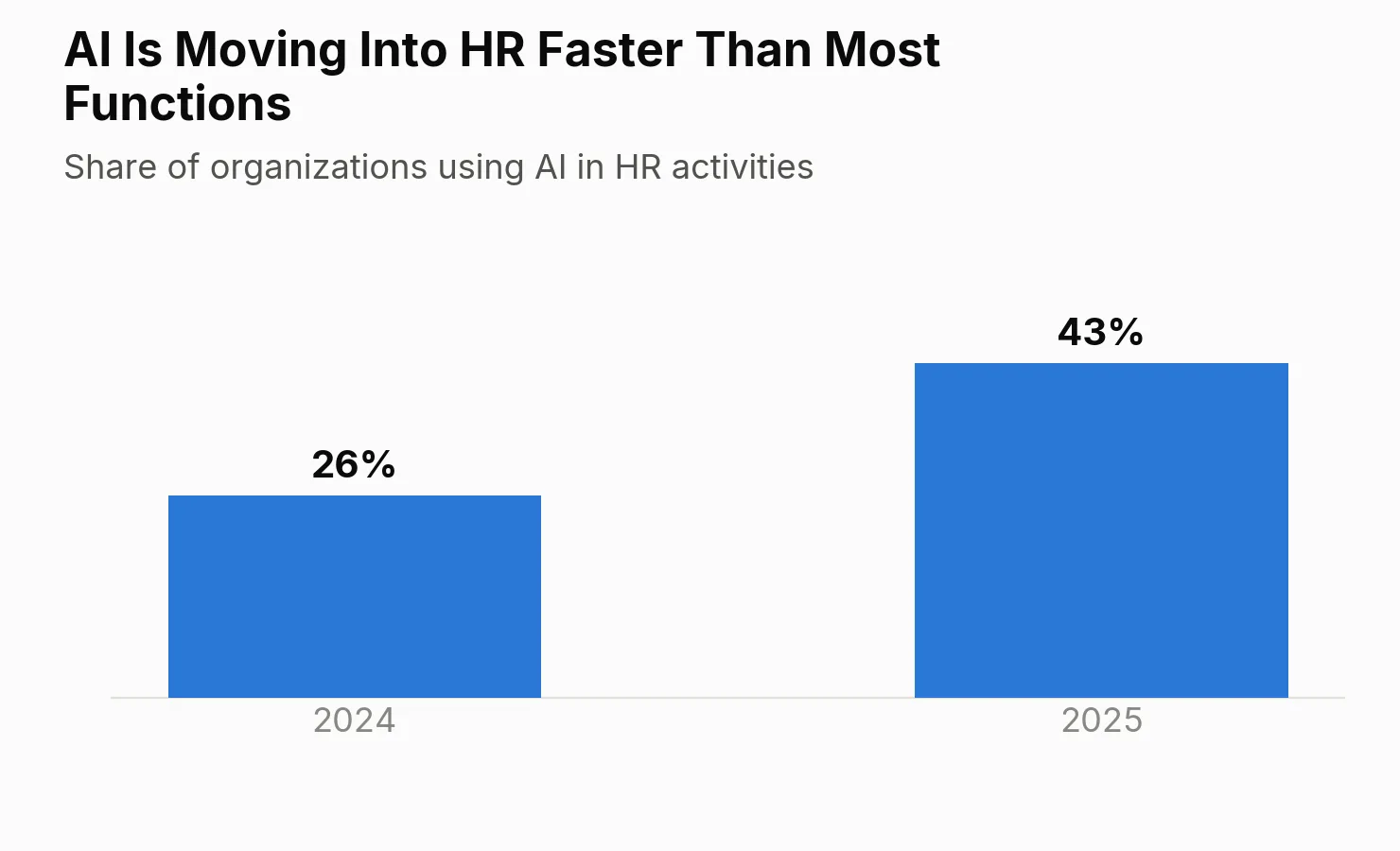
— it's about how quickly artificial intelligence has moved into HR-specific work. The share of
organizations using AI in HR activities jumped from 26% in 2024 to 43% in 2025, according to SHRM
data, a faster year-over-year jump than most other business functions have seen. In practice, this
shows up in things like AI-assisted resume screening, automated scheduling optimization, and
anomaly detection in payroll runs that flags an unusual pay change before it goes out the door rather
than after an employee calls to ask why their check looks wrong.
AI adoption in HR activities nearly doubled year over year, outpacing adoption in many other business functions. Source:
SHRM, via Fortune Business Insights, 2026.
© Orpington Technologies Inc. www.orpingtontech.com
Page No. 3 of 4
— it's about how quickly artificial intelligence has moved into HR-specific work. The share of
organizations using AI in HR activities jumped from 26% in 2024 to 43% in 2025, according to SHRM
data, a faster year-over-year jump than most other business functions have seen. In practice, this
shows up in things like AI-assisted resume screening, automated scheduling optimization, and
anomaly detection in payroll runs that flags an unusual pay change before it goes out the door rather
than after an employee calls to ask why their check looks wrong.
It's worth treating this trend with some proportion. AI-assisted HR tools are genuinely useful for
catching errors and reducing repetitive work, but the judgment calls that matter most in HR — a
difficult performance conversation, a nuanced compliance question, a sensitive accommodation
request — still need a human being who understands the specific context, not an algorithm making
the final call.
Where this tends to get harder than expected
catching errors and reducing repetitive work, but the judgment calls that matter most in HR — a
difficult performance conversation, a nuanced compliance question, a sensitive accommodation
request — still need a human being who understands the specific context, not an algorithm making
the final call.
HCM implementations have a reputation, not entirely fair, for being simpler than financial or supply
chain rollouts. In practice, the complexity often hides in the details: configuring benefits rules
correctly for every plan a company offers, setting up accurate time and attendance rules for every
different work schedule and overtime policy in use, and — the part that surprises people most —
migrating historical payroll and personnel data cleanly enough that year-end tax reporting doesn't
have gaps. None of this is insurmountable, but it deserves the same planning rigor as any other
module, not the "HR software is simple" assumption that sometimes leads teams to under-resource
the project.
Moving forward
chain rollouts. In practice, the complexity often hides in the details: configuring benefits rules
correctly for every plan a company offers, setting up accurate time and attendance rules for every
different work schedule and overtime policy in use, and — the part that surprises people most —
migrating historical payroll and personnel data cleanly enough that year-end tax reporting doesn't
have gaps. None of this is insurmountable, but it deserves the same planning rigor as any other
module, not the "HR software is simple" assumption that sometimes leads teams to under-resource
the project.
Getting people and payroll right solves one kind of operational risk. The next one — for any company
that runs client work, internal projects, or both — is knowing whether the time and resources going
into those projects are actually profitable. That's where the series heads next: professional services
and project management inside Oracle Fusion Cloud ERP, and the surprisingly common gap between
how busy a team feels and how profitable that busyness actually is.
Sources
1. Human Capital Management (HCM) Market, Fortune Business Insights —
https://www.fortunebusinessinsights.com/industry-reports/human-capital-management-hcm-market-100240
© Orpington Technologies Inc. www.orpingtontech.com
Page No. 4 of 4
that runs client work, internal projects, or both — is knowing whether the time and resources going
into those projects are actually profitable. That's where the series heads next: professional services
and project management inside Oracle Fusion Cloud ERP, and the surprisingly common gap between
how busy a team feels and how profitable that busyness actually is.