
Procurement and Spend Control with Oracle Fusion Cloud ERP
Most small and mid-sized companies negotiate good supplier pricing at some point — a volume discount here, better payment terms there — and then quietly lose a meaningful chunk of that value because nobody in the building has an easy way to make sure people actually buy from the negotiated supplier at the negotiated price.
 ORACLE FUSION CLOUD ERP FOR GROWING BUSINESSES
Procurement and Spend Control
with Oracle Fusion Cloud ERP
Turning purchasing into a source of savings, not surprises
with Oracle Fusion Cloud ERP
Most small and mid-sized companies negotiate good supplier pricing at some point — a volume
discount here, better payment terms there — and then quietly lose a meaningful chunk of that value
because nobody in the building has an easy way to make sure people actually buy from the
negotiated supplier at the negotiated price. An office manager orders from whichever vendor shows
up first on a search. A project lead expenses a rush purchase from a retail store because going
through the "official" process would have taken too long. None of it is malicious. All of it adds up.
There's a name for this in procurement circles: maverick spend, meaning any purchase made outside
the approved process or approved suppliers. And the numbers on what it costs are more significant
than most finance leaders assume.
The savings you negotiated aren't the savings you keep
the approved process or approved suppliers. And the numbers on what it costs are more significant
than most finance leaders assume.
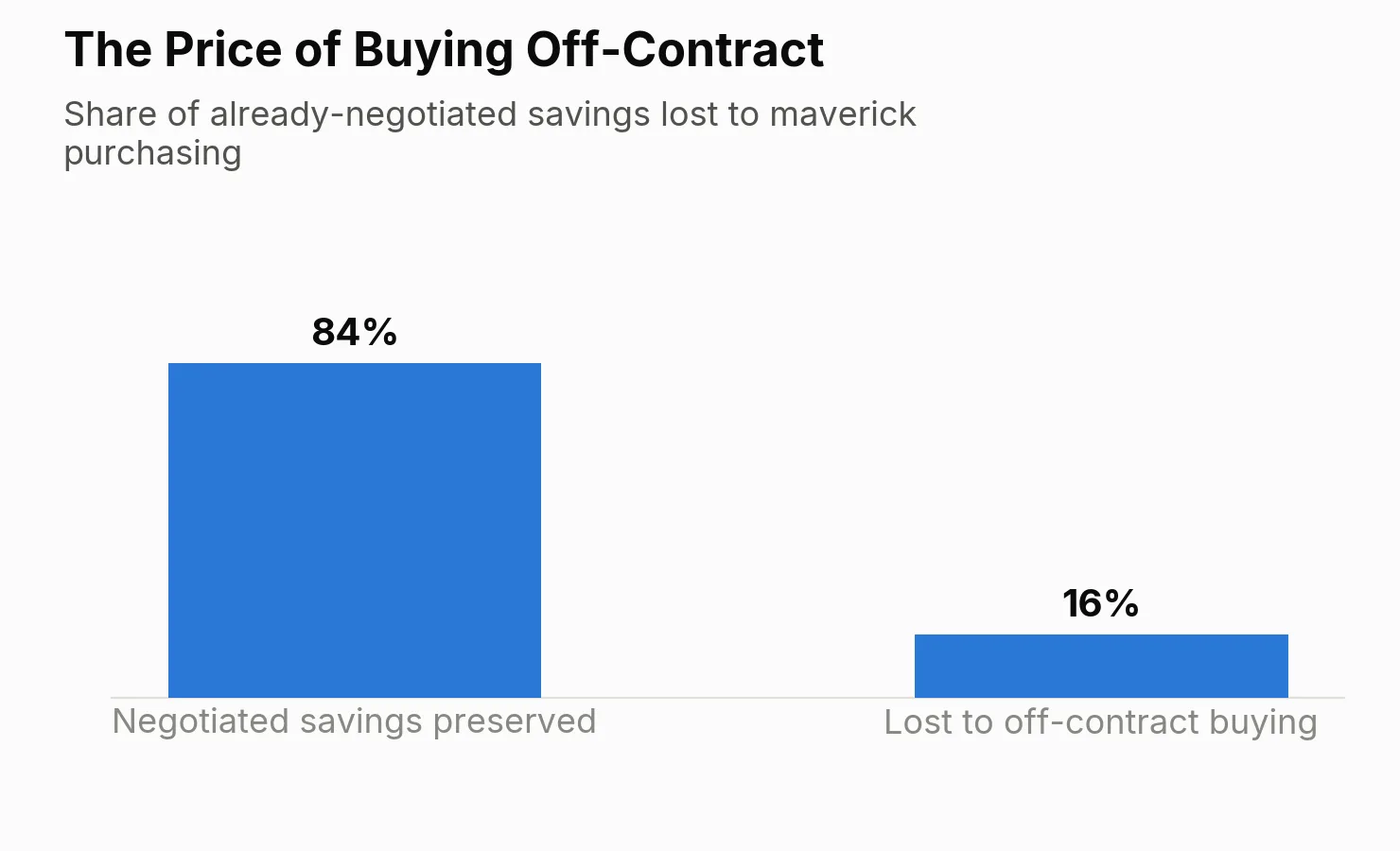
Companies typically forfeit up to 16% of their negotiated savings to maverick purchasing — meaning
if you spent real effort getting a supplier to agree to better terms, roughly one dollar in six of the value
you fought for evaporates because someone bought around the agreement instead of through it. It
compounds in less visible ways too: organizations with high rates of off-contract buying need a
median of 16 additional hours just to issue a single purchase order, because there's no clean, guided
path from "I need this" to "it's ordered," so people invent their own workarounds.
© Orpington Technologies Inc. www.orpingtontech.com
Page No. 1 of 4
if you spent real effort getting a supplier to agree to better terms, roughly one dollar in six of the value
you fought for evaporates because someone bought around the agreement instead of through it. It
compounds in less visible ways too: organizations with high rates of off-contract buying need a
median of 16 additional hours just to issue a single purchase order, because there's no clean, guided
path from "I need this" to "it's ordered," so people invent their own workarounds.
 16%
of already-negotiated supplier savings gets lost to maverick (off-contract) purchasing at a
typical organization — money that was, in effect, already won and then given back.
Source: Mekari, 2026
typical organization — money that was, in effect, already won and then given back.
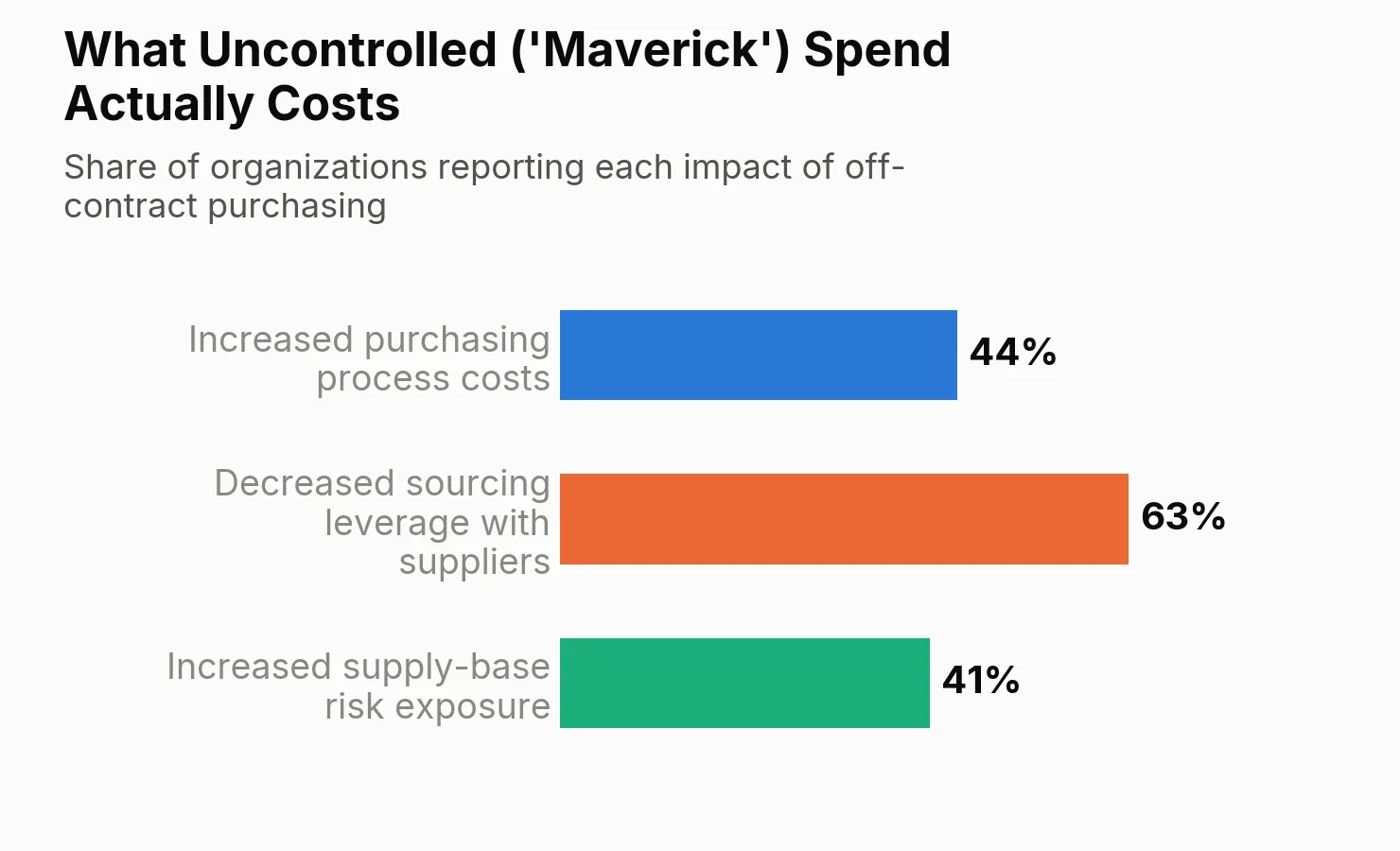
The knock-on effects show up across the business. Organizations dealing with significant maverick
spend report higher purchasing process costs, weaker negotiating leverage with suppliers the next
time a contract comes up for renewal, and — perhaps most consequential for a growing company —
greater exposure to supply-base risk, because purchases happening outside any formal process also
happen outside any formal vendor vetting.
Organizational consequences reported where off-contract purchasing is common. Source: Mekari, 2026.
Why this is a structural problem, not a discipline problem
spend report higher purchasing process costs, weaker negotiating leverage with suppliers the next
time a contract comes up for renewal, and — perhaps most consequential for a growing company —
greater exposure to supply-base risk, because purchases happening outside any formal process also
happen outside any formal vendor vetting.
It's tempting to read all this as an argument for stricter rules and more approval steps, but that
usually backfires. Three-quarters of procurement professionals point to a specific root cause: the
lack of any self-service or guided buying tool that makes doing the right thing the easy thing. When
the "correct" way to buy something requires five extra steps and a three-day wait, and the "wrong"
way takes ten minutes on a company card, most people — quite reasonably — choose speed. More
than half of organizations still run purchasing for indirect materials and services through a
decentralized structure with no single system of record, which makes the problem close to
unavoidable without some kind of platform change.
© Orpington Technologies Inc. www.orpingtontech.com
Page No. 2 of 4
usually backfires. Three-quarters of procurement professionals point to a specific root cause: the
lack of any self-service or guided buying tool that makes doing the right thing the easy thing. When
the "correct" way to buy something requires five extra steps and a three-day wait, and the "wrong"
way takes ten minutes on a company card, most people — quite reasonably — choose speed. More
than half of organizations still run purchasing for indirect materials and services through a
decentralized structure with no single system of record, which makes the problem close to
unavoidable without some kind of platform change.
This is precisely the gap Oracle Fusion Cloud ERP's procurement module is built to close. Instead of
a policy document nobody reads, requisitioning happens through a guided, catalog-based interface
that routes purchases to pre-negotiated suppliers by default, with approval workflows that trigger
automatically based on amount, category, or department rather than depending on someone
remembering to ask permission. The goal isn't more friction — it's less friction on the compliant path
than on the workaround.
What good procurement actually looks like inside the
system
In a properly configured Fusion Cloud environment, an employee who needs office equipment, raw
materials, or a service contract works from a punch-out catalog or a pre-approved supplier list, with
pricing already reflecting whatever volume discount procurement negotiated. The requisition routes
for approval based on rules set up in advance — a $200 purchase might auto-approve, while a
$20,000 one requires a manager and a budget check — and once approved, it flows straight into a
purchase order without anyone re-keying information. When the goods arrive, a three-way match
between the PO, the receipt, and the vendor invoice happens automatically, and only genuine
exceptions land on a human's desk.
The visibility this creates matters as much as the automation. A procurement lead can see, in real
time, exactly how much of total spend is going through approved channels versus how much is
leaking elsewhere — a metric that's almost impossible to calculate accurately when purchasing data
lives across a dozen department budgets and nobody's expense reports.
Even a modest reduction in off-contract purchasing recovers real, already-negotiated savings. Source: Mekari, 2026.
The tradeoffs worth knowing about going in
© Orpington Technologies Inc. www.orpingtontech.com
Page No. 3 of 4
time, exactly how much of total spend is going through approved channels versus how much is
leaking elsewhere — a metric that's almost impossible to calculate accurately when purchasing data
lives across a dozen department budgets and nobody's expense reports.
Procurement modules are sometimes the part of an ERP rollout that gets the least attention during
implementation planning, because finance and IT tend to focus first on the general ledger and
financial reporting. That's a mistake worth avoiding. A procurement module configured with too few
approved suppliers or an overly rigid catalog structure will simply reproduce the maverick-spend
problem in a new system — employees will find workarounds if the "right" path is genuinely harder
than the alternative.
It's also worth being honest that procurement transformation is as much a supplier-relationship
exercise as a software one. Getting real value out of contract compliance features means actually
renegotiating and loading supplier agreements into the system, which takes real time from someone
in procurement or finance — it's not something the software does on its own simply by being turned
on.
Looking ahead
exercise as a software one. Getting real value out of contract compliance features means actually
renegotiating and loading supplier agreements into the system, which takes real time from someone
in procurement or finance — it's not something the software does on its own simply by being turned
on.
Getting purchasing under control tends to have a close cousin: knowing what's actually happening to
the things you bought once they arrive. That's where this series turns next, into supply chain and
inventory visibility — an area where, as the next article lays out, a striking number of small and
mid-sized companies are still flying with far less visibility than they assume.
Sources
1. Maverick Spending: How It Costs Up to 16% Expense Savings, Mekari —
https://expense.mekari.com/en/blog/maverick-spending
2. 58 Must-Know ERP Statistics for 2026, KreativeCoreTech —
https://kreativecoretech.com/erp-statistics/
© Orpington Technologies Inc. www.orpingtontech.com
Page No. 4 of 4
the things you bought once they arrive. That's where this series turns next, into supply chain and
inventory visibility — an area where, as the next article lays out, a striking number of small and
mid-sized companies are still flying with far less visibility than they assume.