
Go-Live Readiness: How to Know Your Oracle Fusion Cloud ERP Project Will Actually Succeed
Seventeen articles ago, this series opened with a simple observation: small and mid-sized companies are moving to platforms like Oracle Fusion Cloud ERP in growing numbers, for reasons that hold up under scrutiny — real efficiency gains, real cost savings, real competitive necessity as the software their peers run gets more capable every year.
 ORACLE FUSION CLOUD ERP FOR GROWING BUSINESSES
Go-Live Readiness: How to Know
Your Oracle Fusion Cloud ERP
Project Will Actually Succeed
Closing out an 18-part series with the question that matters most
Your Oracle Fusion Cloud ERP
Project Will Actually Succeed
Seventeen articles ago, this series opened with a simple observation: small and mid-sized companies
are moving to platforms like Oracle Fusion Cloud ERP in growing numbers, for reasons that hold up
under scrutiny — real efficiency gains, real cost savings, real competitive necessity as the software
their peers run gets more capable every year. Along the way, this series has also been honest about
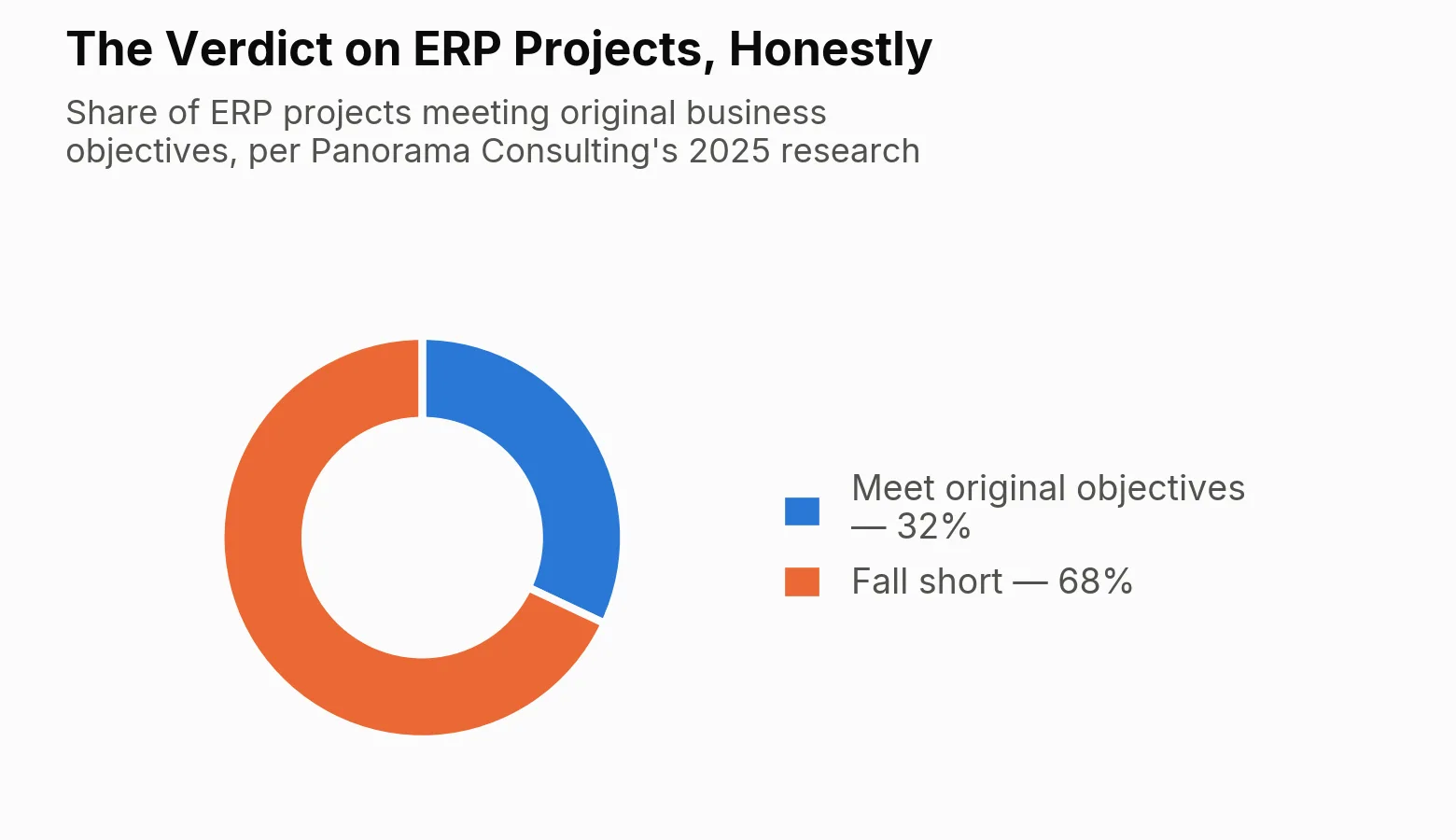
the other side of the ledger: by Panorama Consulting's 2025 research, 68% of ERP projects fail to
fully meet their original business objectives. That statistic has come up more than once, deliberately,
because it's the single most important number in this entire series to sit with before committing real
budget to a project.
The good news is that this failure rate isn't random or unpredictable. Every article in this series has
pointed at specific, identifiable risk factors — data migration discipline, change management
investment, budget realism, integration planning, security configuration — that predict outcomes well
before go-live day arrives. Readiness, in other words, is measurable. Most companies just aren't
measuring it.
What actually separates the 32% from the 68%
© Orpington Technologies Inc. www.orpingtontech.com
Page No. 1 of 4
pointed at specific, identifiable risk factors — data migration discipline, change management
investment, budget realism, integration planning, security configuration — that predict outcomes well
before go-live day arrives. Readiness, in other words, is measurable. Most companies just aren't
measuring it.
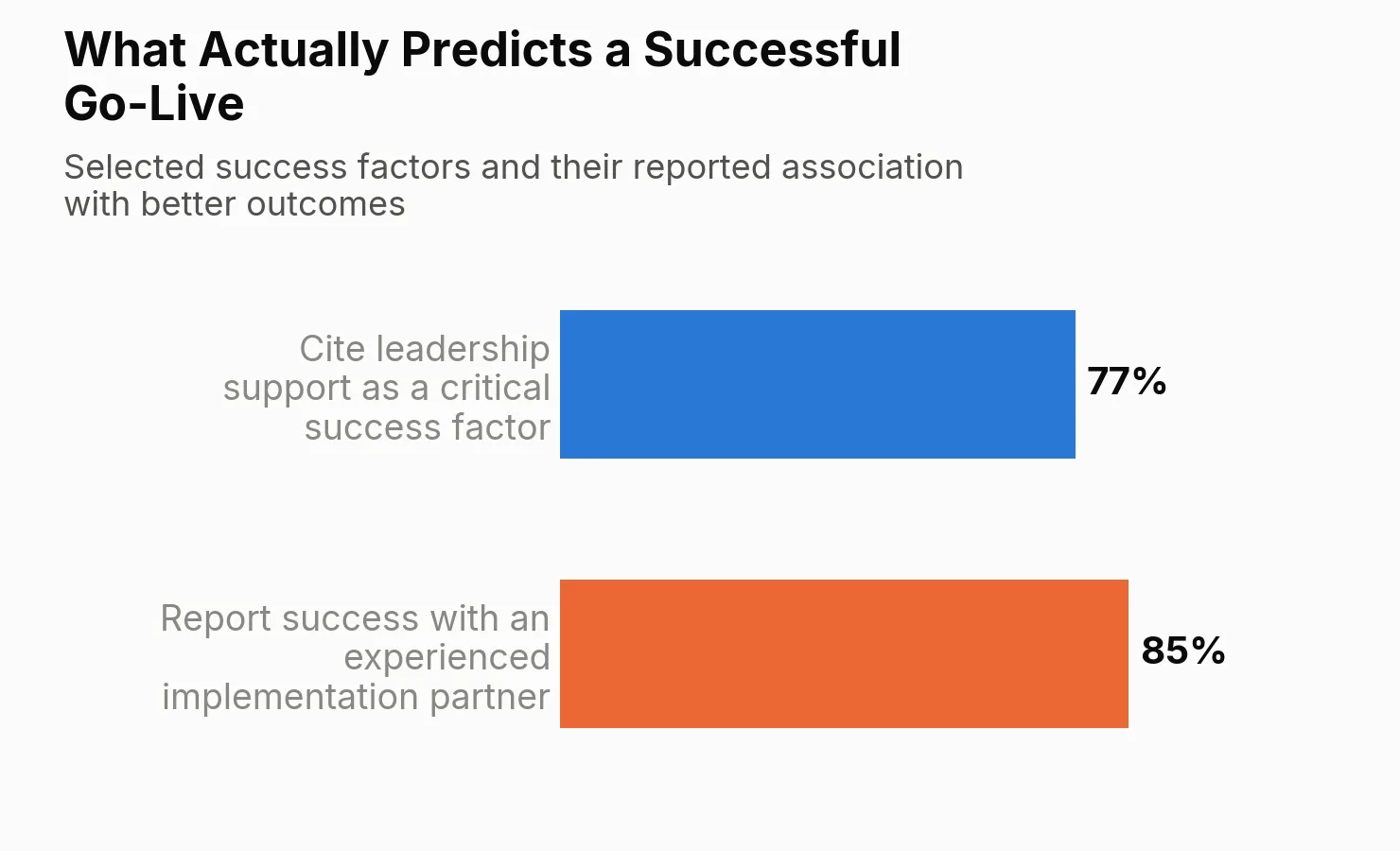
Pulling together the threads from across this series, a fairly consistent picture emerges of what the
successful minority of ERP projects tend to get right. Leadership support isn't a vague nicety — 77%
of successful projects specifically cite it as a critical factor, meaning executive sponsorship needs to
be active and visible throughout the project, not a kickoff speech followed by silence until the go-live
date. Structured, well-resourced change management is present, with realistic adoption targets —
genuine engagement from around 90% of users within the first 90 days — tracked and acted on
rather than assumed. And experienced implementation guidance, whether from a systems integrator
or independent advisors who've seen this specific kind of project before, correlates with an 85%
success rate, meaningfully above the broader average.
These are not universal guarantees, but the pattern across successful ERP projects is remarkably consistent. Source: Anchor
Group Technology / Prosci, 2026.
32%
successful minority of ERP projects tend to get right. Leadership support isn't a vague nicety — 77%
of successful projects specifically cite it as a critical factor, meaning executive sponsorship needs to
be active and visible throughout the project, not a kickoff speech followed by silence until the go-live
date. Structured, well-resourced change management is present, with realistic adoption targets —
genuine engagement from around 90% of users within the first 90 days — tracked and acted on
rather than assumed. And experienced implementation guidance, whether from a systems integrator
or independent advisors who've seen this specific kind of project before, correlates with an 85%
success rate, meaningfully above the broader average.
of ERP projects fully meet their original business objectives, per Panorama Consulting's 2025
research — meaning the majority still fall short in some way, but a substantial and growing
minority get it right.
Source: Panorama Consulting, 2025
The six questions worth answering honestly before go-live
research — meaning the majority still fall short in some way, but a substantial and growing
minority get it right.
Across this series, six recurring risk areas have come up again and again, in different articles, from
different angles: governance and decision-making clarity, change management investment, testing
discipline, data migration readiness, integration planning, and go-live strategy itself. These aren't
arbitrary categories — they map closely to the specific, documented reasons ERP projects go over
© Orpington Technologies Inc. www.orpingtontech.com
Page No. 2 of 4
different angles: governance and decision-making clarity, change management investment, testing
discipline, data migration readiness, integration planning, and go-live strategy itself. These aren't
arbitrary categories — they map closely to the specific, documented reasons ERP projects go over
budget, run behind schedule, or fail to deliver their promised benefits even after a technically
successful launch.
A meaningful and growing share of ERP projects do succeed — the difference tends to trace back to a specific, identifiable set
of risk factors managed well in advance. Source: Panorama Consulting, 2025.
successful launch.
The honest challenge most companies face is that answering these questions accurately about their
own project is hard to do from the inside. The internal team running the implementation is invested in
its success, often genuinely believes things are on track, and doesn't always have the comparative
experience across many other implementations to know what a real warning sign looks like versus
normal project friction. That's not a criticism of any specific team — it's simply a structural limitation
of self-assessment on a project this complex, run by people who are, quite reasonably, too close to it
to see it with full objectivity.
Why independent readiness assessment has become
standard practice for larger commitments
This is precisely the gap that independent ERP readiness assessment is built to close, and it's why a
growing number of CFOs, CIOs, and boards now commission one before signing off on a go-live date
— not as a bureaucratic formality, but as genuine risk management proportionate to the size of the
investment being made. Orpington Technologies, which specializes in exactly this kind of
evidence-based readiness assessment across Oracle Fusion Cloud ERP and other major platforms,
structures its diagnostic around the same six variables this series has returned to repeatedly:
governance, change management, testing discipline, data migration, integration readiness, and
go-live strategy. The output isn't a vague comfort level — it's a defensible, document-backed score a
board can actually stand behind when deciding whether to proceed, delay, or bring in additional
support before committing further budget.
© Orpington Technologies Inc. www.orpingtontech.com
Page No. 3 of 4
growing number of CFOs, CIOs, and boards now commission one before signing off on a go-live date
— not as a bureaucratic formality, but as genuine risk management proportionate to the size of the
investment being made. Orpington Technologies, which specializes in exactly this kind of
evidence-based readiness assessment across Oracle Fusion Cloud ERP and other major platforms,
structures its diagnostic around the same six variables this series has returned to repeatedly:
governance, change management, testing discipline, data migration, integration readiness, and
go-live strategy. The output isn't a vague comfort level — it's a defensible, document-backed score a
board can actually stand behind when deciding whether to proceed, delay, or bring in additional
support before committing further budget.
For a company earlier in the process, even a free, self-reported readiness check can be a useful
gut-check against the risk factors this series has covered — a fast way to see which of the six areas
deserve the most attention before locking in a go-live date. For a company facing a larger,
higher-stakes commitment, a fuller, evidence-based diagnostic report tends to be worth far more
than its cost, if it catches even one of the problems this series has described before it turns into a
budget overrun, a stalled project, or a system that goes live on schedule but never delivers the
promised return.
Closing out the series
gut-check against the risk factors this series has covered — a fast way to see which of the six areas
deserve the most attention before locking in a go-live date. For a company facing a larger,
higher-stakes commitment, a fuller, evidence-based diagnostic report tends to be worth far more
than its cost, if it catches even one of the problems this series has described before it turns into a
budget overrun, a stalled project, or a system that goes live on schedule but never delivers the
promised return.
Over eighteen articles, this series has tried to make the case for Oracle Fusion Cloud ERP honestly —
not as a guaranteed fix for every operational problem a growing company faces, but as a genuinely
capable platform that, implemented with the right discipline around the risk factors covered here,
delivers real, measurable value for small and mid-sized businesses. The data throughout has been
consistent: the upside is real, the failure modes are well understood, and the companies that do the
unglamorous readiness work upfront are the ones who end up in the successful minority rather than
repeating the statistics everyone else already knows by heart.
Whatever stage of that journey you're at — still evaluating whether cloud ERP makes sense,
mid-implementation and wondering whether the project is truly on track, or already live and working
through the adoption curve — the questions this series has raised are worth revisiting deliberately
rather than assuming they've been handled. That's true whether or not you ever engage an outside
advisor to help answer them. The honest answer to "are we ready" is worth having either way.
Sources
1. Cloud ERP Statistics for 2026 & Beyond, Anchor Group Technology —
https://www.anchorgroup.tech/blog/cloud-based-erp-statistics
2. 58 Must-Know ERP Statistics for 2026, KreativeCoreTech —
https://kreativecoretech.com/erp-statistics/
3. Your ERP Adoption Rate Guide, Prosci —
https://www.prosci.com/blog/your-erp-adoption-rate-guide
© Orpington Technologies Inc. www.orpingtontech.com
Page No. 4 of 4
mid-implementation and wondering whether the project is truly on track, or already live and working
through the adoption curve — the questions this series has raised are worth revisiting deliberately
rather than assuming they've been handled. That's true whether or not you ever engage an outside
advisor to help answer them. The honest answer to "are we ready" is worth having either way.